What was Vandenberg base like in 1960? Go behind the scenes of ‘fantastic installation’
Vandenberg Space Force Base entered the space age in Dec. 16, 1958, with the launch of a Thor intermediate-range ballistic missile.
Almost two months later, the base near Lompoc launched the world’s first polar earth orbiting satellite.
Since then, Vandenberg has hosted more than 1,980 launches.
Originally known as Camp Cooke during World War II, the facility changed its name from Vandenberg Air Force Base to Vandenberg Space Force Base in May 2021.
The name is fitting given its popularity as a launching point.
Because the California coast takes a sharp turn to the east at Vandenberg, south of Point Conception, it allows a rocket to be lofted from an isolated area over an unpopulated stretch of the Pacific Ocean.
If things go wrong, the world’s largest ocean absorbs the impact.
Vandenberg was the first place in the United States where intercontinental ballistic missiles were based. The site is also used to test the missiles that are the platform for nuclear warheads.
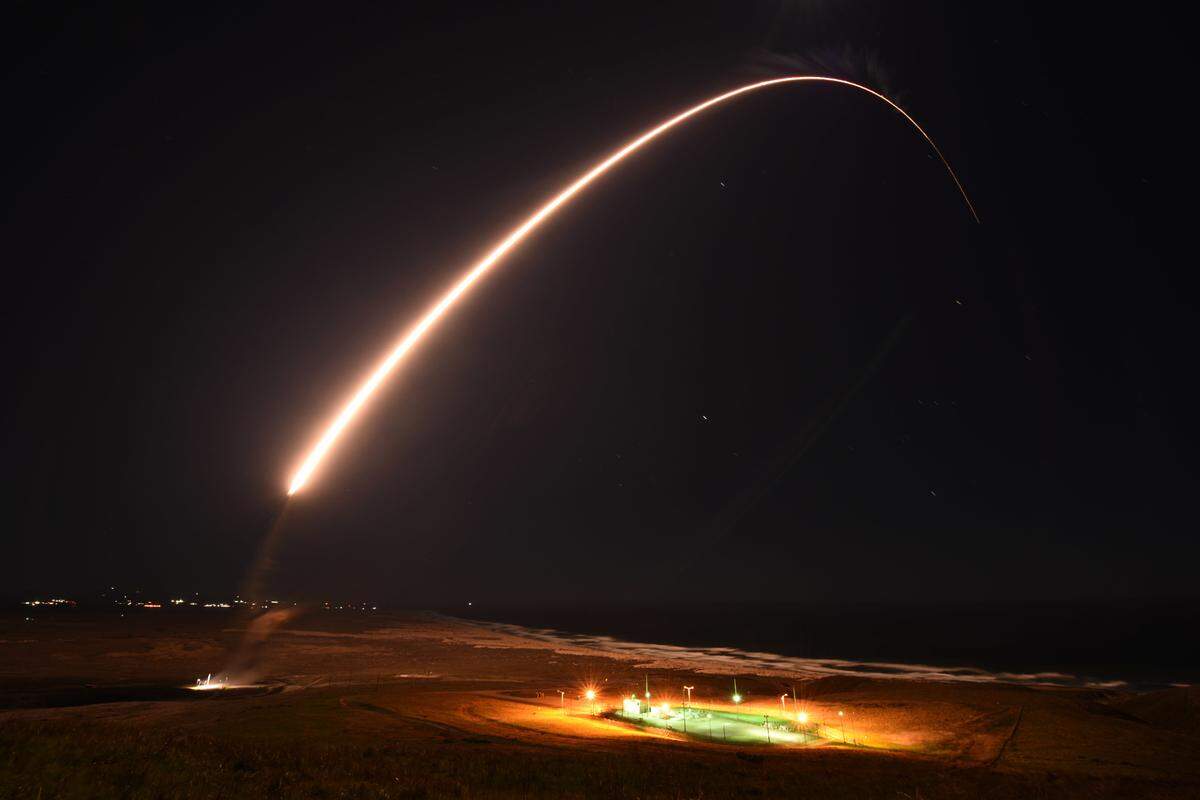
All of this has made the base a popular destination for politicians such as President John F. Kennedy, who watched a missile launch there in 1962.
U.S. Vice President Kamala Harris paid Vandenberg a visit on April 18.
The Feb. 29, 1960, Telegram-Tribune published a rare behind-the-scenes look at Vandenberg written by city editor John Sarber.
Archive systems have since changed from the 1960s and photos from that trip are no longer around so others are used here.
Sarber would cover J.F.K.’s tour of the base two years later.
Newsmen Tour Underground Maze at Missile Base
“And they won’t even let me take a picture of my girl friend in front of the base exchange!” exclaimed an astonished young airman at Vandenberg Air Force Base last week.
His open-mouth comment was made in awe as newsmen and photographers entered previously barred confines of the nation’s only combat-ready operational missile base, about 60 miles south of San Luis Obispo.
It is at Vandenberg AFB that America is ready to “fire in anger,” and launch a shot which could trigger World War II or could retaliate should an enemy be the first to fire.
Nothing was restricted from the view of the newsmen who made the day-long tour of the fantastic installation, but an embargo was imposed on all matter until today.
Should the significant and awesome red telephone ring in a Vandenberg blockhouse to signal a launch in anger, a crew of only four men would send an Atlas ICBM on its fearful path, headed for a predetermined target.
And a tiny sealed capsule worn about the neck of a launch control officer contains a code which would tell if the information given on the red telephone is correct, a safeguard against any war by mistake.
The blockhouse which controls the complex of three operational Atlas missiles is the most guarded point on the base, and signs warn of the patrol of vicious sentry dogs.
The Atlas complex bears the top strategy stamp of the Air Force, “Category 1” which means it is combat ready and is maintained on a wartime footing.
Outside the blockhouse, fanned out toward the Pacific Ocean, are the gantry cranes which service the Atlas.
Two of the missiles are cradled in their supporting gantries, while a third stands alert and ready to go—with gantry withdrawn on its steel rails.
The vertical position in which these missiles are held in the initial emplacements at Vandenberg are being changed to more protected and concealed underground systems.
The Atlas, Thor and Titan missiles which form the Strategic Air Command arsenal at Vandenberg are served from various types of complexes, most of which have not been completed.
The newer systems keep the missiles in a horizontal position beneath a shed-like covering that quickly rolls back its roof at the push of a button, with the bird then lifted upright to a firing position by a hydraulic hoist on which the missile is “mated.”
Another complex provides a blockhouse and control center, along with fuel system, underground, while the missile pad remains on the surface.
But the most amazing complex is the new Titan site, monumental holes in the ground linked together by a series of tunnels in a subway arrangement. Tunnels run for 820 feet and are 10 feet in diameter.
There are five of these silos which extend 165 feet into the earth and each has a diameter at the surface of 60 feet.
These concrete-lined silos would each accommodate a 15-story building.
There will be two complete Titan complexes when the Army Corps of Engineers, which directs construction turns the site over to the Air Force.
Workmen using extremely heavy-duty equipment are installing two doors, each weighing 250 tons, and which will hinge together to cover the “barrel” of the underground launch silo.
This will afford concealment for the complex which will withstand anything but a direct atomic hit.
On a surface pad at another location, the site swarms with engineers and scientists readying the Discoverer XI for a shot expected soon.
The Agena nose cone is under final test, and it is programmed for polar orbit. It will be boosted into space by a Thor.
It was explained that it takes from 15 to 19 minutes to conduct the final countdown of all the systems of a missile before blast-off.
The huge Vandenberg Air Force Base covers 64,000 acres along the coast in northern Santa Barbara County.
The operation of the SAC is supported by the U.S. navy’s adjacent Port Arguello which maintains instrumentation of tracking and telemetering devices.
But behind all of this fantastic aura of this scientific world there still remains the ingeniousness always reflected by the American soldier or airman.
At one Atlas site, an airman was keeping his orange juice and ice cream chilled on the frosty pipes pumping liquid oxygen to a missile.