How an endangered species review could slow Los Osos development again
AI-generated summary reviewed by our newsroom.
- Morro manzanita's endangered status review may complicate Los Osos development.
- Developers must obtain a state permit to impact Morro manzanita during the review.
- County seeks streamlined permits via Habitat Plan to avoid individual applications.
The addition of a plant species native only to Los Osos to the endangered species list could place another obstacle in front of the path of new development in the no-build town.
According to a California Endangered Species Act petition submitted to the California Fish and Game Commission, Morro manzanita — scientific name arctostaphylos morroensis — is an evergreen shrub found only in the Los Osos area of San Luis Obispo County, primarily occupying stabilized sand dunes associated with Baywood fine sand.
Found across the Los Osos area both within the developed parts of the town and in large patches in the Elfin Forest and Montaña de Oro State Park, Morro manzanita’s population has been in decline since at least the 1990s, according to California Department of Fish and Wildlife information officer Krysten Kellum.
The July 2024 petition, assembled by Dr. Christopher Kofron and Dr. Claudia Tyler for the Department of Fish and Wildlife, identified several threats to the continued existence of the Morro manzanita, including the clearing of habitat for residential development, nonnative invasive plant species, stochastic events, climate change and the invasive sudden oak death pathogen.
“It is only found in the Los Osos area of coastal San Luis Obispo County, California, and occurs primarily on stabilized sand dunes associated with Baywood fine sand,” Kellum said in an email. “In the early 1990s, Morro manzanita was estimated to occupy 840-890 acres, which is a decrease from historical estimates of 1,977 to 2,718 acres.”
With the petition submitted to the Fish and Game Commission for evaluation, the status of the Morro manzanita as a “candidate species” for the California Endangered Species Act protection means that a new wrinkle has been introduced into the already hard-to-navigate development landscape in Los Osos.
Should the species gain California Endangered Species Act protection at the conclusion of the Department of Fish and Wildlife’s review, the future of development in Los Osos could face continued roadblocks from the species’ presence on project sites.
How endangered species affects Los Osos Habitat Conservation Plan
In March, the San Luis Obispo County Board of Supervisors upheld its vote to allow a handful of development projects to move forward, after lifting a 35-year building moratorium caused by water shortages.
The moratorium was lifted when the board passed the Los Osos Habitat Conservation Plan, which protects endangered species while allowing the nearly 400 people currently on the building waitlist to commence development.
Under the Los Osos Community Plan’s 1% annual growth cap for new residential developments, 50 new residential projects per year can permitted, according to a Coastal Commission staff report at the time.
Los Osos’ environmental status means it requires protection by a federally certified preservation program in order for new development to take place. Usually that would be done through the U.S. Fish and Wildlife service’s mitigation banking, but the county’s habitat conservation plan is simply a faster and cheaper alternative to a federal requirement, Hanh said.
The county began preparing its conservation plan in 2009 and finally received approval from Fish and Wildlife on Feb. 15, giving the county authority to handle environmental mitigation efforts for individual property owners.
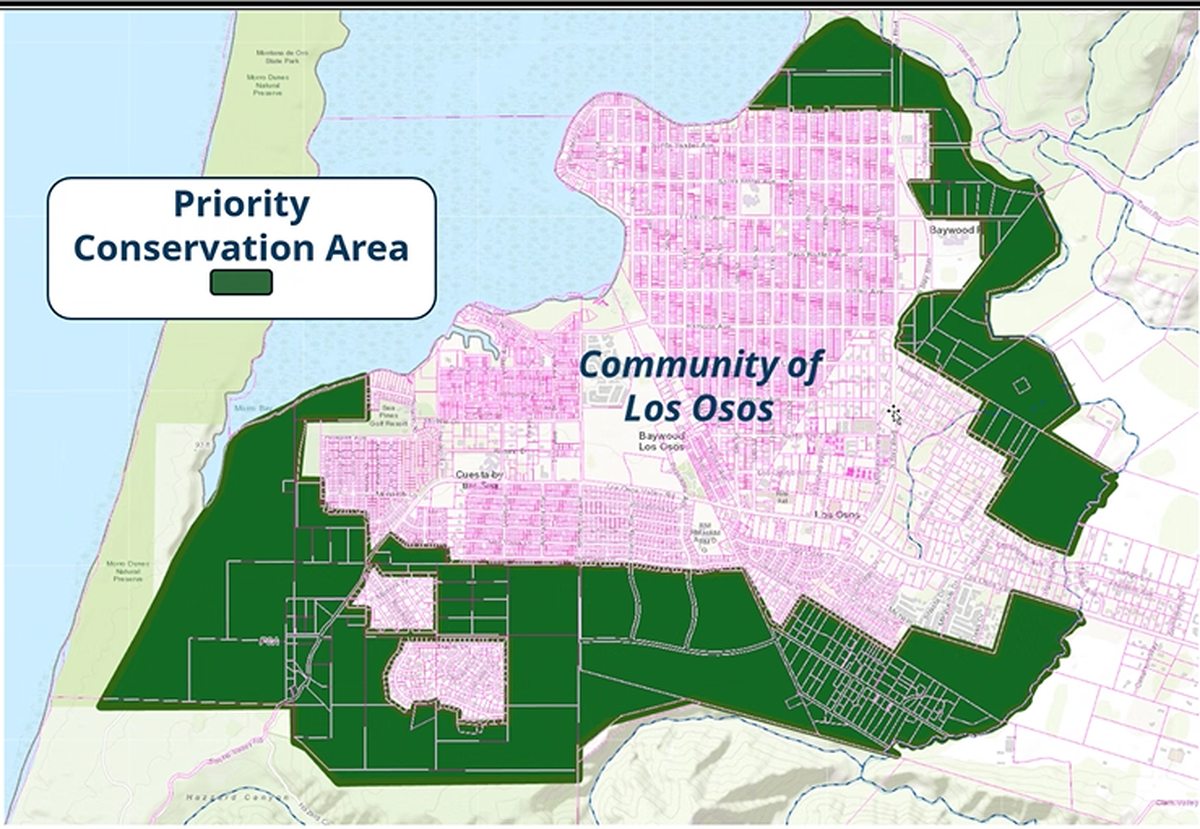
Without the county’s conservation plan, individual landowners would be left to navigate the complicated federal permitting system on their own, potentially causing roadblocks to their desired use of their land, Hanh said in 2024.
But under the adopted plan, the county will do all the mitigation work first and landowners will be able to start building their homes immediately and with fewer regulations, Hanh said.
Morro manzanita’s status as a potential endangered species under review adds another interesting wrinkle to the rules and regulations governing where and when development can happen in Los Osos.
The United States Fish and Wildlife Service issued an “incidental take permit” — which allow a permitee to move or destroy the plant for construction, utility, transportation or other infrastructure-related reasons — to the county so the Los Osos Habitat Conservation Plan could move forward with objectives including residential development and construction of firebreaks on private land currently home to Morro manzanita, according to the petition.
Kellum said while the Department of Fish and Wildlife conducts its status review, “taking” Morro manzanita will not be allowed without an incidental take permit — which allows a permitee to move or destroy a plant for construction, utility, transportation or other infrastructure-related reasons.
Until that review wraps up by May 16 of next year, any entity looking to develop a site where Morro manzanita is present will need an incidental take permit from the Department of Fish and Wildlife, Kellum said.
That means that development won’t be fully frozen again by the new species discovery, but builders must be mindful of the new permit hurdle during the review period.
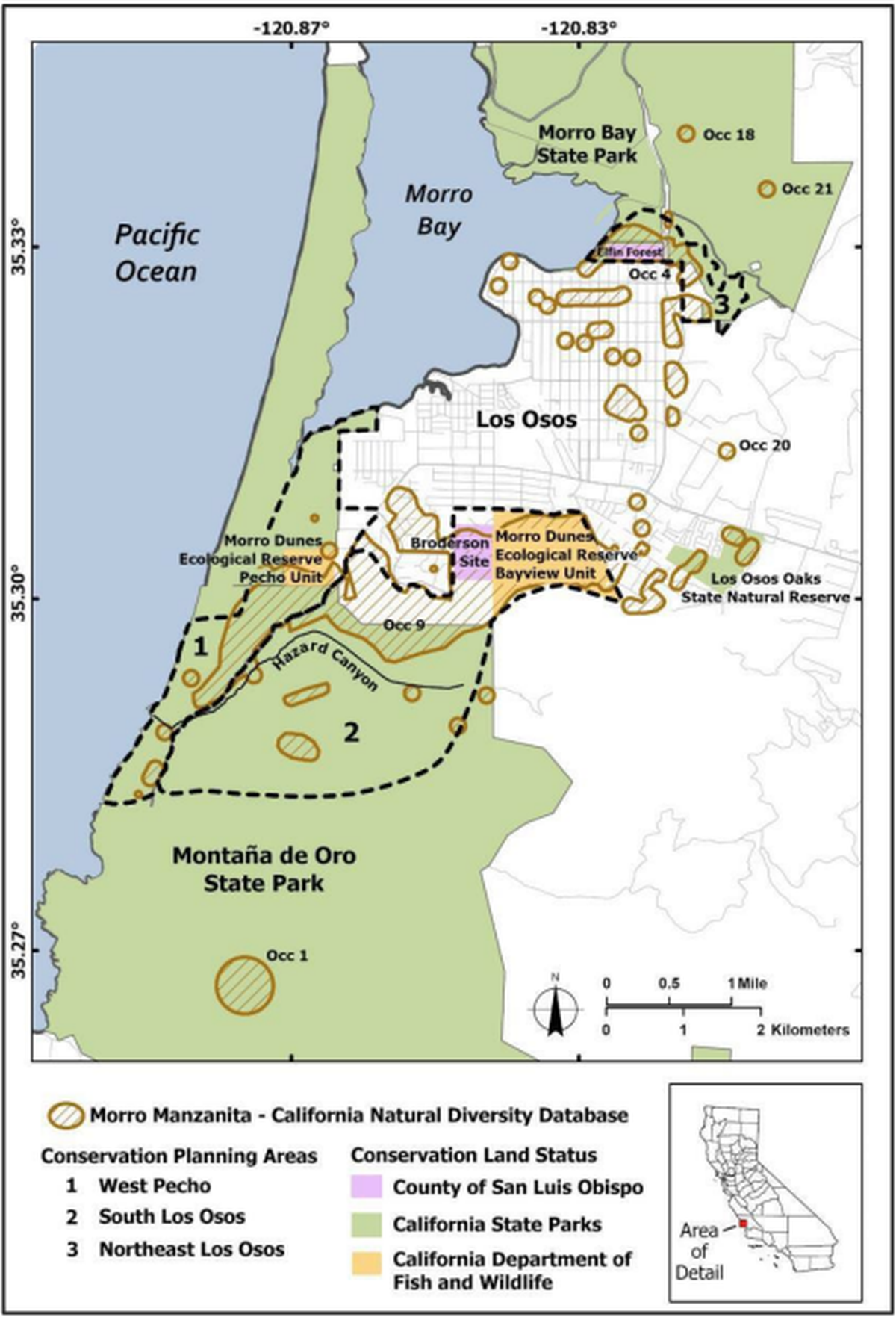
“An incidental take permit would allow the take of Morro manzanita incidental to the specific project as long as the impacts of the proposed taking are minimized and fully mitigated for,” Kellum said in an email.
Hanh said the county is proposing that the state Department of Fish and Wildlife’s incidental take permit period run in conjunction with the existing federal Fish and Wildlife Services-issued incidental take permit, which is set to expire Feb. 14, 2049.
That would prevent people or entities from individually having to go through the state process, which Hanh said “can be daunting, costly and time consuming for those that are not well-versed in the process.”
“Until then, implementation of the LOHCP and the county’s ability to provide take coverage under the LOHCP to individual property will be limited to areas and activities where there would otherwise be no impacts to Morro manzanita,” Hanh said.
What’s next for building in Los Osos?
As the evaluation progresses, more details on Morro manzanita’s role in Los Osos’ ecosystem will become available, including its habitat preferences and overall current population, Kellum said in an email.
According to the Department of Fish and Wildlife’s news blog post about the Morro manzanita petition, individuals can submit relevant data about the plant — along with comments and questions — by Aug. 18.
Kellum said during the review process — and in the event that Morro manzanita gains endangered species protections — developers will need to account for its presence.
“Construction/development project proponents would need an incidental take permit for impacts to Morro manzanita anywhere it grows,” Kellum said in an email. “Any take or impacts would require actions to minimize and mitigate for take or impacts.”