
Federal cuts chop funding to Ventana Wildlife Society. What that means for CA condors
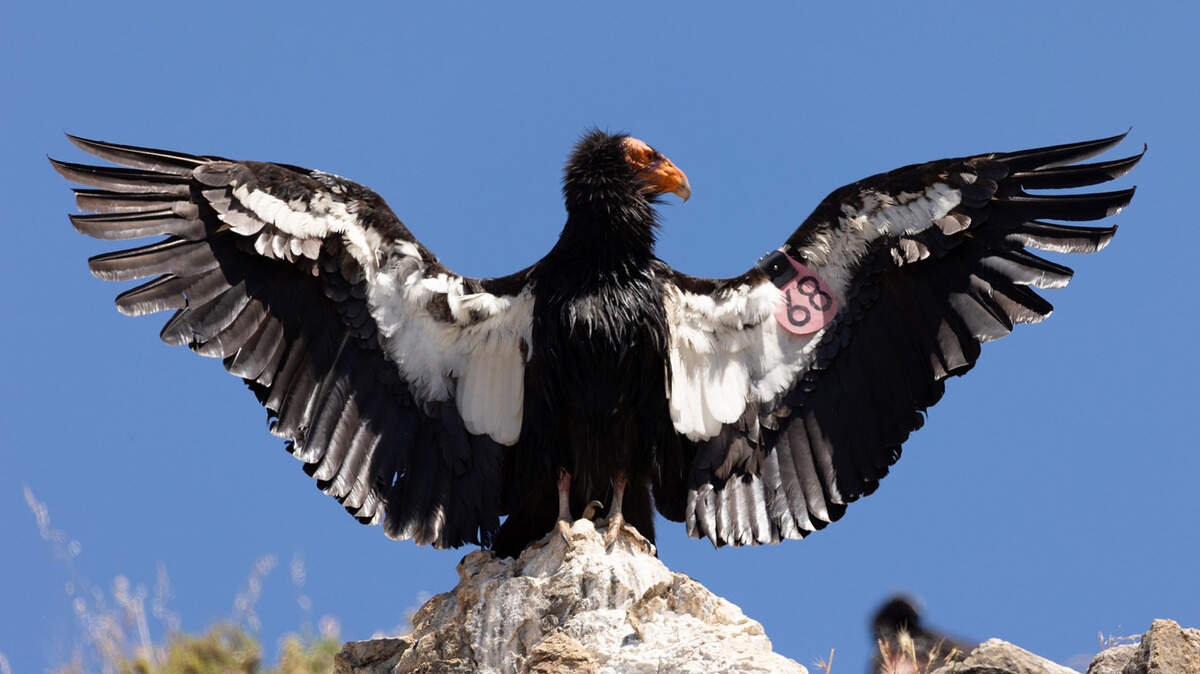
With its unofficial mandate to reduce government waste, Elon Musk’s Department of Government Efficiency slashed hundreds of federal programs; it also killed numerous conservation grants administered by the U.S. Fish and Wildlife Services — including two that benefit the Central California Condor flock.
The two grants — appreciated for years by Ventana Wildlife Society, a member of the Condor Recovery Program — include the Recovery Challenge and State of the Birds grants.
With the loss of those grants, the Condor Recovery Program is taking an annual hit of $450,000.
Under the DOGE chopping block, the Recovery Challenge Grant will end in the December, while the State of the Birds grant has already been jettisoned.
“Both grants helped fund our free Non-lead Ammunition Program,” Ventana Wildlife Society executive director Kelly Sorenson said.
Condors are not raptors — they are scavengers, feeding on dead animals. And when the rabbit, deer, squirrel or other critters they consume have been felled by lead bullets, the condor can become ill and may die.
“Lead poisoning remains the greatest threat to condor recovery,” and the Ventana Wildlife Society is now seeking “new funding partners to keep California’s only (free non-lead) program alive,” Sorenson continued.
To that end, the Ventana Wildlife Society — a state-licensed ammunition vendor — has launched “Save the Condor Fund,” a campaign to fill in the funding gap created by DOGE’s shutting down of the two grants.
The goal is to raise $410,00 by October. The Ventana Wildlife Society is asking “existing donors to give 25% more than last year” and is hoping to attract “150 new donors,” according to a news release.
Meanwhile, in deference to the Condor Recovery Program, state law requires the use of non-lead ammunition when shooting wildlife.
And yet “hunters and ranchers have faced numerous obstacles in their efforts to make the switch,” Sorenson explained.
“Foremost among these barriers is the poor availability of certain non-lead calibers,” Sorenson said.
In fact, while non-lead large caliber ammunition like .270 or .300 are readily available in gun shops, non-lead .22 Long Rifle ammunition “is very hard to find in local stores right now,” Sorenson said in an email.
The Ventana Wildlife Society’s research over a two-year period — using weekly surveys of availability — resulted in locating .22 Long Rifle in gun shops only 13% of the time, Sorenson reported.
However, .22 Winchester Magnum Rimfire is “much more available than Long Rifle, but America’s most common rifle is the .22 LR. – and using WMR is overkill,” he said.
Hunters and ranchers, “for the most part, want to follow the law, but poor availability … is significantly hampering their ability to comply with the law,” he said.
Recent lead poisoning deaths among condors
Lead poisoning has been the main mortality menace for the critically endangered California Condors for many years.
Thus far in 2025, three of the giant birds with 9-1/2 foot wingspans have perished from lead poisoning in the Central California flock (which includes Big Sur, San Simeon and Pinnacles).
Four condors died in 2024 (two confirmed from lead poisoning and two suspected to be due to lead poisoning; necropsies pending).
Lead poisoning killed 11 condors in 2023 (eight of those were in Arizona and Utah).
Three died in 2022, 10 in 2021, eight in 2020 and seven in 2019, according to the California Condor Recovery Program’s 2024 Annual Population Status Report.
In addition to the three that have perished in 2025, the the Ventana Wildlife Society lists five birds as “missing in the wild” (236, 729, 800, 1079 and 1144). It won’t be known if lead poisoning was the culprit until those condors are located and a necropsy has been completed.
.jpg "Lauren Pudenz, DVM, of Oakland Zoo swabs CA Condor for HPAI, Biologist Danae Mouton holding bird_Big Sur_ 05.27.25_Meredith Evans (1).jpg")
Condor bird flu vaccinations
Another existential threat to condors is the deadly bird flu, the Highly Pathogenic Avian Influenza (HPAI), which has killed an estimated 166 million birds world-wide (chickens, ducks, geese, shorebirds). It has also caused the deaths of dairy cattle, foxes and other mammals.
In 2023, when HPAI killed 21 condors in Arizona — a significant setback to the Condor Recovery Program — it kick-started the development of a specific vaccination to protect condors in California.
That unique condor-specific vaccination has proved effective, and as of late June, of the 110 free-flying condors in the Central California flock, 95 (86%) have received one dose and 68 (62%) have received two doses and are “fully vaccinated” against HPAI, according to the Ventana Wildlife Society.
How are the free-flying birds captured in order to be vaccinated?
Sorenson points to several large “release pens” that were recently assembled in Monterey in the event of an HPAI outbreak — and the need for birds to potentially be quarantined — among the Central California flock.
“Each of our release pens also serve as a trap,” Sorenson pointed out in an email. “The condor crew must wait in a blind, behind one-way glass, awaiting the opportunity to pull the doors shut after baiting the inside with a still-borne calf carcass.”
Once the “larger condors” have been captured, “we then schedule a team to ‘process’ the birds, meaning health checks, radio transmitter replacements (if needed), and vaccinations,” Sorenson said.
‘Condor Canyon’ film
A new film, “Condor Canyon,” is expected to be featured on public television for three years. A total of 155 airings — 59 are prime time showings — are scheduled for June.
The story is about a female condor living in Big Sur who is treated for — and survives — lead poisoning, while her mate raises the couple’s chick.
In the film, a true life documentary, the female is happily reunited with the male and the chick. The film was funded by the Doris Day and Terry Melcher Foundation.
To learn more about the “Save the Condor Fund,” and how to view the acclaimed “Condor Canyon” film — visit ventanaws.org.
This story was originally published June 24, 2025 at 10:00 AM.