Many more SLO County homes are now in a fire hazard zone. Find yours on the map
Cal Fire has released new maps that identify fire-prone areas in California, and San Luis Obispo County saw an 862% increase in the number of acres included since 2011.
This is large part because Cal Fire updated its model to include three fire hazard severity categories in the map instead of one, which significantly expanded the acreage that fell into hazard zones.
Cal Fire’s fire hazard severity zone maps identify the likelihood of a fire in a particular area based on the vegetation type, weather conditions, fire history, terrain and how far embers could travel.
The maps do not, however, predict fire severity — which can be reduced by removing flammable vegetation near buildings and using fire-resistant materials when building a home.
“The maps are a critical component of determining where a wildfire may occur, so that we can then apply critical wildfire mitigation to those areas,” Cal Fire State Fire Marshal Daniel Berlant said.
The county’s new map was released on March 10 as part of the third of four phases of updated mapping for statewide Local Responsibility Areas, which designate where local governments are responsible for fire protection and prevention. The four maps were rolled out from Feb. 10 to March 24.
The maps classify three hazard severity zones: “moderate,” “high” and “very high.”
New homes built in a “high” fire hazard severity zone must meet fire-resistant building standards and notify potential buyers of the fire hazard.
Homes in a “very high” fire hazard severity zone must meet the same requirements, and residents must also clear 100 feet of defensible space around their property.
“The maps are intended as planning tools so that as new communities are built, they are built to a higher standard,” Berlant said.
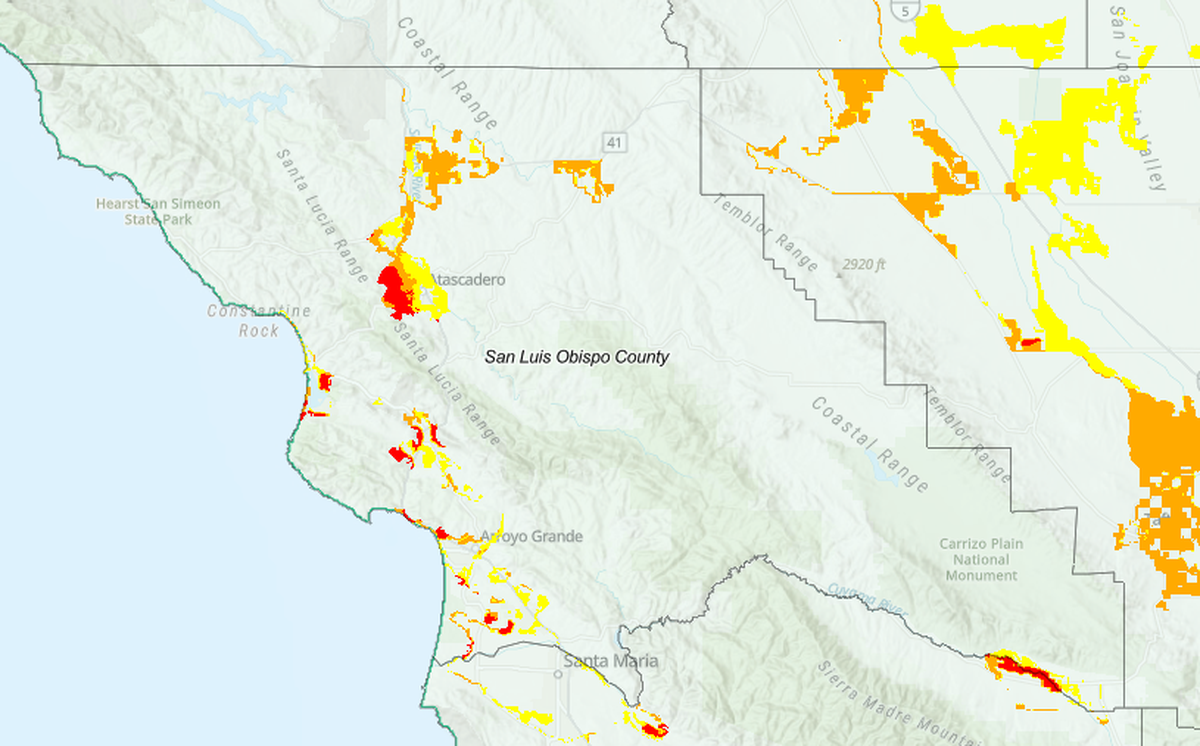
The map shows a 69% increase in acreage added to the “very high” fire hazard severity zone in San Luis Obispo County, according to Cal Fire data.
In 2011, the county’s “very high” hazard zone included 7,637 acres. The 2025 map, however, now includes 12,909 acres, the data shows.
For the first time, the 2025 map also includes the two new lesser severity zones: “high” and “moderate.”
Together, those two zones added 60,577 acres to the map.
It total, 73,486 acres are now classified under one of the three fire hazard ratings in a local responsibility area, making up about 3.5% of the county.
This doesn’t account for state responsibility areas, which are overseen directly by Cal Fire.
In San Luis Obispo County, about 66,000 homes fall into a hazard severity zone, Berlant said.
You can see how your property is classified and view an interactive comparison of the old maps vs. the new online at bit.ly/4m1zTHp. Local governments are accepting public comment on the maps until July 1.
While some homeowners may object to being included, Cal Fire will not remove properties from a hazard zone. It can, however, add properties.
For example, some properties in Arroyo Grande are halfway in one fire hazard severity zone and halfway in another. The 5 Cities Fire Authority is working on cleaning up those lines, so each property is in only one zone, Chief Scott Hallett said.
“We’re hopeful that it will create a lot less confusion in the future,” he said.
San Luis Obispo City Fire Department Chief Todd Tuggle encouraged people to submit all of their comments and concerns — from suggestions for properties to add to the map to questions about how to implement defensible space requirements.
“We can help work towards developing a community that’s less vulnerable to the hazard of a wildland fire,” he said.
Why did fire hazard zones expand?
Fire hazard severity zones expanded for three reasons over the last 15 years, Berlant said.
In 2021, the state Legislature passed Senate Bill 63, which required the addition of “moderate” and “high” severity zones to the map.
Meanwhile, climate change-induced weather patterns dried out vegetation in the Western United States and “doubled the number of large fires between 1984 and 2015,” according to the National Oceanic and Atmospheric Administration.
A 2021 study showed that climate change “is the main cause for increasing fire weather,” according to a peer-reviewed report published in the Proceedings of the National Academy of Sciences Journal.
“In the last decade, we’ve continued to experience some of our most damaging and destructive fires within our state’s history,” Berlant said.
Finally, Cal Fire’s modeling has improved — allowing the agency to make more precise predictions about when and where extreme weather events will occur, as well as measuring ember cast, or how far an ember can travel.
“There’s a mixture of better science ... but then also a changing climate that has resulted, then, in higher fire hazards,” he said.
He encouraged people to visit readyforwildfire.org to learn more about how to protect their homes from wildfire.
“As we transition into the peak of our fire season and our fire year, it’s so important that all Californians are taking extra precaution preparing for wildfires,” Berlant said. “While this map is intended as a planning tool for local jurisdictions as they build out new communities, it’s still an important reminder that all of California needs to be prepared for wildfire.”
Atascadero has largest fire severity zone
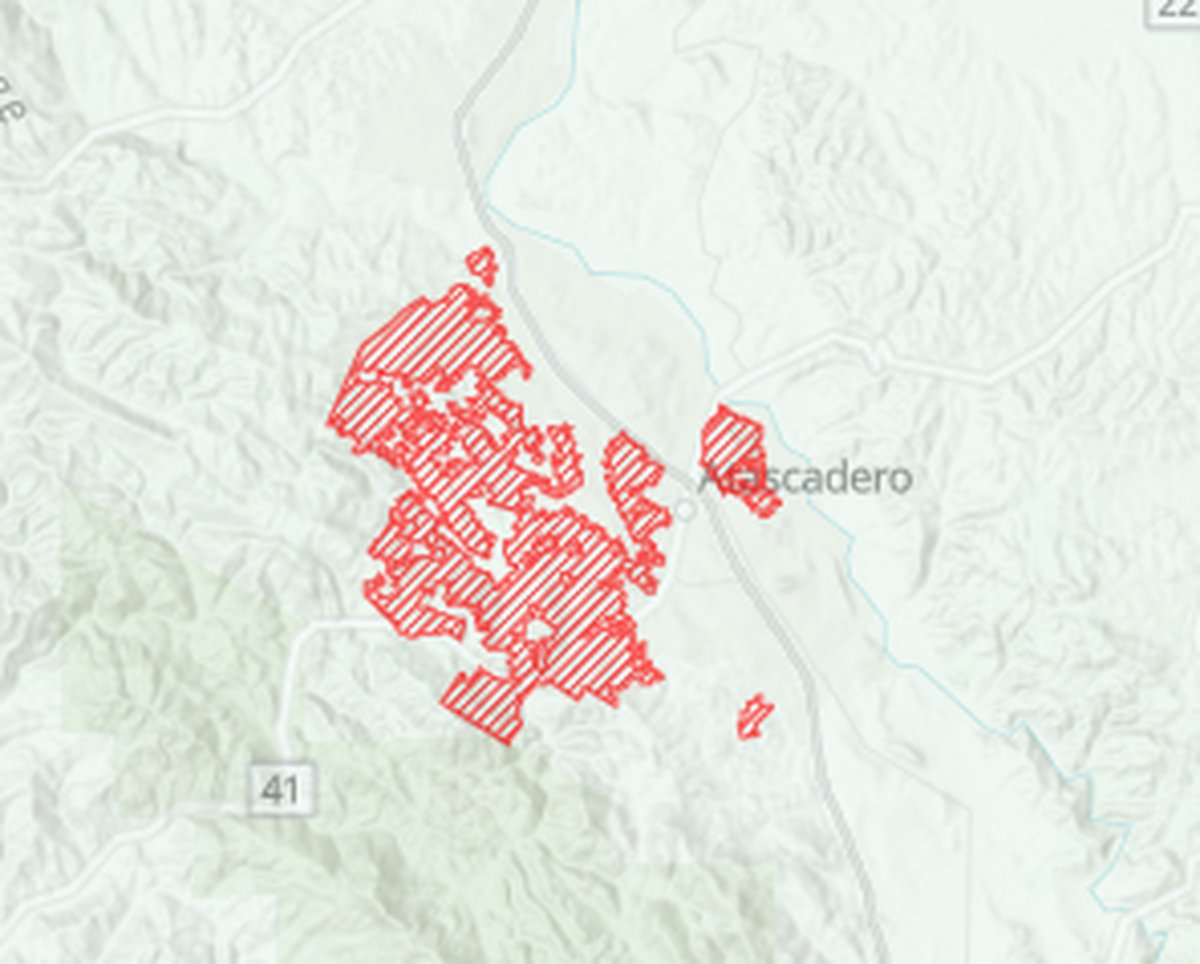
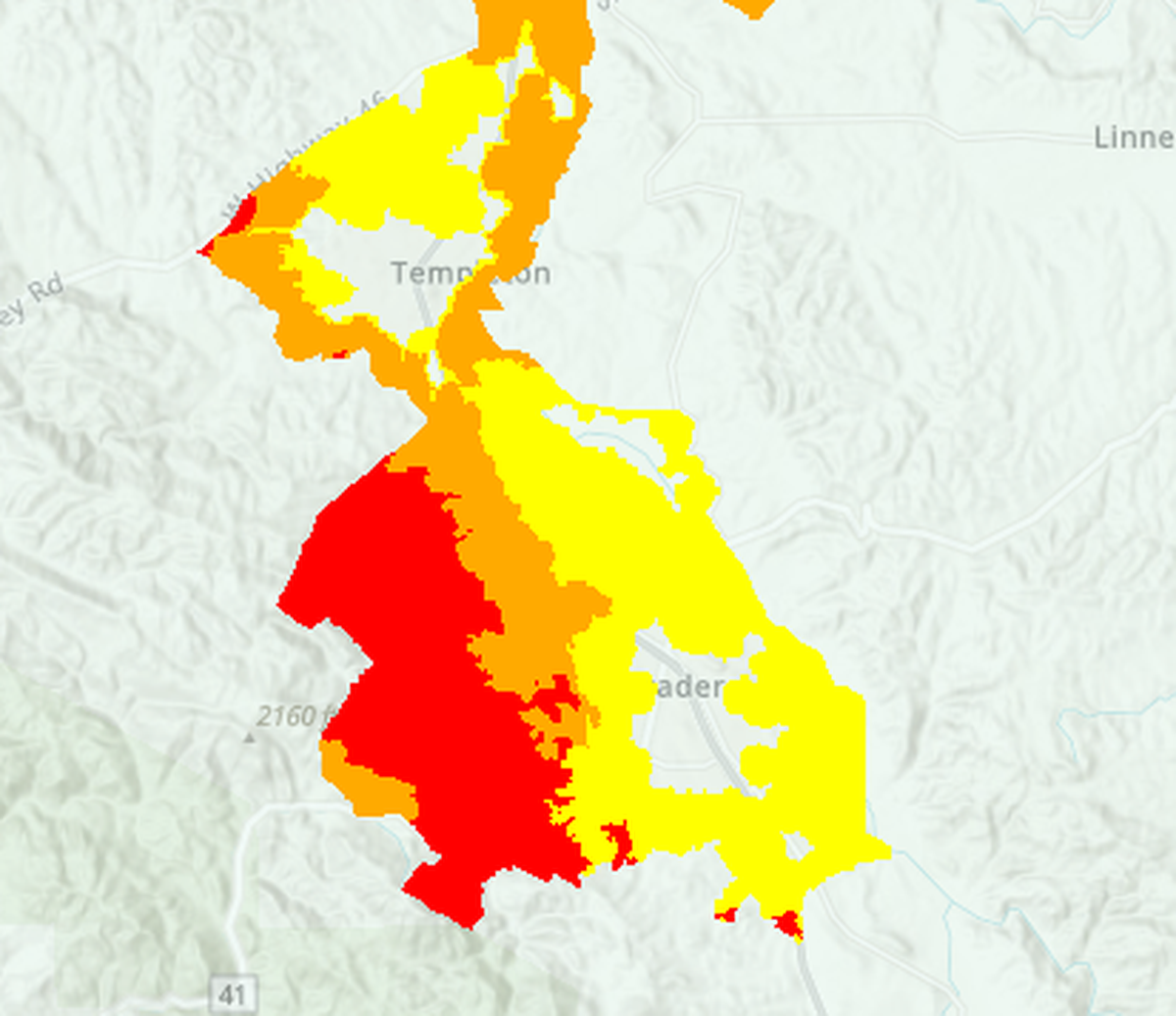
The west side of Atascadero is home to the largest “very high” fire hazard severity zone in San Luis Obispo County — even though it shrunk over the last 15 years.
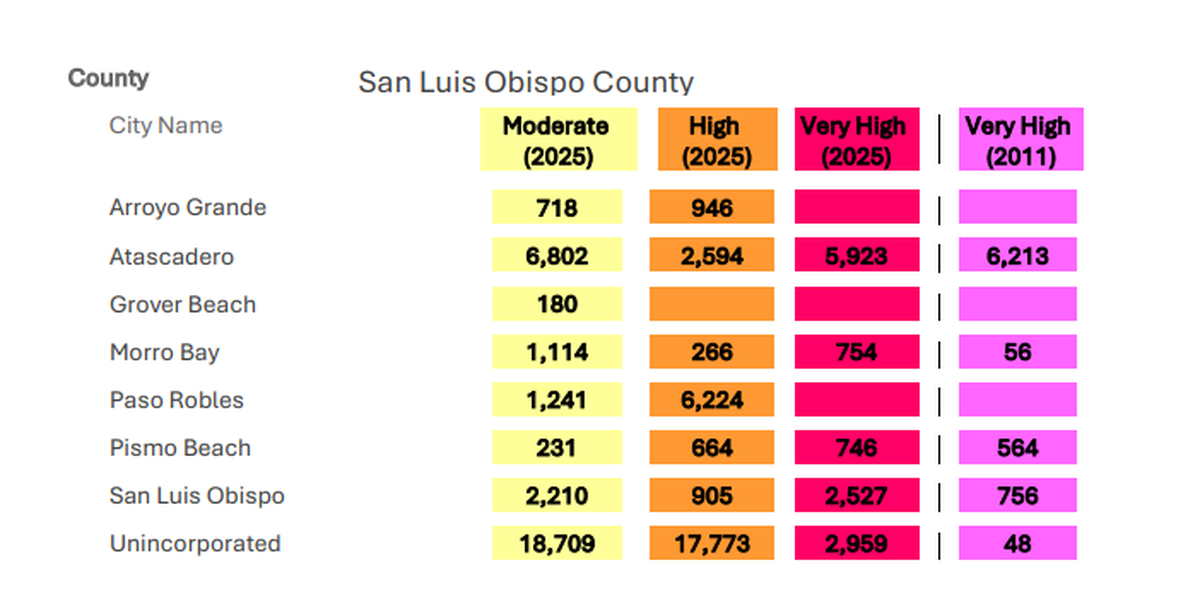
The city’s “very high” hazard zone covered 6,213 acres in 2011, but decreased by 4.6% to 5,923 acres in 2025, according to Cal Fire data.
However, Atascadero added 2,594 acres to the “high” hazard zone and 6,802 acres to the “moderate” hazard zone in 2025, so even though Atascadero’s “very high” acreage decreased, its overall area under some kind of fire hazard classification grew to a total of 15,319 acres, or 140%.
Now as a result, more than 75% of the city lands in one of the three zones, Atascadero Fire Department Chief Dave Van Son said.
Flammable vegetation like oak woodlands and dense, scrubby chaparral plants grow on the west side of Atascadero, contributing to the fire hazard, Van Son said.
West Atascadero also includes steep hills and narrow canyons, and fire travels more quickly uphill, he said.
Learn more about the city’s fire hazard severity zones online at bit.ly/3GlDOOK, and submit comments or questions to fire@atascadero.org.
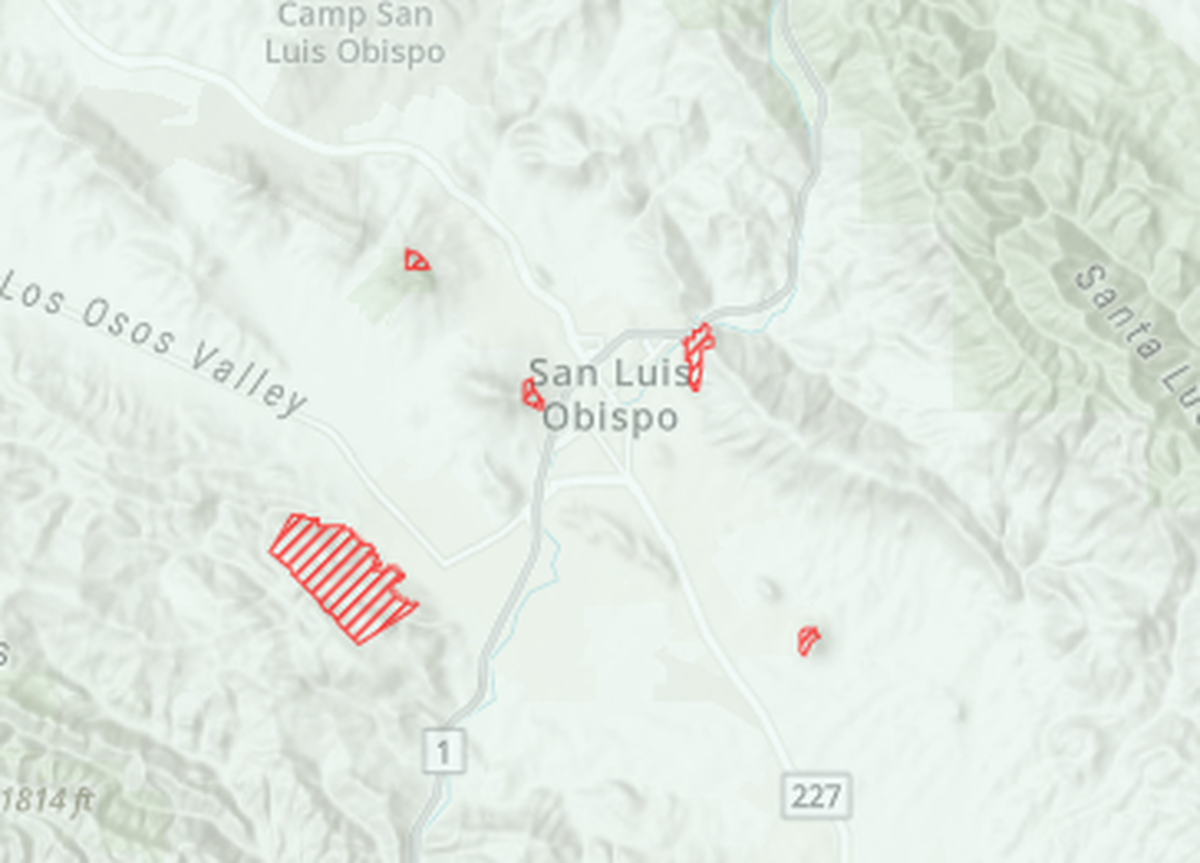
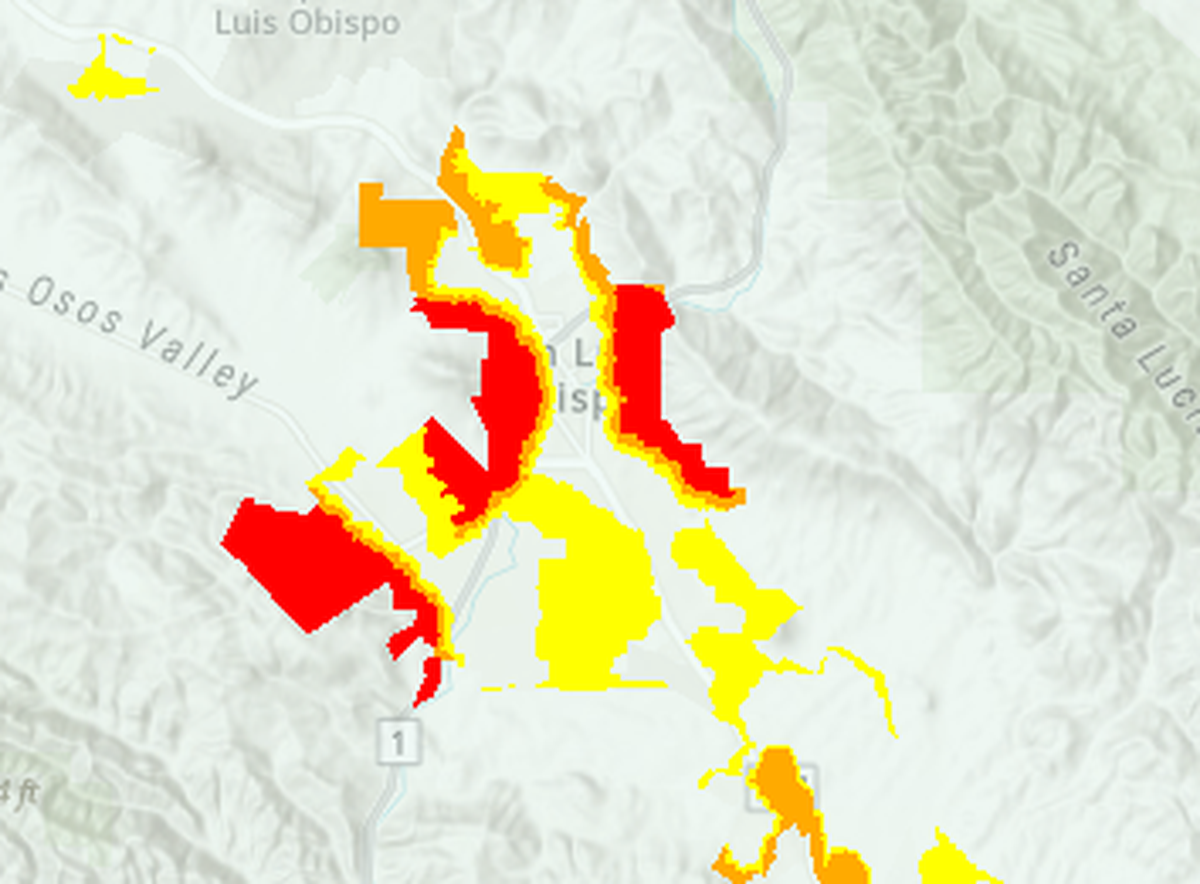
SLO city’s fire zones expanded by 250%
Previously, fire hazard severity zones almost exclusively bordered open space areas in the city. The new map, however, shows those zones encroaching into the city.
Notably, a new “moderate” severity zone stretches through Cal Poly, while another extends through the city from Tank Farm to Broad Street.
The city’s “very high” hazard zone included 756 acres in 2011, but expanded to 2,527 acres in 2025, Cal Fire data showed.
Meanwhile, the city added 905 acres to the “high” severity zone and 2,210 acres to the “moderate” severity zone.
The updated map doesn’t change the Fire Department’s emergency response plans, Tuggle said, but the department will increase fuel management projects in the new hazard zones.
There are two ways to approach fire risk reduction, he said.
The first is at a community level, which includes efforts like creating buffer zones between vegetation and the built environment and educating the community about evacuation zones. The second is at a parcel level, which aims to create defensible space around properties and hardening homes to fire, he said.
“We know we live in a fire-prone environment,” Tuggle said. “We know that we’ve got vegetation around us, and we know we need to prepare ourselves for the inevitable wildland fire.”
Learn more about the city’s map at bit.ly/3S0Dvvg, and submit public comment online at bit.ly/3Y9BMY7.
Do fire hazard zones affect insurance?
One key question homeowners will have is what impact, if any, the new maps may have on their insurance coverage.
According to Cal Fire’s website, the new maps do not impact fire insurance rates.
While Cal Fire’s maps identify fire hazard, which is the likelihood of a fire, insurance companies analyze risk, which is the potential severity of a fire and the property damage it could inflict.
Insurance companies use their own models to determine a property’s fire risk and then set rates from there.
While insurance companies likely do not reference Cal Fire’s maps directly, “much of the same data that is used in the fire hazard severity zone model are likely included in the insurance companies’ risk models,” Cal Fire’s website said.
This story was originally published April 24, 2025 at 11:53 AM.