No water in wine country: How SLO County residents survive when their wells go dry
Two scruffy dogs spilled onto the porch when Candy Nachel opened her front door. She stooped to pick up a fluffy Chihuahua named Poppy, then looked out across the property east of Templeton that she’s owned since 1996.
Each year, she watches her neighbor’s vineyards grow heavy with wine grapes. Each year, pickers toil to harvest the bruise-purple fruit fattened with water from the Paso Robles Groundwater Basin.
But Nachel can’t enjoy the view.
In fact, these days, she can’t even enjoy a glass of wine. Because it reminds her that the vineyards have water — while she has none.
“I can see grapes less than a mile away,” Nachel said. “That’s right out my front door. And it’s not pretty to me. It doesn’t bring smiles to my face, because I’m sitting here with no water, and they’ve got plenty.”
Nachel, 74, is one of many property owners living above the Paso Robles Groundwater Basin whose wells have gone dry.
Since the summer of 2014, the California Department of Water Resources has received 337 reports of dry wells over the basin, San Luis Obispo County groundwater sustainability director Blaine Reely said.
In 2024, people pumped about 25,500 acre-feet of water more than was returned to the underground reservoir, according to the most recent annual report on the basin.
The California Department of Water Resources considers the basin “critically overdrafted,” and residential property owners with dry wells are some of the first casualties of a poorly managed groundwater supply.
Those residents blame farms and vineyards for pumping more than their fair share of water. According to the basin’s 2024 report, agriculture used about 94% of the water pumped from the basin.
“It does bring you to tears. Brings you to tears because you get frustrated,” Nachel said. “You get frustrated with your own life, frustrated with the county and frustrated with the vineyards that don’t listen and the fact that they don’t even care.”
While agricultural pumping reduced water levels in the basin, it’s not the only reason wells are going dry, Reely said. Some parts of the basin are shallower than others, or they’re far away from streams that would replenish the aquifer.
“There’s a lot of pieces to the puzzle,” Reely said.
Either way, it’s an untenable situation, and residents are now urging the county to create a water-delivery program or reimburse residential well owners for the cost of ordering water.
Managing a water basin in overdraft
Part of the Salinas Valley Groundwater Basin, the Paso Robles Area Sub-basin spans 681 square miles from the slopes of the Santa Lucia Mountains — dividing the North County and the North Coast — to the arid grasslands that give way to the California Valley in the eastern part of the county.
Replenished by rainfall and rivers, the basin is like a giant underground lake that ebbs and flows in size beneath the land above, which is owned by residents and growers, all of whom have stuck straws of varying sizes and numbers into the aquifer.
Many wells supply the water that feeds row upon row of fertile vineyards, which produce world-class wine grapes that were the county’s No. 1 crop in 2023 with a value of $324 million.
The problem is, with so many people sipping at a limited source, the waters of that giant subterranean lake are receding from the underground shoreline.
When that happens, the shorter straws in the shallower areas — typically those owned by individual homeowners — begin sucking nothing but dirt and dust.
Meanwhile, farms and vineyards that typically own deeper wells can still reach the dwindling water supply in the basin.
California’s longtime water policies give property owners the right to pump groundwater for “beneficial uses,” despite the fact that groundwater isn’t contained by property lines. Those with the funds to dig deeper wells are able to access water — reaching into the supply that their neighbors might need but can’t afford to reach.
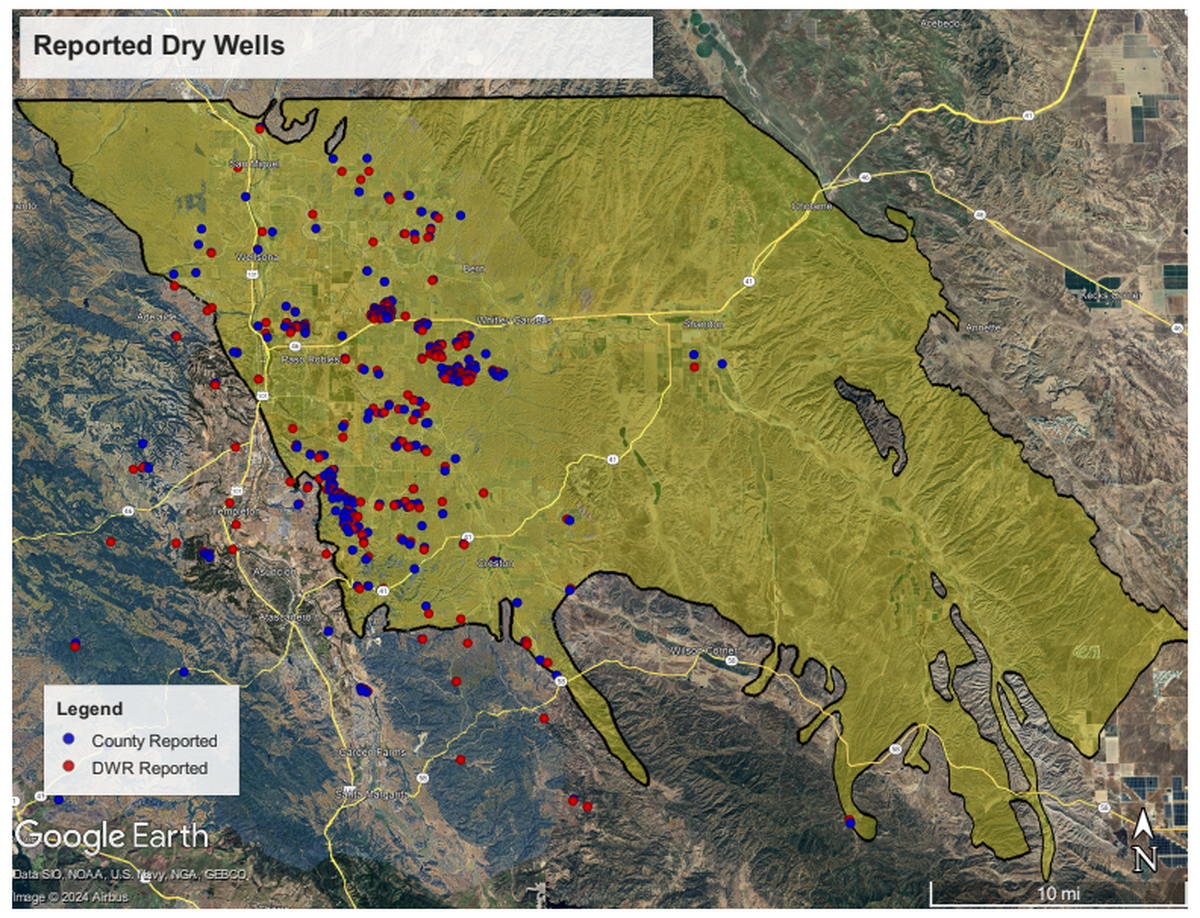
Dry wells in Paso Robles wine country
Deep in wine country, Nachel lives among the vineyards on El Pomar Drive with her son and 12-year-old granddaughter.
Her 5-acre property sits on the western edge of the Paso Robles Groundwater Basin, a shallow area where “the aquifer feathers out to nothing,” Reely said.
Wells in this part of the basin often go dry first, because there’s less water there to begin with, he said.
Originally, these properties were sold to cattle ranchers, dry farmers and residential developers whose operations didn’t require as much water, Reely said.
Then the vineyards moved in, and they drilled deeper wells that could reach farther into the aquifer than residential wells. Nachel’s property has three, 250-foot-deep wells.
She and her husband purchased the property in 1996 because it had a barn for their horses and it felt like home.
“It felt comfortable, where somebody could come and visit and you weren’t taking your shoes off at the door,” Nachel said. “That, to me, is important.”
All was good until 2017, when her first well went dry, so she connected to another well on the property.
About two years later, that well dried up too, and she discovered that her third well didn’t contain enough water for use — so she had to start ordering water.
Nachel considered drilling an 800-foot well, but that would cost $85,000, and she figured the bank would refuse her a loan without access to water on the property. So, she never applied for one.
Instead, she now pays $350 per month for a water delivery, which she stores in a 500-gallon tank. The payment “financially puts me in the dumps,” she said, as she’s on a fixed income of Social Security and pension payments.
Sometimes, the supply isn’t enough to last the whole month.
“When I run out of water, when I’m waiting for a water truck, I feel confined,” she said. “Honestly, it feels like somebody’s got me in shackles.”
It’s also forced her to change her habits.
Nachel washes dishes differently now — soaping all of the dishes before briefly running them under the faucet. She takes short showers and only does bulk loads of laundry.
“It’s just changed my life in every way,” Nachel said. “You don’t waste water on things that aren’t necessary, and if they are necessary, you’re just careful on how you use it.”
The limited water supply also affected one of her favorite hobbies: gardening.
That used to be her preferred way to decompress after a long day. When her wells held water, she tended to more than 100 rose bushes. When her wells ran dry, she ripped the rose bushes out.
Nachel even had to close her boarding kennel, because she didn’t have enough water to bathe the dogs or wash down the facility.
“It all takes water, water that I can’t waste,” she said.
What officials say about the failing wells
The Paso Robles Area Sub-basin has long been the focus of stabilization efforts, which intensified in 2020 when the basin was designated as “critically overdrafted.” The Sustainable Groundwater Management Act mandated the creation of a Groundwater Sustainability Plan that would bring the basin back into balance by 2040.
“The solution is we have to reduce pumping,” Reely said. “It’s achievable.”
San Luis Obispo County, the city of Paso Robles, the Shandon-San Juan Water District and the Estrella-El Pomar-Creston Water District recently formed a Joint Powers Authority, which will have the power to levy water use fees in all of the basin except areas served by a fifth entity, the San Miguel Community Services District.
Entities that use water commercially, like farms, vineyards and breweries, will be charged the fee on their property taxes. Domestic well owners will not be charged.
Reely hopes the fees will motivate growers to make their operations more efficient so they can reduce their water use, he said. Meanwhile, those fees will fund programs designed to balance the basin.
One such program is the Paso Robles Groundwater Basin Multibenefit Irrigated Land Repurposing Program, also known as the MILR Program.
Through the program, a staff member will support irrigators who want to pivot to farming practices that use less water. This could look like changing the property’s irrigation system so it is more efficient, changing farming practices, or converting irrigated farmland to dry land farming, open space or a project like a solar farm.
Right now, it’s too expensive to connect to the State Water Project or use recycled water to recharge the basin, but those projects could become viable in the future, Reely said.
If farmers don’t voluntarily reduce pumping over the next few years, the Groundwater Sustainability Agencies governing the basin may need to implement pumping restrictions — an action authorized by the Sustainable Groundwater Management Act.
“We have that hammer if we ever need it. We just are hoping — and have been working towards a strategy where — we don’t pull that hammer out of the tool kit,” Reely said.
Creston resident had water before the vineyards arrived
Like Nachel, Creston resident Carol Rowland, 84, also misses gardening.
As the water levels in her well dwindled, she stopped irrigating her experimental garden, where she grew flowers, plump heirloom vegetables and dye plants that she used to color her home-woven tapestries.
The 80-foot-deep well on her 14-acre O’Donovan Road property goes dry intermittently, and she’s worried she’ll soon have to start buying water.
“It’s just really scary, because I live on such a fixed income,” she said.
Her husband bought the house in 1975, and she only started having problems with her well during the past few years, she said.
Sure, the well is shallow. But “it used to be fine for us before all the vineyards came in,” she said. “It’s just so unfair.”
Unlike the El Pomar area, the Creston area of the groundwater basin is in good shape, Reely said.
The Huer Huero stream system empties into Creston from the southern foothills, recharging the basin. So there hasn’t been a significant decline in water levels there.
But still, people with shallow wells like Rowland could struggle during extended periods of drought — especially if they’re surrounded by agriculture, which tends to increase irrigation during dry years, Reely said.
How do vineyards manage water?
Vineyards extract the most water of any agricultural operation from the Paso basin. In 2024, vineyards drew 58,585 acre-feet, which was 78% of the total amount pumped that year, according to the annual report.
Some vineyards, like J. Lohr, prioritize efficient water use.
J. Lohr owns two vineyards in the El Pomar area of Paso Robles, which consume about 1 acre-foot of water each per year, owner Jerry Lohr said. That is less than the 2 acre-feet of water allotted to domestic groundwater users.
Lohr irrigates his grapes according to rain patterns in France, which means he irrigates heavily in the spring, lightly in the summer and moderately in the fall.
Irrigating this way saves water and produces small grapes packed with flavor, he said.
“We wanted higher quality, and we got higher quality with less irrigation,” he said.
Wells at J. Lohr vineyards range between 600 and 870 feet deep, and none have gone dry.
Meanwhile, the Wonderful Co., which owns Justin Vineyards, planted drought-tolerant rootstocks in Paso Robles and used precision irrigation to avoid wasting water, according to Justin Vineyards director of grower and community relations Molly Scott.
“We are constantly focused on the long-term sustainability of the basin and participating in efforts to protect it,” she said in a statement.
But the Wonderful Co. declined to share how much water they apply to each vineyard, so there’s no way to tell how much water is saved by their efforts.
SLO County Farm Bureau executive director Paul Clark said the agriculture industry acknowledges that it uses the vast majority of water pumped from the basin. As a result, many farmers and vintners are prepared to pay the water use fees proposed by the Joint Powers Authority.
If those fees are passed, “agriculture is going to be paying the lion’s share of the cost” of improving the basin’s sustainability, Clark said.
He expects the fees to prompt a reduction in irrigation, but he can’t promise that this will improve water levels significantly enough to restore dry wells.
“Groundwater is a very complicated, and, at times, a very mysterious science. So it’s hard to say specifically, if you do x than y is going to happen,” Clark said. “It’s going to take awhile for these areas to recover.”
Single mom searching for solutions
Sara Maciel never leaves the faucet running at her Paso Robles home.
She takes short showers, limits water use while brushing her teeth or doing the dishes and only runs full loads of laundry. She thinks about water every day — and that’s because she doesn’t have any.
Maciel’s 450-foot well went dry two years ago.
Now, she pays $500 per month to have water delivered, which she stores in a 2,500-gallon storage tank. She waits in suspense each month for the tank to run out before calling in a new delivery.
“When it does run out, it’s, like, that gut-wrenching feeling,” Maciel said. “You don’t know when it’s going to happen. You turn on the faucet, and there’s just nothing.”

Maciel moved to the 1-acre property on Jardine Road about six years ago with her three children, now ages 10, 15 and 17.
At first, her well dried up during the summer and was replenished by winter rains. But for the past two years, it stayed dry.
“The situation for me right now is a little scary,” she said.
There’s a residential subdivision in the Jardine area full of homes that rely on individual wells, Reely said.
Homes on the southern end of the subdivision were built during the 1950s when water levels were higher, so wells were only built to be about 200 feet deep, he said. Many of those wells have now gone dry.
As the subdivision developed north, people drilled deeper wells that can still access water. The northern part of the subdivision also borders a river that recharges the basin, providing more support for their wells.
Meanwhile, the Jardine area — like other rural neighborhoods in the North County — is surrounded by vineyards, Reely said.
Maciel blamed dwindling water levels on agricultural pumping.
“It’s definitely just frustrating knowing how much they’re using,” she said.
Could the county pay for water delivery?
All three homeowners The Tribune spoke to urged the county to support a water delivery service for people with dry wells.
Maciel supports a water-use fee, as long as the rates are reasonable. The fee could fund a program that reimburses domestic well users when they have to buy water, she said.
“I’m just wanting to survive,” Maciel said. “I’m not trying to get rich. I’m just trying to keep water for my family.”
Similarly, Nachel urged the county to operate a water truck that delivers water to residents with dry wells for free — or at least at a reasonable price.
She also thinks farmers should pay a fee when they use more than a certain amount of water.
Rowland went a step further: She advised the county to limit how much water vineyards can pump.
Reely said the county is designing a dry well assistance and mitigation program, which would include delivering water to residents who need it. Shasta County and Santa Cruz County offer similar water programs, according to the California State Water Resources Control Board.
Until then, dry well owners over the Paso basin are on their own.
While the county works out a solution, Nachel said vineyards owe their neighbors an apology.
“Nobody’s making the vineyards stand up to the plate and go to their neighbor and say, ‘I’m sorry. I understand that my pumps could have made your wells go dry,’” Nachel said. “None of them are taking accountability.”