Judge ordered SLO County to release more water from Lopez Dam. Will it drain the lake?
San Luis Obispo County and a coalition of environmental groups are fighting over the appropriate amount of water to release from Lopez Dam to support an endangered fish without jeopardizing the drinking water supply.
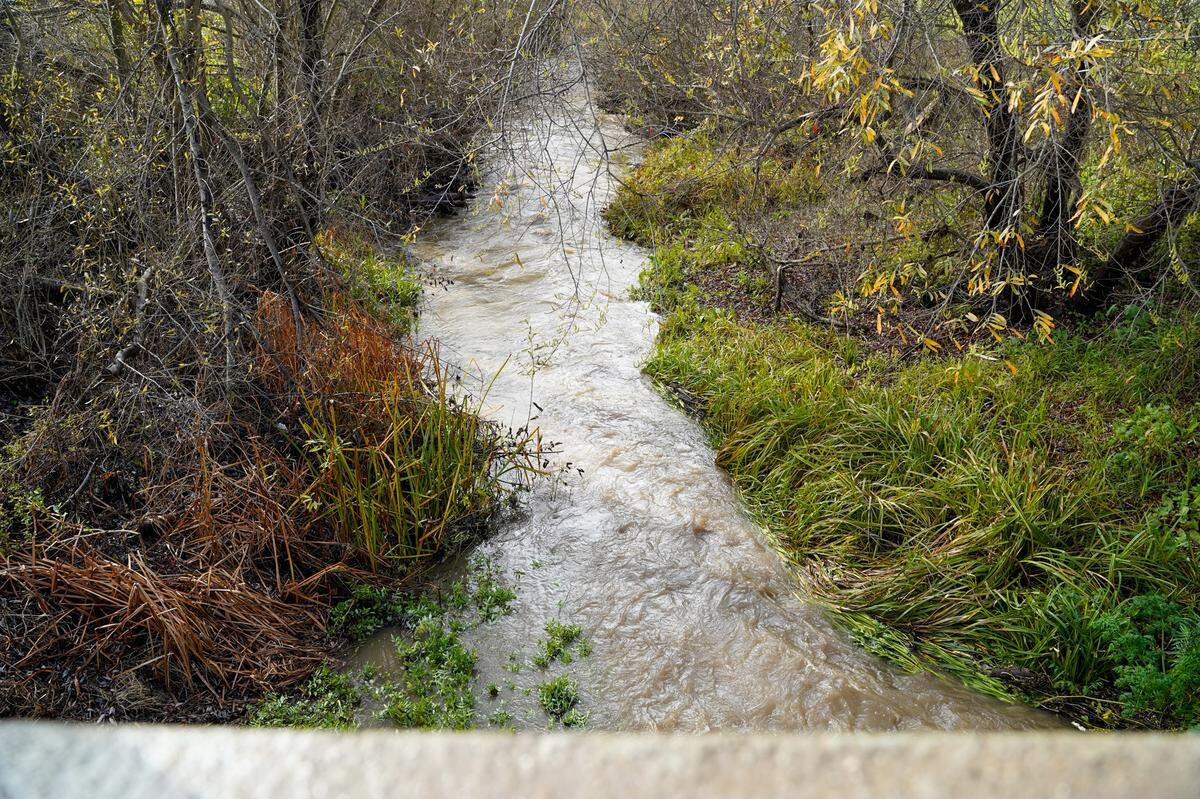
In December, U.S. District Court Judge Sherilyn Peace Garnett ordered the county to release more water from Lopez Dam to support steelhead trout migration through Arroyo Grande Creek.
The county appealed the decision, arguing that the court-ordered water release schedule would drain Lopez Lake during a drought — preventing the county from delivering drinking water to South County.
Lopez Lake isn’t only a home to steelhead trout — it’s also a drinking water source for more than 45,000 SLO County residents living and working in Arroyo Grande, Oceano, Pismo Beach, Avila Beach and Grover Beach, according to county documents.
County Supervisor Jimmy Paulding said the judge’s decision didn’t adequately balance the importance of protecting the water supply and the needs of the trout.
“Under drought circumstances that we’ve previously encountered, we would have actually drained the lake if we were forced to release the water at the rate that this particular order requires,” San Luis Obispo County Supervisor Jimmy Paulding told The Tribune. “The data shows that what’s being asked of us does not result in protecting our water supply, which is incredibly frustrating and problematic.”
However, Chris Sproul, the attorney for the environmental groups, said claims that the new water release schedule would jeopardize the water supply are “false and fear-mongering.”
He represents the San Luis Obispo Coastkeeper, California Coastkeeper Alliance, Los Padres ForestWatch and the Ecological Rights Foundation, the groups who filed the original lawsuit.
Sproul said the county could implement water conservation measures to avoid draining the reservoir.
“There are options for both supplying drinking water needs and protecting the environment,” Sproul said. “Maybe we have to change some things, maybe we have to use water more wisely, maybe we have to conserve more, but it’s false to say, ‘Well, this is impossible.’”
What is the water release schedule?
From 2007 to 2024, the county released water from the dam seasonally, according to an Interim Downstream Release Schedule.
The schedule ordered the county to release 3 cubic feet of water per second during the wet season, and 7 cubic feet of water per second during the dry season.
A cubic foot of water is about 7 gallons.
According to the court order, however, the county must release a base water flow level of 5.9 cubic feet per second at all times during a dry year and 7.9 cubic feet per second during a normal or wet year, the court document said.
Additionally, the county must release “pulse flows” from the dam when the mouth of Arroyo Grande Creek is connected to the ocean, measured by when the Arroyo Grande stream gauge reaches 100 cubic feet per second.
The purpose of the pulse flows are to release a consistent amount of water at a high enough volume to signal to steelhead trout in the ocean to return to the creek to spawn, Sproul said.
During a dry year, the county must release one pulse of 20 cubic feet of water per second on the first day of the managed release, and 10 cubic feet of water per second during the following three days.
During a normal year, the county must release two pulses of 20 cubic feet per second on the first day and 10 cubic feet per second the next three days.
During a wet water year, the county must release two pulses of 30 cubic feet of water per second on the first day, followed by 50, 40, 30, 20 and 10 cubic feet of water released per second on each subsequent day. For the next four days the county will taper off the releases at 0.5 cubic feet per second.
The county submitted a similar yet more complicated flow release schedule as an option in its original draft Habitat Conservation Plan application submitted to the National Marine Fisheries Service and California Department of Fish and Wildlife in 2004, Public Works Department deputy director Kate Ballantyne said.
The plaintiffs then took that data and created the flow release schedule ordered by the judge, she said.
The court-ordered plan has not yet been reviewed by the necessary regulatory agencies, she said.
“The biology and hydrology of Arroyo Grande Creek is highly complicated involving numerous evolving factors, and flow releases should be properly evaluated by qualified experts through the appropriate regulatory process,” Ballantyne said in a statement. “While the county has studied various flow releases for Lopez Lake, including those proposed in the 2004 HCP, they (including the court-ordered flow releases) have not been fully evaluated or given final approval by the National Marine Fisheries Service or the U.S. Fish and Wildlife Service.”
Sproul, however, said his clients created the court-ordered water release plan based on the county’s 2023 draft Habitat Conservation Plan and the Interim Downstream Release Schedule.
Sproul said it’s the county’s fault if regulatory agencies haven’t yet reviewed and approved an official downstream release schedule.
“They’ve had 20 years to analyze this,” he said. “The county’s just sat on its heels.”
Water release plan could drain the lake, county said
The county appealed the decision, citing concerns that following the court-ordered water release schedule would jeopardize the South County drinking water supply.
The reservoir can hold almost 50,000 acre-feet of water. An acre-foot is enough water to cover a football field in a foot of water.
If the water level dips below 20,000 acre-feet, the county must deliver less water to municipalities and limit downstream releases, according to the county’s Low Reservoir Response Plan.
When the water level drops below 7,000 acre-feet, the water becomes unseasonably warm, grows more algae and is expensive to treat to drinking water standards.
Finally, the reservoir is considered a “dead pool” at 1,690 acre-feet, and the county would halt municipal water deliveries and downstream releases.
The county studied how the court-ordered water release schedule would have impacted water quantity and quality in the reservoir since 2011.
If the county had followed the schedule during previous years, the water level would have dropped below 7,000 acre-feet in May 2016, with 15 months of poor water quality lasting through 2017, county data showed.
Later, in 2021, the county would have seen 27 months of poor water quality, with 15 months at dead pool status where no drinking water would have been delivered to communities, county data showed.
If the county’s calculations are correct, communities that rely on the reservoir would have been scrambling for drinking water.
The city of Arroyo Grande filed an amicus curiae brief in support of the county’s appeal, explaining that losing access to Lopez Lake would send them into a water emergency and require more groundwater pumping — which could damage the groundwater basin.
The county delivers about 4,530 acre-feet of water per year to municipal users, including people in Arroyo Grande, Oceano, Pismo Beach and Grover Beach, a county report said.
The county is contracted to annually deliver 303 acre-feet of water to Oceano, 892 acre-feet to Pismo Beach and 800 acre-feet to Grover Beach, according to a letter from those communities supporting Arroyo Grande’s amicus curiae brief.
“In 2023, Lopez Lake water accounted for 63% of Oceano’s total water deliveries, 31% of Pismo’s total water supply and 62% of Grover’s total water supply,” the letter said. “If Oceano, Pismo and Grover are precluded from providing water pursuant to the water supply contract, none of the agencies has a readily available water source to make up for the loss in water supply. As such, a decrease in reliable water from Lopez Lake will have a devastatingly severe impact on the health and safety of the Oceano, Pismo and Grover communities.”
Another attorney for the environmental groups, Brian Orion, however, said the court-ordered schedule does not threaten the reservoir.
Right now, the reservoir is almost 93% full, according to the county website. Even during a year with low rainfall, the county’s isn’t close to draining the lake, he said.
The county will no longer need to follow the court-ordered water release schedule when they implement an official Habitat Conservation Plan. This should occur during the next two years, Orion said, so there’s no time for the county to drain the reservoir with the new water release plan.
“There’s all these assumptions about ‘what if’ that the county is positing in that graph,” Orion said. “That’s really an irrelevant hypothetical set of circumstances that doesn’t relate what the judge actually ordered.”
California Institute for Water Resources environmental scientist and policy analyst Erik Porse agreed that there isn’t necessarily a cause for alarm.
The court order requires the county to monitor the impacts of the water release schedule and allows the county and the plaintiffs to work together to improve the plan, he said.
“It’s been an ongoing challenge in California to make sure we have enough water available for all uses that we seek. We’re looking at supporting water supply for agriculture and urban uses, also habitat and more quality requirements for species,” he said. “How we allocate water across the state is best done through a collaborative process where you bring people together to identify common goals.”
State Sen. John Laird encouraged the county and the environmental groups who filed the lawsuit to reach a solution quickly.
“The Lopez Lake water litigation is one of the most significant issues facing San Luis Obispo County,” Laird said in a statement. “On the one hand, we need to protect important steelhead and other natural habitat; on the other hand, we need to ensure that people who live in the county can count on their water supply for household use, fire protection, drought management and so on. We need to find the right balance between these issues, and I encourage all parties to the litigation to put their heads together and resolve this swiftly — and not lose precious time and resources in a drawn-out legal battle.”