Two separate studies have now have been ordered to determine the potential for building an offshore wind port on the Central Coast, with the second and most recent one coming from San Luis Obispo County.
On Tuesday, the SLO County Board of Supervisors approved $1 million in grant funds for the Mott MacDonald consulting group to prepare a study considering three different locations for an offshore wind operations and maintenance port: Port San Luis, the Cal Poly Pier and Morro Bay.
The terminal would serve as a support hub for the offshore wind turbines in the Morro Bay Wind Energy Area and serve as a place for maintenance and service operation vessels to restock supplies and change crew members between two-week trips, said County Planning and Building Department Division manager Susan Strachan.
“Basically, it’s a place for vessels to dock,” Strachan said.
It would also include warehouses, offices and storage yards, but these structures do not need to be located directly next to the coast, she said.
The Cal Poly Pier in Avila Beach. Joe Johnston jjohnston@thetribunenews.com
Port San Luis will now see not one, but two independent studies into its potential to host an offshore wind port. Morro Bay and the Cal Poly Pier in San Luis Obispo Bay will also be considered only by the county’s study.
Funded entirely by the $1 million Caltrans grant, the county is now slated to pay Mott MacDonald up to $684,750 to carry out the study and distribute the remaining $315,250 to the Port San Luis Harbor District, Cal Poly and the city of Morro Bay for staffing resources and community engagement and outreach costs, Strachan said.
The board approved the motion to enter into the contract with Mott MacDonald on a 4-1 vote, with Supervisor Debbie Arnold the sole dissenter.
“For us to not go forth with the study would be completely irresponsible,” Supervisor Dawn-Ortiz Legg said as she cast her yes vote.
But community critics did not share the same sentiment.
“Why do feasibility studies when (Clean Energy Terminals) is already doing one for Port San Luis and ... Morro Bay is is not a viable alternative,” Mandy Davis, president of local anti-offshore wind nonprofit REACT Alliance, said during public comment. “You are looking to do something that is 100% unnecessary.”
Other attendees were concerned that the port project would interrupt the Central Coast way of life, noting the minimal access to both Morro Bay and by one road to Avila Beach that would be congested by a massive infrastructure project.
“You will destroy a gem of San Luis Obispo,” a Morro Bay resident said during public comment.
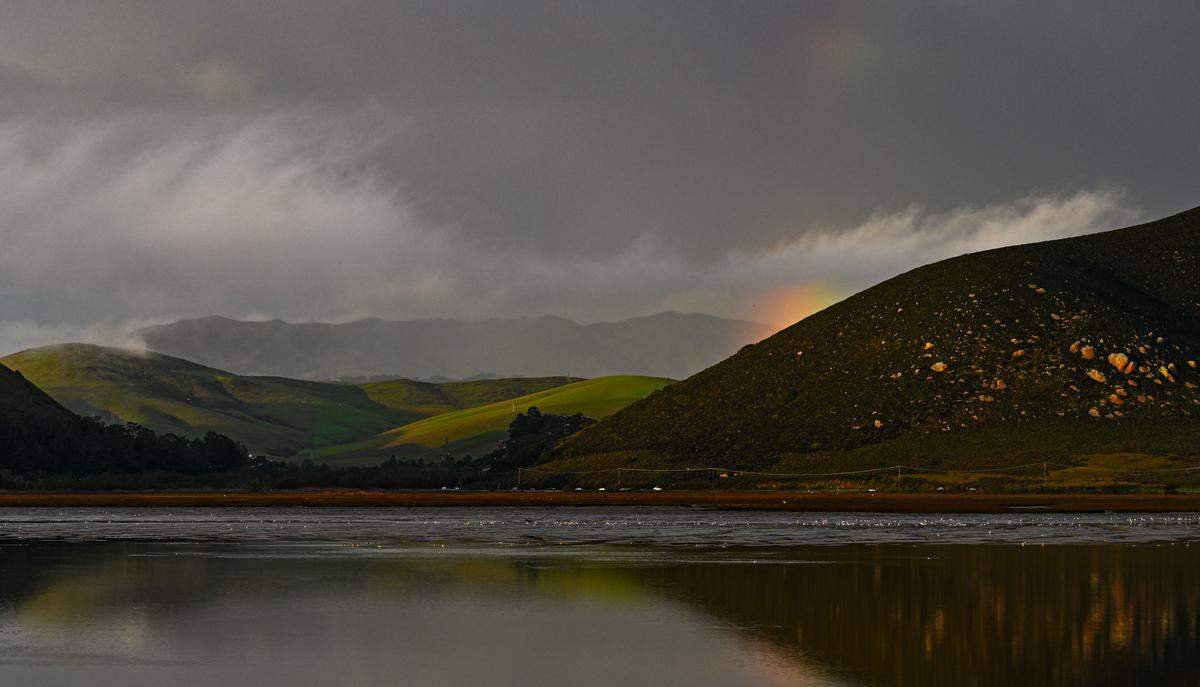
A partial rainbow in Morro Bay.
Study looks at Port San Luis, Cal Poly Pier, Morro Bay for potential offshore wind port
The proposed study would be divided into two parallel parts — one focused on the San Luis Bay area covering Port San Luis and the Cal Poly Pier, and another focused on the Morro Bay area, Strachan said during the board meeting.
Costs would be more or less split between the two sites, with $281,300 requested for San Luis Bay for an expected 5-month timeline and $341,200 for a 9-month study in Morro Bay, totaling $622,500. With a 10% contingency, the county will offer Mott MacDonald up to $684,750.
The two prongs differ slightly in their details — for example, the San Luis Bay study would include wave modeling to determine when wave conditions would preclude vessels from docking, as well as an assessment of potential co-uses and benefits to the community, while the Morro Bay study includes two public meetings with Mott MacDonald to discuss the draft and final study results.
But both sides of the study will conduct environmental and permitting assessments in partnership with a local firm and develop conceptual waterfront infrastructure designs at the three different locations, Strachan said.
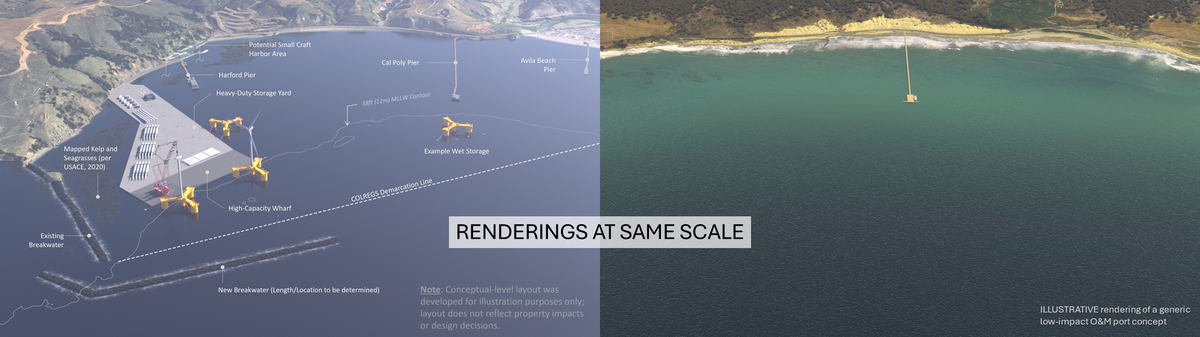
County staff made it clear that no plans have been designed yet and that a formerly proposed design for a much larger, more obstructive staging and assembly port is no longer on the table.
“There are no larger facilities proposed to go on the Central Coast,” Assistant County Administrative Officer Rebecca Campbell said at the meeting. “This picture is not representative of the facility that would be here.”
Campbell said that an earlier study explored whether those facilities could be accommodated along the SLO County coastline and determined they could not. The development of those larger construction facilities are now being pursued in Long Beach and Humboldt, she said.
Clean Energy Terminals is evaluating the potential for building a 3,000-foot-long pier as part of an offshore wind operations and maintenance port in San Luis Obispo Bay. This is much smaller than the port included in an early feasibility study published by REACH in 2022, shown on the left. Courtesy of Clean Energy Terminals
Instead, a proposed operation and maintenance port would primarily include service operation and crew transfer vessels, Strachan said.
The service operation vessels are typically 250 to 300 feet long and can accommodate up to 100 wind technicians and crew members, she said. They would spend up to two weeks at a time performing maintenance on ocean wind turbines, before returning to port to resupply and swap out crews.
The smaller crew transfer vessels are around 65 to 90 feet long and make shorter daily trips of around 30 miles or less to the wind farms, Strachan said. These vessels would dock at the proposed port daily to pick up and drop off technicians and crews servicing the turbines.
Port facilities would also include warehouses, offices and storage yards to support the offshore operations. While these supporting infrastructure elements do not necessarily need to be located directly on the waterfront, they are an integral part of the overall operations and maintenance hub.
Community has a split reaction the proposed study
Despite the majority support from the Board of Supervisors, many community members spoke in opposition to the proposed study.
“The absurdity of the fact that the county is looking at doing feasibility studies does not escape me or many others in this county,” REACT Alliance president Davis said.
She also claimed that wind companies had declared Morro Bay an unviable alternative in private meetings.
“It’s narrow. It’s shallow. It is a marine protected area. It is the site of endangered species habitat,” Davis said. “The ridiculousness of even looking at Morro Bay is pretty mind-blowing.”
Strachan later said that Morro Bay wrote a letter to the Board of Supervisors in support of the county study.
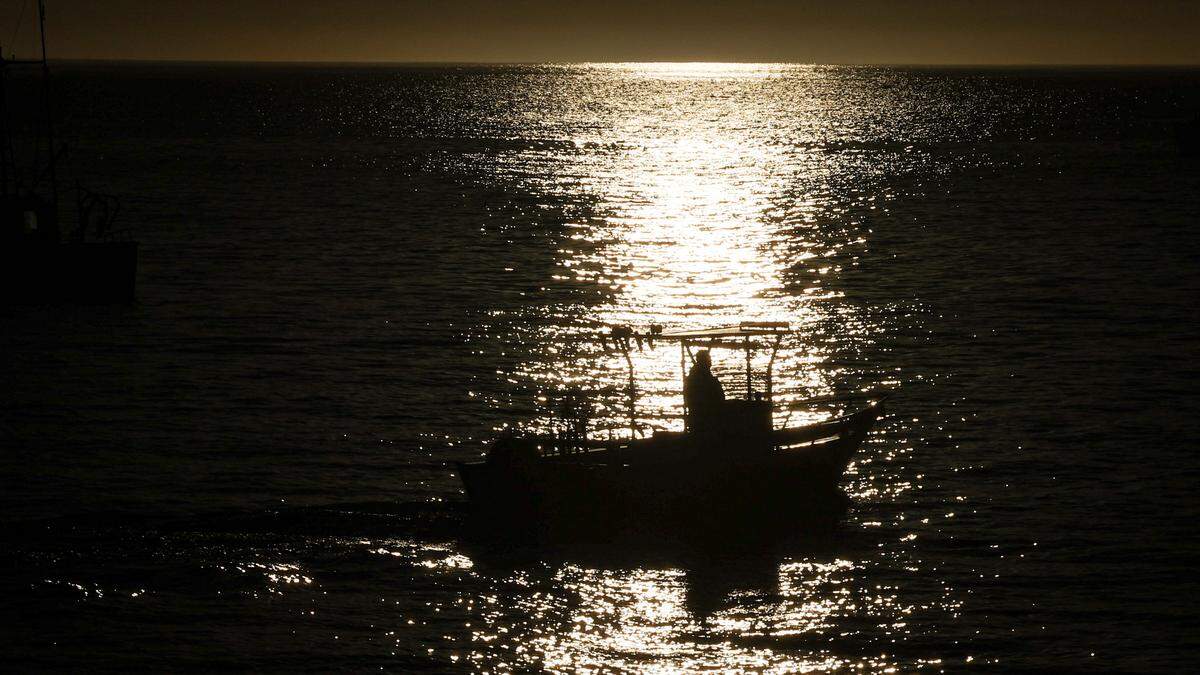
A boat heads out from Port San Luis as the sun rises near Avila Beach on Monday, Jan. 29, 2024. David Middlecamp dmiddlecamp@thetribunenews.com
Multiple others also brought up the ways in which the study appears “unnecessary,” including Cambria resident Ted Key.
“It would seem that the proposed technical assessments is a repetition of what (Clean Energy Terminals) is already doing in Avila,” Key said during public comment. “Why repeat it?”
Morro Bay resident Nicole Dorfman supported that allocation of funds to Morro Bay for the offshore wind efforts, but found it “disingenuous” and “schizophrenic” for the county to support clean energy at the same time as supporting an increase in Vandenberg missile launches that massively contribute to carbon emissions
“We’re talking about these wind turbines as solving the climate crisis, but I really think that’s a false narrative,” Dorfman said.
However, a number a proponents spoke on behalf of the study, too.
“Any decision for or against offshore wind development is a decision against or for fossil fuel development,” Director of Cal Poly’s Initiative for Climate Leadership and Resilience Erin Pearse said.
Karen Tillman, Cal Poly’s director of economic development, highlighted the necessity of a study at this time.
“The Central Coast region is uniquely positioned to become a leader in clean energy,” Tillman said. “The offshore wind industry offers an unprecedented opportunity for our region in terms of economic development, job creation and contributions to California’s ambitious climate goals. At the same time, we must protect the natural beauty and environmental integrity that define the Central Coast.”
The board ultimately voted to support the motion, pushing the study into its next steps.
“This is a study,” Supervisor John Peschong said. “We’re going to do science and we’re going to figure out if the thing is actually viable. ... We’ll have another public comment on this in the future when the results are known, and we’ll get a pretty good idea of what we’re able to actually get accomplished.”
Supervisor John Peschong asks questions at the San Luis Obispo County Board of Supervisors meeting on May 21, 2024. David Middlecamp dmiddlecamp@thetribunenews.com
This story was originally published September 12, 2024 at 5:00 AM.
Chloe Shrager is the courts and crimes reporter for The Tribune. She grew up in Palo Alto, California, and graduated from Stanford with a B.A. in Political Science. When not writing, she enjoys surfing, backpacking, skiing and hanging out with her cat, Billy Goat.