Then-and-now photos: See how Avila Beach looked before the oil tanks were removed
READ MORE
Then-and-now photo series
See David Middlecamp’s series of photo sliders comparing historic San Luis Obispo County scenes to today.
Expand All
Editor’s note: This is one in our new “Then and Now” series comparing historical San Luis Obispo County photos to the same locations today.
For much of the 20th century, Avila Beach was associated with Union oil.
That history began in 1910, when Union and a group of independent San Joaquin Valley oil producers broke the monopoly shared by Standard Oil and Southern Pacific Railroad by building the Alaska pipeline of its day, according to the Unocal book “A Century of Spirit.”
The $4.5 million, 240-mile pipeline was built to connect Valley production to tankers that would dock at Port San Luis, and by 1914, it had become the largest shipping port for oil in the world.
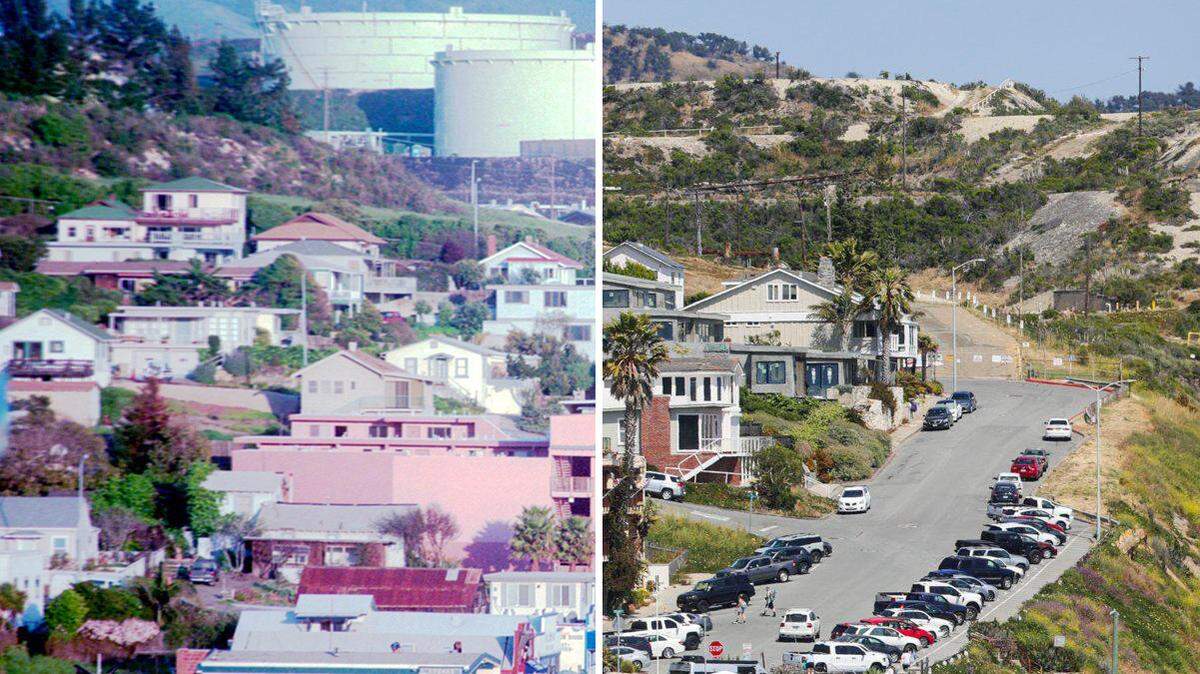
Massive tanks were built on the hill above town to store the oil as the tankers came and went. During World War II, one of them, the Union Oil tanker Montebello, was sunk by a Japanese submarine north of Cambria after it departed Port San Luis.
The facility was so critically important that Dwight Eisenhower sent a 1942 telegram congratulating Union Oil for its war contribution.
Over the years, however, the pipelines under the town between the tank farm and pier began to leak, and longtime residents remember the tar balls that would seep to the surface and stain the feet of beach-goers.
Eventually, the pollution got so bad, business owners couldn’t get loans for contaminated property, and after years of hearings and lawsuits, the company now called Unocal took responsibility. It demolished the town to save it.
The lower portion of Front Street below the Inn at Avila Beach was razed, and 200,000 tons of oily sand were excavated. Only two buildings were moved and returned, the Avila Market and the Yacht Club.
After the cleanup was complete, the tanks were removed, the first cut down with industrial shears in December 1997. The project eventually wrapped up in the early 21st century.
By the early 2000s, the old junky, funky buildings were gone and new freshly painted and landscaped construction replaced them.
Here’s a look at how the hillside of Avila Beach looked 25 years ago compared to today.
Use the slider tool to compare the images (if the slider doesn’t appear, refresh the page).
This story was originally published May 31, 2023 at 5:30 AM.