Monarch butterflies now listed as endangered by international group: ‘It’s heartbreaking’
The migratory monarch butterfly has been classified as endangered by an international group due to its declining population, climate change and threats to its habitat.
The International Union for Conservation of Nature (IUCN) works with scientists and researchers around the world to conserve nature and analyze species to determine whether they are threatened, endangered or extinct.
The organization released its updated assessment for migratory monarch butterflies on Thursday.
“Climate change has significantly impacted the migratory monarch butterfly and is a fast-growing threat; drought limits the growth of milkweed and increases the frequency of catastrophic wildfires, temperature extremes trigger earlier migrations before milkweed is available, while severe weather has killed millions of butterflies,” the organization wrote in a release on Thursday.
However, despite years of advocacy and petitions from various environmental groups, the species does not have protection under California or federal endangered species acts.
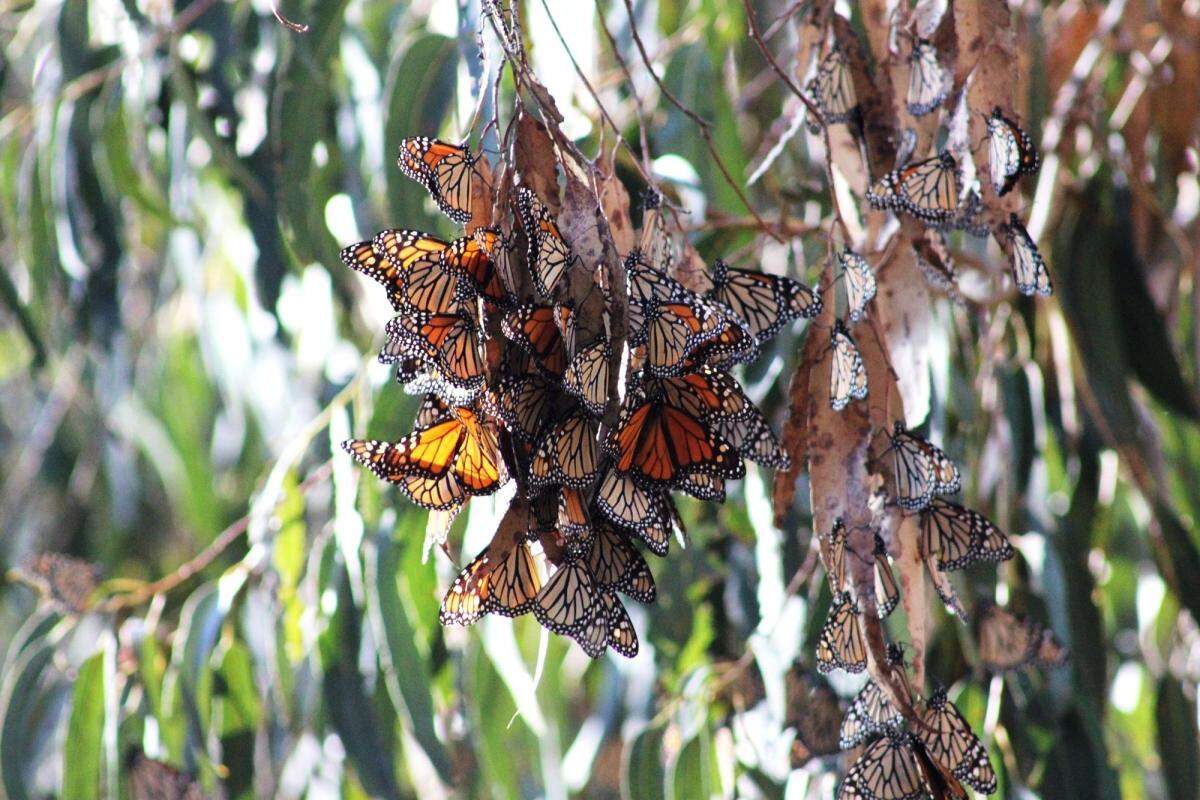
Western monarch butterflies typically flutter through San Luis Obispo County in huge numbers every winter to rest in groves along the coast.
The Pismo Beach Monarch Butterfly grove off Highway 1, which is managed by California State Parks, often sees the largest number of monarch butterflies in the state.
The Xerces Society for Invertebrate Conservation first organized annual counts of western monarch butterflies in the late 1990s and found more than a million of the winged orange-and-black insects found their way to overwintering groves in California.
By 2000, that number steeply dropped to less than 400,000. It remained relatively steady at fewer than 250,000 butterflies counted until 2015, when the species saw a small resurgance and nearly 300,000 were counted.
But then in 2017, the western monarch population saw a huge drop in numbers — in 2018 fewer than 30,000 were counted.
2020 brought the most dismal butterfly count yet. That year, about 1,900 monarchs were counted across the whole state, representing a 99.8% decrease from the 1997 numbers.
Hope was somewhat restored in 2021, however, when the monarch population increased dramatically and nearly 250,000 were counted across the state.
Volunteers conducting the Xerces Society’s annual count found nearly 21,000 butterflies overwintering at the Pismo Beach grove.
Though jubilant about the rebound of the species’ overwintering population in California, experts at the time were quick to temper their enthusiasm — noting that the jump in numbers was not impressive to the populations counted just five years before.
The IUCN’s classification of the monarch butterfly includes its global population — not just the western subspecies that float through California groves every winter. The western and eastern populations are separated in their migratory range by the Rocky Mountains.
“The Xerces Society is very supportive of listing the migratory monarch as endangered and contributed expert review to IUCN for this listing,” Scott Hoffman Black, Xerces Society executive director, said in a prepared statement on Thursday. “We have seen the numbers dramatically decline over the years in our western monarch count and know this species needs our help.
“Fortunately, there is still time to act,” he added, “and we are encouraged by the thousands of individuals who have made it their mission to help monarchs by planting milkweed and nectar flowers and protecting these animals from pesticides.”
The eastern population of monarch butterflies have historically been more stable than its western counterpart.
The eastern monarch population has an extinction risk of 5 to 43% over the next 20 years, according to the IUCN, while the western population’s risk of extinction over the next 20 years is 99.9% probable.
The western and eastern populations together have declined by between 22% and 72% over the past decade, according to the IUCN.
“Population declines, mostly attributed to climate factors, host plant declines in summer breeding areas and habitat loss in overwintering sites, have been observed in both the eastern and western migratory populations,” the IUCN wrote in its assessment of the species. “The causes of decline are partially understood, though they have not ceased and may not be reversible. Therefore, using a precautionary approach, this sub-species qualifies as endangered.”
The IUCN stopped short of classified the species under a more severe level of endangerment, however, because of its broad, relatively stable range. Instead, the group noted it considers the species as “near threatened.”
Monarch butterflies still lack US, state protection
The U.S. Fish and Wildlife Service announced in December that the monarch butterfly has to wait for federal protection under the Endangered Species Act.
That’s despite the federal agency’s estimates that there is a 96% to 100% probability that the western monarch population will collapse within 50 years, and and 80% probability for the species’ eastern population.
The move by U.S. Fish and Wildlife gave experts and researches grave concerns that the species would be doomed.
If granted classification under the Endangered Species Act, the monarch butterflies would have federal protection that would prevent any future habitat destruction without a permit, and a plan to help the butterflies recover would be implemented.
In addition, the state of California would receive federal funding to help conserve the species.
“It’s heartbreaking that monarch butterflies are now classified as endangered by the IUCN Red List, the preeminent international scientific body on extinction,” said Stephanie Kurose, senior endangered species policy specialist at the Center for Biological Diversity, in a prepared statement Thursday. “The Fish and Wildlife Service must stop sitting on its hands and protect the monarch butterfly under the Endangered Species Act right now, instead of hiding behind bureaucratic excuses.”
Additionally, though the monarch butterfly is designated as imperiled and vulnerable by the California Department of Fish and Wildlife, receiving federal protection status would boost efforts to save the species.
A Sacramento County Superior Court judge ruled in November 2020 that the state of California does not have the legal authority to protect insects under the California Endangered Species Act. This means that the monarchs cannot be protected under the state’s Endangered Species Act.
However, when President Joe Biden signed the $1 trillion Infrastructure Investment and Jobs Act into law in mid-November, it established a $2-million-per-fiscal-year federal grant program available to Native American tribes, the federal land management agency and state departments of transportation to carry out pollinator-friendly practices on roadways and highway rights-of-way.
A separate bill reintroduced by U.S. Rep. Salud Carbajal, D-Santa Barbara, Rep. Jimmy Panetta, D-Carmel Valley, and Sen. Jeff Merkley, D-Oregon — the Monarch Action, Recovery and Conservation of Habitat (MONARCH) Act — is still under consideration by the House.
As it was proposed, the MONARCH Act would set aside $62.5 million to implement a massive western monarch butterfly conservation plan prepared by the Western Association of Fish and Wildlife Agencies in January 2019, and another $62.5 million for any eligible entities that implement a monarch conservation project.
“There’s still so much to learn about monarch migration population dynamics to better understand how and why we are seeing these troubling statistics,” Rebeca Quiñonez-Piñón, chief monarch recovery strategist for the National Wildlife Federation, said in a prepared statement.
“However, we know that habitat deterioration, together with extreme weather events, threatens the migratory monarch,” Quiñonez-Piñón said. “This is as clear as it gets that the migratory monarch butterflies are in danger and need the full support of federal and private investment.
“We cannot overlook the warnings anymore and need to act to pass meaningful legislation and work to retain and restore habitat that is crucial to all pollinators and other native wildlife.”
How you can help save the monarch butterfly
There are several things people can do to help protect monarch butterflies, according to the Xerces Society.
The nonprofit organization suggests the following:
- Adopt an overwintering site and become an advocate for the site’s protection and management.
- Plant native California flowers that bloom in the early spring (February through April) to provide critical food for the monarchs.
- Plant native milkweed including woollypod, California, heartleaf, narrowleaf and showy milkweed plants.
- Seek out non-chemical options to prevent and manage pests in your garden and landscaping. Pesticides, herbicides and insecticides can all kill monarch butterflies.
- Report all monarch adult, catepillar, egg, nectaring and milkweed sightings to the Western Monarch Milkweed Mapper.
- Use the hashtag #SaveWesternMonarchs on Facebook, Twitter and Instagram to raise awareness, and add a Save Western Monarchs frame to your Facebook profile picture.
For details, go to xerces.org/western-monarch-call-to-action.
This story was originally published July 21, 2022 at 2:04 PM.