Small farmers vs. Big Carrot: How a water fight is dividing this dusty California valley
In the early afternoon in the Cuyama Valley, a hot June sun bears down as a dry wind gusts through the remote area that runs along San Luis Obispo County’s southeastern border.
Dust devils whip up the fine, tan soil, interrupted only by a pair of two-lane highways and the few hundred buildings that make up the valley’s towns of Cuyama, New Cuyama and Ventucopa — total population, roughly 660 people.
It’s an arid contrast to the region’s dominating business of agriculture fed solely by a declining and far-from-infinite groundwater basin.
In fact, aside from the noise of the blowing winds or cars whooshing by, only two other sounds penetrate the silence: the rumbling motors of wells bringing water to hundreds of hissing sprinklers that feed thirsty row crops.
The result is a sight to behold — California’s Central Coast high desert turned green to produce fresh vegetables, wine grapes and nuts for demanding shoppers around the world.
Over the past few decades, carrots in particular have taken over the valley floor, including some of the world’s largest growers of the crop, Grimmway Farms and Bolthouse Farms, which each harvest thousands of acres in the Cuyama basin.
Wine grapes are another popular crop in the area.
The Harvard University-owned corporation Brodiaea Inc. has about 7,500 acres of vineyards, 840 of which are planted, in the western-most reaches of the basin, while Arroyo-Grande based Laetitia Vineyard & Winery owns another few thousand acres in the southeastern finger of the valley.
Some farmers fear that the massive demand on the groundwater basin, along with California’s worsening droughts, will leave the region without the resource protection it needs.
So, over the past three years, the community drafted a new groundwater sustainability plan to plot a way toward bringing the basin into balance. It will soon be sent to the California Department of Water Resources for final approval, although efforts are already underway to implement some of its main priorities.
But now, suddenly, a new fear — what some might call a moving of the goalposts — is looming.
Bolthouse and Grimmway recently filed an adjudication complaint in state court that could delay or alter the pumping restrictions laid out in the groundwater sustainability plan — which many locals consider the most important pieces of the plan.
“There are farmers that have been in our valley for generations that have adapted during the droughts,” said Robbie Jaffe of the small dry-farming operation Condor’s Hope Ranch. “There are local farmers who really care about the basin and want to see it survive, and are making changes in their practices to adapt to that. What we have from Bolthouse and Grimmway, then, is quite the opposite.”
Water levels plunge in the Cuyama basin
The Cuyama basin, like others in the state, is considered to be experiencing conditions of critical overdraft as far more water is extracted than what the region’s little rainfall, Cuyama River and small creeks can supply.
The river is seldom seen running in recent years, the dry riverbed snaking through the middle of the valley a cruel reminder of a more saturated past.
And the Cuyama Valley is drying out, with average annual rainfall amounts falling about a full inch since 1955 to 7.63 inches, according to the Santa Barbara County Water Resources Division.
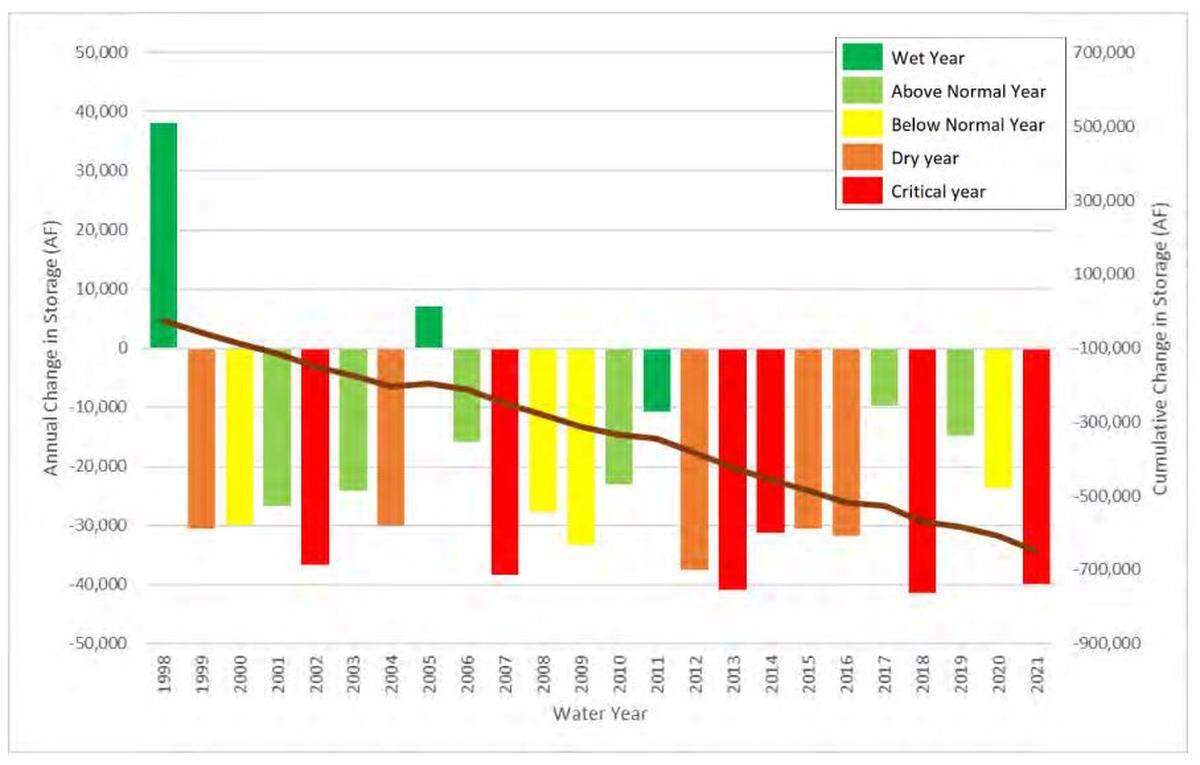
Unfettered groundwater pumping over the decades has led to dramatic declines in the groundwater supply. The basin has seen a net loss of nearly 700,000 acre-feet of water since 1998, according to the latest annual report examining the basin’s condition.
One area of the basin saw groundwater levels drop nearly 81 feet from fall 2020 to fall 2021, according to the report. Other areas saw water levels fall anywhere from about 7 to 50 feet in the same period, the report says.
In 2021, about 59,300 acre-feet of water was pumped from the basin — nearly three times the estimated sustainable yield for the basin of about 20,000 acre feet. Such pumping resulted in a 40,000 acre-foot decrease in water stored in the basin, according to the annual report.
One acre-foot of water equals 325,851 gallons, or roughly the size of a football field under one foot of water.
“During this drought period, we looked around at this and said we really shouldn’t be pumping water right now because the land is so dry; the area is so stressed as far as water goes,” said Pamela Doiron, owner of The Spanish Ranch, a Cuyama Valley cattle ranch.
Some longtime farmers now see their water increasingly contaminated with minerals and chemicals such as arsenic and nitrate as they must reach deeper into the depths of the basin to find water.
Even so, thirsty new growers have continued to dip their straws into the dwindling underground supply.
In efforts to bring the basin into sustainability and comply with the 2014 California Sustainable Groundwater Management Act (SGMA), a new groundwater management plan was drafted that proposes pumping cutbacks and other measures. That plan is expected to be sent to the California Department of Water Resources in July for consideration.
The plan took three years to create with dozens of meetings held to bring the small community together and find compromises where the precious resource could be saved.
Seemingly, everyone had a say in the plan — from the families who only use water for their homes to the giants of Bolthouse and Grimmway.
But it’s those two companies who are now dissatisfied with the groundwater sustainability plan and, in August, filed an adjudication complaint in Kern County Superior Court. The case was recently moved to the Los Angeles County Superior Court.
The groundwater sustainability plan for the Cuyama basin was required under SGMA — but SGMA does not govern water rights.
An adjudication complaint can be taken to a court to determine water rights in an area. Typically, the court allocates water rights to users based on how much they used in the past, and it must determine whether such use is “reasonable and beneficial,” according to state law.
So even though the Cuyama basin’s groundwater sustainability plan calls for pumping reductions, there’s a chance the court could determine water rights that conflict with those.
“Farming depends upon the health and sustainability of the groundwater basin supply,” representatives for Grimmway and Bolthouse wrote in response to Tribune questions. “Because the groundwater basin is in overdraft, meaning more water is being pumped from the basin than is recharging the basin based primarily upon precipitation, an adjudication is legally required to determine water right allocations to correct overdraft and maintain sustainability of the groundwater basin supply.”
Longtime farmers upset with corporate growers
The adjudication complaint has sparked dismay and disgust in the Cuyama Valley.
Farmers and other community members told The Tribune they are frustrated, stressed and generally confused by the adjudication — especially when they already have a groundwater sustainability plan for correcting the basin’s overdraft.
“Nobody wants to be told what to do,” said James Wegis, a longtime farmer in the Cuyama Valley who gave The Tribune a tour of his pistachio and olive orchards. “So nobody was really that happy with the GSP (groundwater sustainability plan). But we’ll do it — we understand we need to do it. But now we’ve got this adjudication, and now the court is going to tell us what to do.”
Farmers like Wegis have recently had to pay pumping fees for how much water they extract from the basin — some up in the tens of thousands of dollars. Those fees go toward implementing the groundwater sustainability plan’s programs.
One such program requires pumping reductions.
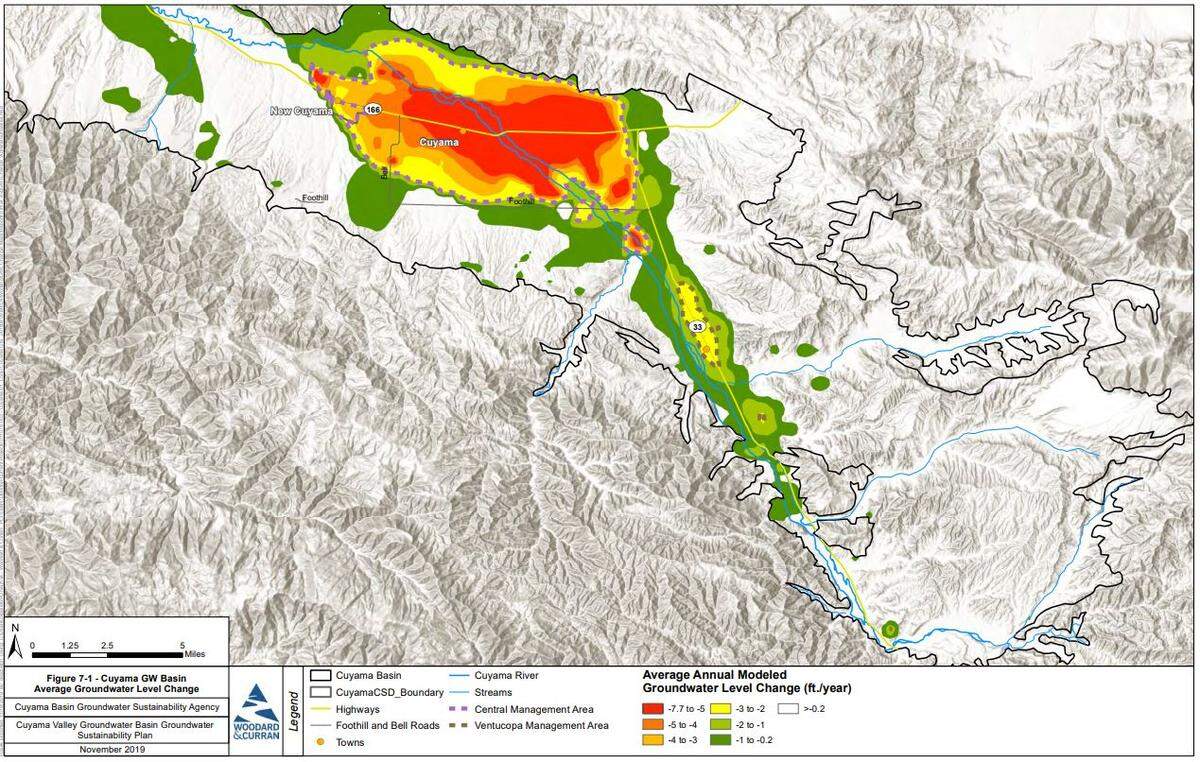
Over the next 15 years, farmers in the central area of the basin will have to cut their water use by a collective 67%.
According to the groundwater sustainability plan, the mandated pumping reductions are focused on the central area of the basin because that’s where the steepest declines in groundwater have occurred. Annually, the water levels there are estimated to have dropped anywhere from 5 to 7.7 feet, the plan says.
It also happens to be where Bolthouse and Grimmway’s operations are located.
In response to a Tribune inquiry, Bolthouse and Grimmway’s representatives indicated they wish to have pumping reductions required across the entirety of the Cuyama basin — not just the central management area.
“Yes, pumping from the basin clearly exceeds natural recharge of the basin,” the companies’ representatives wrote to The Tribune. “To protect the basin supply, analysis of the entire hydrologically connected basin is necessary because pumping in all areas of the basin affects the amount of water which can sustainably be pumped from the basin.”
The companies’ protest to the groundwater sustainability plan through adjudication leaves local farmers irritated: Bolthouse and Grimmway were both deeply involved in the drafting of the plan the entire time through leadership roles that helped guide the plan’s ultimate direction.
Now, local farmers, residents and politicians alike say the companies are effectively trying to rewrite the agreed-upon rules.
“Not only do both Bolthouse and Grimmway have seats on the GSA (groundwater sustainability agency), and the person representing Bolthouse has been chair of the GSA, he is also a chair of the Cuyama Basin Water District,” said Jaffe, whose dry farm is located on the western end of the basin. “So it seems they’re wearing three hats in this game. It seems like a conflict of interest.”
Das Williams, a supervisor for Santa Barbara County who sits on the Cuyama basin groundwater sustainability agency board of directors, told The Tribune he thinks the adjudication is unfortunate and an apparent play to potentially delay the water-pumping restrictions.
“If the two big pumpers had any legitimate reason to ask for adjudication, then that would have been used early on in the process,” he said. “Instead, they put us all through a rigmarole.”
“We worked with them for years. They tended to have the majority of votes on every major decision point,” Williams continued. “Yet, even though they voted for it (the groundwater sustainability plan), even though they won just about every battle, they are apparently unsatisfied with the result and want to ask for adjudication.”
Lynn Compton, a supervisor for San Luis Obispo County who is vice chairperson for the groundwater sustainability agency board of directors, did not respond to a Tribune request for comment about the adjudication complaint.
What happens in an adjudication?
Adjudications are lengthy, expensive legal processes convoluted to anyone except the experienced water-rights attorneys who have handled the few recent cases in California’s history. Some have taken more than 20 years to resolve.
Although an act was passed in 2015 to streamline the process, it will likely take at least two to four years to settle the Cuyama basin adjudication, according to an attorney familiar with the situation.
Wegis, who farms in the Cuyama Valley’s Ventucopa region, said he’s banded together with five other farmers in that area to obtain legal counsel.
Other farmers still aren’t sure what they’re going to do.
“It’s been confusing,” said Meg Brown, who, alongside her husband Jean Gaillard, owns land and farms on a tiny portion of her property to provide food for local businesses and residents in the Cuyama Valley. “As small pumpers, we feel like we’ve been ganged up upon by the big pumpers who can afford the big lawyers.”
But local farmers in the Cuyama Valley said that the lengthy court battle isn’t necessarily the thing they’re most worried about.
It’s their groundwater — and what could happen if the pumping reductions outlined in the groundwater sustainability plan aren’t implemented beginning in 2023.
Already, low-income residents on the Cuyama basin spend more than 7% of their income on bottled water because the water that comes out of their tap is polluted with minerals, according to a 2020 study by a University of California at Santa Barbara researcher.
In their own efforts to avoid making the groundwater basin’s steep declines in storage worse, local farmers have replaced water-intensive crops that used to dominate the valley, such as alfalfa, with less thirsty crops, such as olive orchards.
Cattle ranchers buy hay during drought years instead of pumping groundwater to grow their own hay, in an effort to conserve the basin’s water supply.
Some locals surmise that the two agriculture giants have the economic means to “pump and dump,” or pump groundwater from the Cuyama basin until it runs out, then move their operations elsewhere, therefore stranding the smaller farmers who either inherited their farms or bought the land because it was cheap and remote.
The pumping restrictions in the groundwater sustainability plan will likely have huge economic impacts to the valley.
One analysis by ERA Economics, a company that provides data-based insights and guidance to the agriculture industry, found that a total of $207.7 million annually and 1,337 jobs could be lost from the Cuyama Valley and greater region of Kern, San Luis Obispo, Santa Barbara and Ventura counties during the plan’s implementation.
“You might say that economic impact is inevitable: You either have to reduce pumping now to get the basin into something sustainable,” said John Caufield of Bar 3J Ranch on the western end of the basin, “or you continue pumping (at the same rate), and that will also deliver an economic impact when you run out of water.”
For their part, the representatives for Bolthouse and Grimmway wrote in their response to Tribune questions that they were “continually seeking to reduce the amount of water necessary to grow crops” by using “state of the art” practices and “increasingly more efficient irrigation methods.”
“Some growers in the basin have been unwilling to reduce water use or even provide pumping data to the GSA, and some have substantially increased water use,” the representatives wrote. “We have chosen to lead by example and have agreed to reduce historic water use by 5% per year, for the next two years, pending further data and scientific evaluation. Once water rights are clearly defined, all water users will be incentivized to use water efficiently and eliminate waste.”
All water users on the Cuyama basin who want to defend their water rights are encouraged to file an answer to the adjudication complaint through the Los Angeles County Superior Court before the next hearing on July 22. The form to do so can be found on the Cuyama basin groundwater sustainability agency’s website at www.cuyamabasin.org/#adjudication.
This story was originally published June 30, 2022 at 5:00 AM.
CORRECTION: This article was updated to correctly identify how many acres of vineyards Harvard University-owned corporation Brodiaea Inc. has planted in the Cuyama Valley, which is 840 acres of the 7,500 acres it owns.