California drafts ‘aggressive’ offshore wind energy targets. How does Morro Bay fit in?
The California Energy Commission released a draft report that outlines what some call “aggressive” goals for offshore wind energy development in the Pacific Ocean — and Morro Bay will likely play a key role in helping the state achieve its targets.
The draft report, posted to the CEC’s online offshore renewable energy docket log on Monday, was required under Assembly Bill 525.
That bill requires the state agency to establish the maximum feasible capacity for floating wind turbines off the coast of California in federal waters by June 1.
But the CEC’s staff report fails to do that; it notes that there is still work underway to identify more areas of the ocean that would be suitable for offshore wind energy development. Therefore, the maximum feasible capacity was impossible to calculate, staff wrote.
Even so, the CEC’s draft report lays out three goals.
The state wants to install 3 gigawatts of offshore wind energy capacity in the Pacific Ocean by 2030.
It also wants between 10 and 15 gigawatts of capacity by 2045, and potentially up to 20 gigawatts between 2045 and 2050.
The CEC staff report says that other studies have found that 21.5 gigawatts of offshore wind energy is the “technically feasible capacity” limit. The the state is still working to establish its own maximum feasible capacity and will include it in a later report, according to agency spokesman Mike Ward.
The three goals differ slightly from the original goals outlined in the very first version of AB 525, which were 3 gigawatts by 2030 and at least 10 gigawatts by 2040. However, that bill underwent revisions that eventually gave the CEC discretion for how much offshore wind energy it would plan.
California Energy Commission offshore wind goals praised
California State Assemblymember Jordan Cunningham (R-San Luis Obispo), who was one of the politicians to write AB 525, praised the goals in a statement sent to The Tribune on Monday.
“The CEC’s aggressive offshore wind targets are right in line with what we were aiming for in AB 525,” he said. “Once finalized, these targets will give industry a strong signal that California is serious about offshore wind power. With offshore wind on its way, the Central Coast and San Luis Obispo County are well on their way to becoming the clean energy capital of the United States.”
Offshore Wind California, a trade group of offshore wind developers and technology companies, released a statement on Sunday in support of the CEC’s targets and acknowledged the goals are ambitious.
“They show that California is serious about ‘going big’ on floating offshore wind to drive economies of scale and realize the substantial jobs, climate and clean power benefits from responsibly developing this remarkable renewable energy resource,” the group wrote in its statement. “The ultimate goal is to develop a thriving, world-leading floating wind industry and make offshore wind a key part of California’s diverse clean power portfolio, while also protecting marine and coastal resources.”
Alla Weinstein, CEO of Castle Wind, a joint venture between renewable energy companies Trident Winds and TotalEnergies commended the work done by the CEC to draft the goals. Castle Wind wishes to develop in the Morro Bay wind energy area.
“The draft offshore wind goals and report recently published by the agency represent bold and realistic planning targets for California,” she said in a written statement to The Tribune. “Most, if not all, of the 3 gigawatts by 2030 planning goal could be satisfied with offshore wind generation from the Morro Bay Wind Energy Area, slated for auction later this year.”
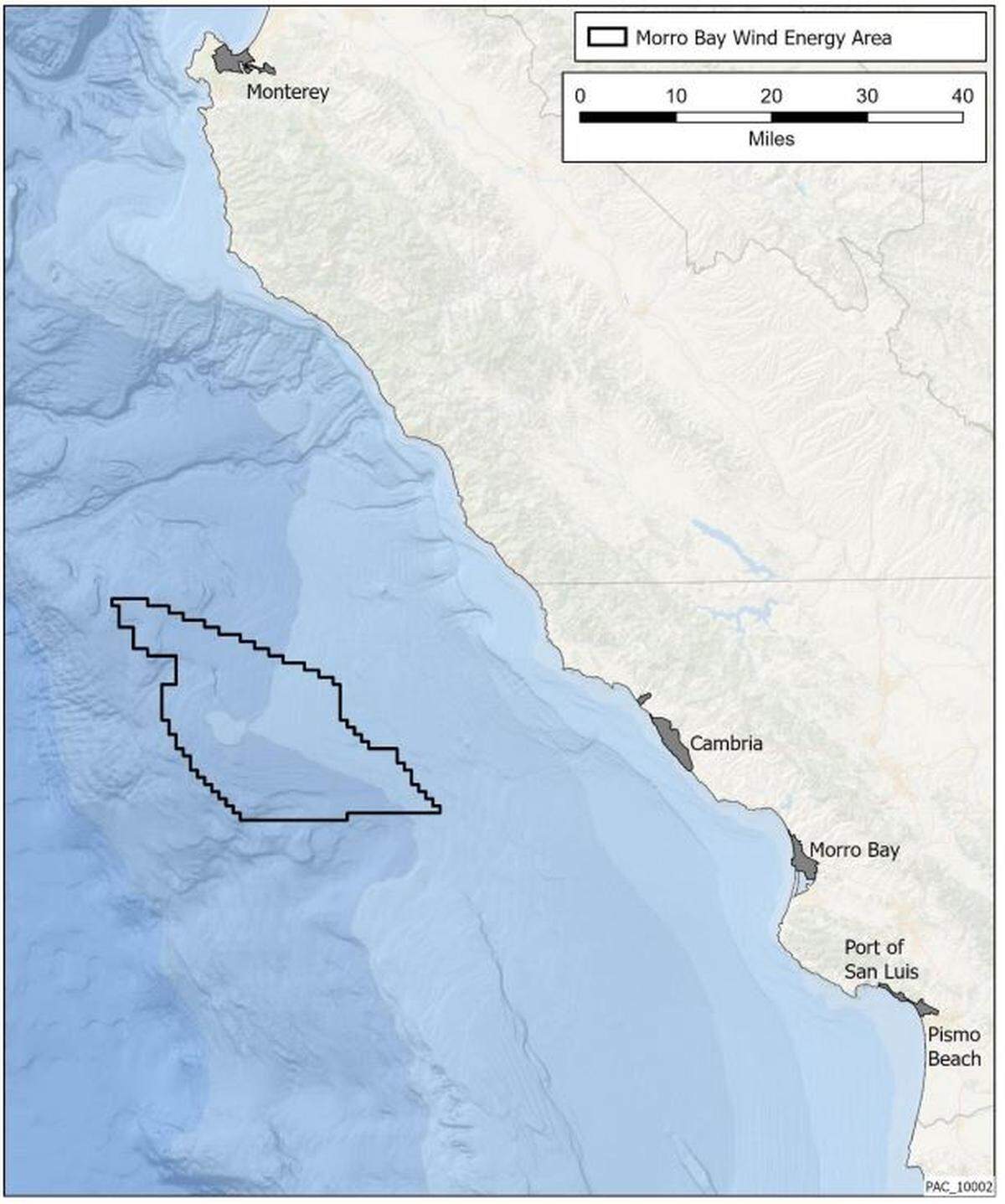
The CEC’s draft report points out that the 2.9-gigawatt-compatible Morro Bay Wind Energy Area off the coast of San Luis Obispo County is key to achieving the goals — particularly the first goal.
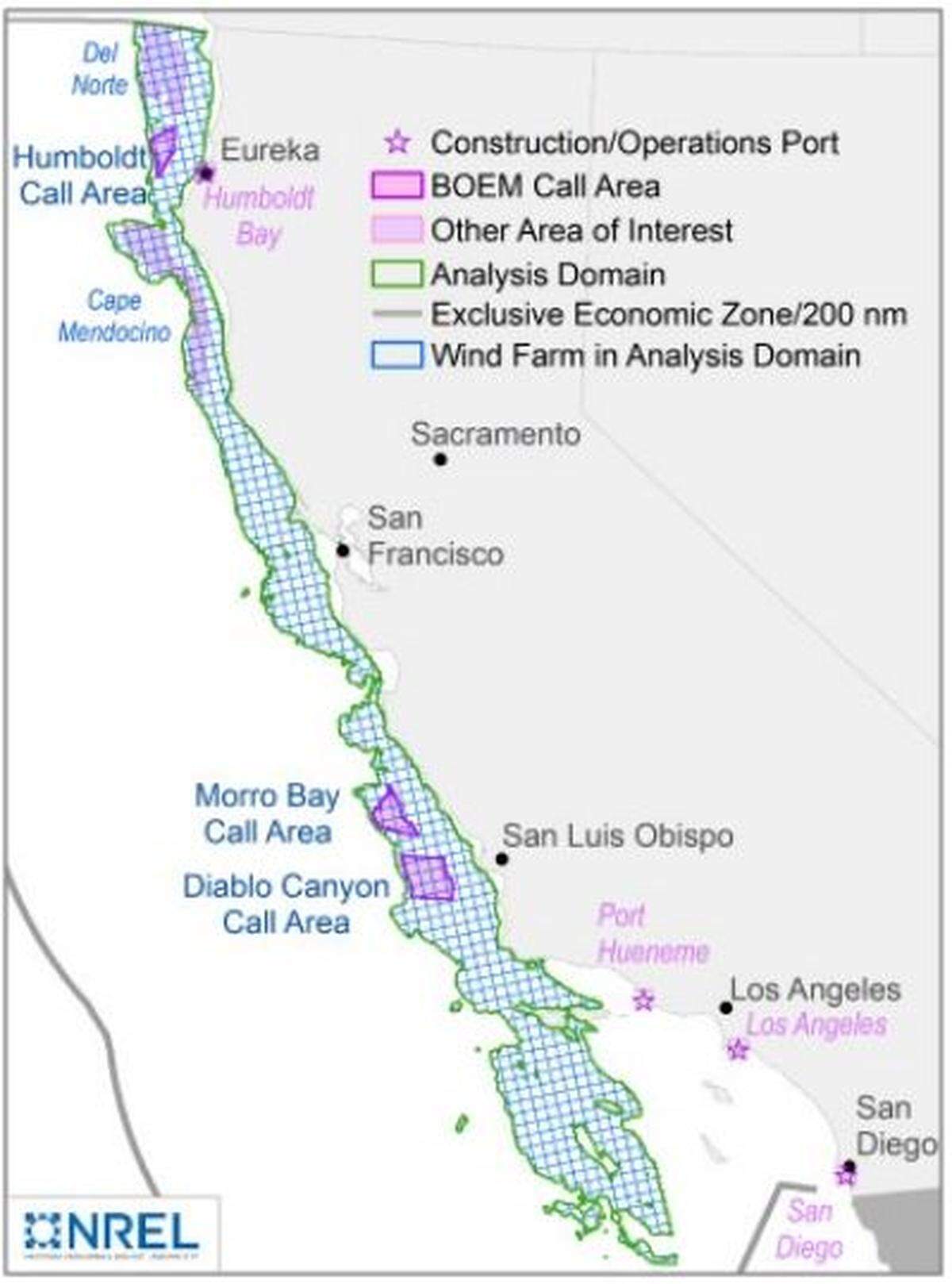
Another established wind energy area off the coast of Humboldt County, set to be developed with up to 1.5 gigawatts worth of floating wind turbines, is also key, the staff report says.
Those two wind energy areas are the only two that have been established off California’s coast, and a lease sale auction for both areas is expected to happen this fall.
Another area off the San Luis Obispo County coast near Diablo Canyon Power Plant was at one time established but has since been taken off the table due to conflicts with the U.S. Navy, according to the federal Bureau of Ocean Energy Management.
Additionally, two large areas off the coast of Del Norte and Mendocino counties have been assessed as being potentially suitable for offshore wind energy development, but no official wind energy area has been established for those areas to date.
Wind industry expert: Energy Commission’s plan ‘ambitious’
Achieving the CEC’s goals will not be easy, said Jonah Margulis, Aker Offshore Wind’s senior vice president of U.S. operations.
Aker Offshore Wind is an international developer that has been most active in the process underway in the Humboldt area, but has also expressed interest in building in the Morro Bay area, Margulis said.
“It’s ambitious, no doubt, and it’s similar to how the 30 gigawatt-by-2030 goal by the Biden administration is ambitious,” he said. “But it’s really right in line with what we as an industry have been advocating for ... it’s a good signal and a positive signal to the market.”
Margulis said that for the state to realistically meet the goals, it needs to consider four factors: port infrastructure, transmission infrastructure, supply chain management and efficient permitting processes.
Port infrastructure is key, he said, because that’s how offshore wind turbines are going to be maintained and built.
REACH, a Central Coast economic impact research group, found that if San Luis Obispo County builds a so-called “wind energy port” to support the Morro Bay wind energy area, it could generate at least 650 good-paying jobs and $262 million in annual economic impact to the region.
The CEC recently approved a $10.5 million grant to renovate the Port of Humboldt Bay to prepare it for offshore wind energy development.
Similarly, both of the areas’ transmission infrastructure needs to be equipped to handle the electricity coming from the floating wind turbines to ensure the goals can be met, Margulis said.
This will likely be easier to accomplish in Morro Bay, where substations at the Diablo Canyon Power Plant and the now-shuttered Morro Bay Power Plant can connect the offshore wind energy to the grid. But improvements are needed and being analyzed in the Humboldt area.
Then there’s the question of the supply chain, Margulis said.
“What’s really encouraging for me as a developer — to see the goals now on paper — is that the supply chain can rally around that,” he said.
Margulis suspects that manufacturers will now see the CEC’s goals as substantial enough to “put down a footprint” and perhaps build factories on the West Coast to support offshore wind energy development.
Margulis said that he hopes the state and federal governments can work together to streamline the extensive permitting processes developers will have to undergo before turbines can be built in the Pacific Ocean. Any delays in those could topple the timeline and prevent the CEC’s goals from being met, he said.
State agency has more steps to take in AB 525 process
The CEC will hold a workshop on May 18 to go over the staff’s draft report. No vote on the draft report will be taken but the agency will take public comments at the meeting, which will be held in person and virtually.
The draft report will come before the CEC during its meeting on May 24, during which the commissioners may vote on it, according to Ward.
Next, the CEC must submit to the California Natural Resources Agency and other entities a “preliminary assessment of the economic benefits of offshore wind” by Dec. 31.
Finally, the bill requires the CEC to create a plan for its targeted offshore wind procurement including where the wind turbines would be built, port infrastructure needs, necessary electricity transmission and grid upgrades, and potential impacts to coastal resources, fisheries, Native American and indigenous people and the military.
That plan, which will now also include the CEC’s analysis of the maximum feasible capacity of offshore wind, must be submitted to the California Natural Resources Agency and the California State Legislature by June 30, 2023.
California State Sen. John Laird (D-San Jose) wrote in an email to The Tribune that he’s pleased with the CEC’s draft report outlining its initial goals for offshore wind energy procurement and is excited for what is to come.
“If we’re serious about managing climate change and avoiding the catastrophic consequences of it (including drought, wildfires and sea level rise) we have to do this, and there’s no time to waste,” Laird wrote.
This story was originally published May 9, 2022 at 5:02 PM.