Jordan Cunningham bill on offshore wind energy heads to Gov. Gavin Newsom’s desk
A bill that would require California to develop offshore wind energy is headed to Gov. Gavin Newsom’s desk after it passed the state Assembly 74-1 and Senate 38-0 on Sept. 9 with some members abstaining.
The bill, AB 525, was introduced by Assembly members Jordan Cunningham, R-San Luis Obispo; David Chiu, D-San Francisco, Laura Friedman, D-Glendale and co-authored by a bipartisan group of 13 other Assembly members and eight senators.
The bill, if signed by Newsom, would require the California Energy Commission on or before June 1, 2022, to “evaluate and quantify the maximum feasible capacity of offshore wind to achieve reliability, ratepayer, employment and decarbonization benefits and to establish offshore wind planning goals for 2030 and 2045.”
The Energy Commission must partner with the Coastal Commission, Ocean Protection Council, the Governor’s Office of Business and Economic Development and other federal, state and local agencies to develop that plan, according to the bill.
“The Central Coast has the opportunity to be America’s clean energy capital,” Cunningham said in a news release about the bill. “Offshore wind is the future of energy production in California. It is clean, it is efficient, and — unlike other types of emission-free energy production — it produces power during periods of peak demand. And the Central Coast is uniquely situated to be the hub of this new industry, which will create jobs and increase local tax revenue.”
The bill went through several amendments and now requires the Energy Commission to establish goals of how much offshore wind energy must be developed.
Originally, the bill required the Energy Commission’s plan to specify how the state was going to achieve a goal of at least 10 gigawatts of offshore wind energy installed off the coast by 2040. An interim target of 3 gigawatts would need to be reached by 2030, according to the first version of the bill.
What those procurement targets would be is now up to the Energy Commission, according to today’s version of the bill.
If approved, the bill as it stands now would provide a plan to help get the state to its goal of 100% carbon-free electricity by 2045 by supplying some portion of the more than 140 gigawatts of new renewable energy through offshore wind energy.
Currently, the state has no viable plan to reach even its 60% renewable energy mandate by 2030 after PG&E’s Diablo Canyon nuclear power plant goes offline in 2025.
Offshore wind energy development likely coming to Central Coast
The bill’s passage through the Legislature comes as the federal government moves forward with plans to develop a massive 399-square-mile floating offshore wind energy farm off the Central Coast northwest of Morro Bay and another smaller area off the coast of Humboldt County in Northern California.
The Morro Bay wind energy farm could potentially produce 3 gigawatts of electricity at max production. On unusually calm days, however, zero electricity could be produced.
Most recently, the U.S. Department of the Interior’s Bureau of Ocean Management (BOEM) published on July 29 a call for information on and nominations for two new areas within the proposed 399-square-mile Morro Bay floating offshore wind farm call area.
The Morro Bay call area previously encompassed 311 square miles when the first call for information and nominations was sent out in 2018.
The east and west extensions — as BOEM is formally labeling the new call areas — encompass about 141 square miles. Part of the former Morro Bay call area is no longer being considered for offshore wind farm development.
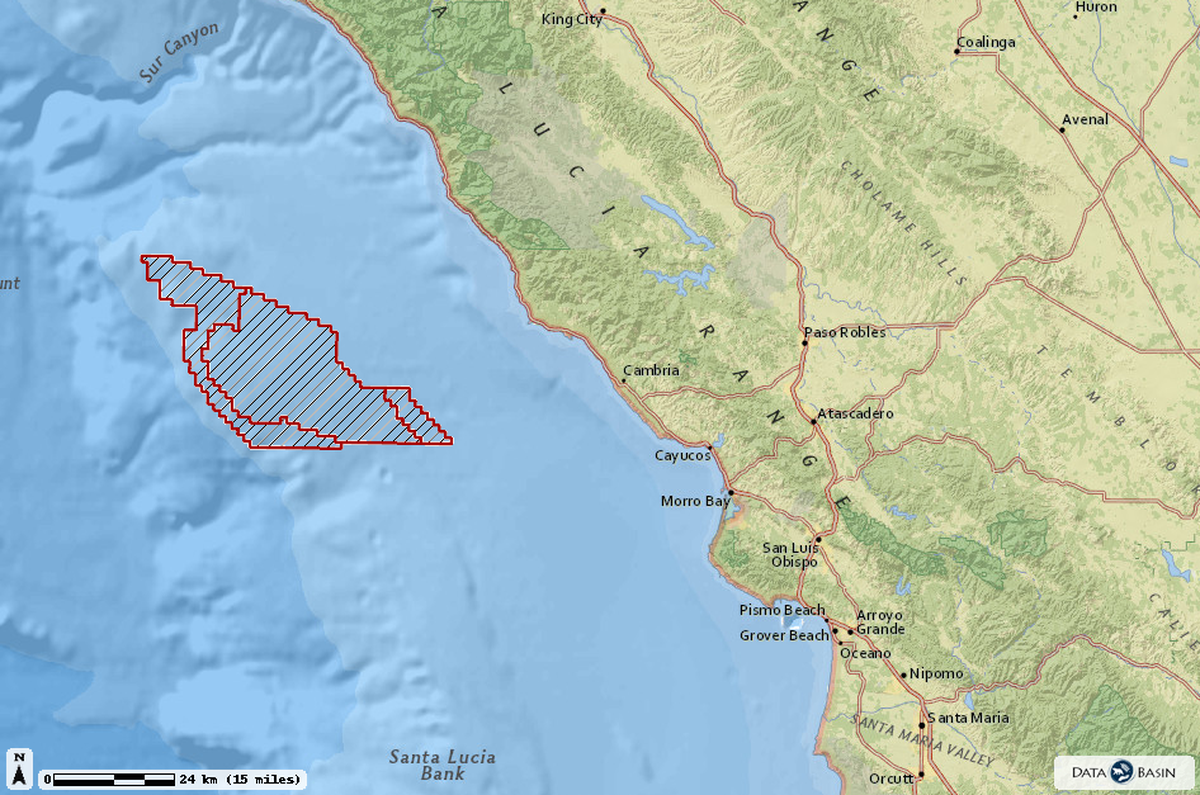
The total 399-square-mile area is located about 17 to 40 miles offshore of Cambria and San Simeon, several miles northwest of Morro Bay.
Members of the public may comment on the new Morro Bay call area extensions, and wind turbine companies wishing to develop within the new areas may submit their nominations to BOEM while the call for information and nominations is open.
Eventually, after that process is complete, BOEM will conduct the required environmental review to examine how floating wind turbines in the 399-square-mile area could have environmental impacts on marine ecosystems, birds, ocean currents and more.
The next step in the process would be a lease sale auction, which is predicted to happen as soon as mid-2022.
It may take a few years after a lease is granted for floating wind turbines to actually be constructed in the Morro Bay call area as a company then has to go through an extensive planning and review process.
Offshore will could bring big benefits to SLO County
The move to develop the massive floating wind energy farm off the Central Coast coincides with a recent proposal to build the nation’s largest battery storage plant in Morro Bay, and it could add thousands of jobs in San Luis Obispo County.
“San Luis Obispo County should see major economic expansion as a result of the growing offshore wind industry,” Cunningham said in a prepared statement in February, when AB 525 was first introduced. “Clean power, high-paying trades jobs and local economic expansion: Offshore wind is a winner for the Central Coast.”
A recent study by REACH, a regional economic impact group, found that if San Luis Obispo County builds a “wind energy port” — essentially a port that would have the infrastructure and size to service the Morro Bay wind energy farm — it could generate at least 650 good-paying jobs and $262 million in annual economic impact to the Central Coast.
And the wind energy farm may help keep the lights on when the sun is down.
Additionally, a 2020 study by Cal Poly and U.S. Bureau of Ocean Energy Management (BOEM) researchers found that offshore wind energy production is at its peak in the evening hours — when other production from renewable energy production sources such as solar power is down.
Not all are happy about the potential for the 399-square-mile wind energy farm, however.
Fishermen are concerned their fishing grounds will be shrunk by the development.
Local fishermen have told The Tribune that they’re “basically screwed” should the massive wind energy farm be built because it may cut out 399 square miles of viable, healthy fishing grounds.
Representatives from the multi-million-dollar Morro Bay fishing industry said they have adamantly opposed the offshore wind farm development.
And locals in Cambria and San Simeon say they worry their flawless coastal views will be impacted.
The wind turbines, once built, would give off a red glow at night from their safety lights and look like blips on the horizon during the daytime, according to a BOEM analysis. However, those 2019 visual simulations use a 1-gigawatt project, one third the size of the proposed 3-gigawatt project.
Opportunities for public comment and Tribune event to learn more about offshore wind
The call for information means that this is the public’s opportunity to weigh in on the extensions to the Morro Bay call area and provide feedback to BOEM.
That call ends on Monday, Sept. 13.
If you would like to submit your public comment, you can do so by searching for Docket No. BOEM-2021-0044 in the Federal Register. Or you can go to bit.ly/BOEMcall.
The Tribune will host a virtual informational panel event on Nov. 19 to discuss the potential offshore wind energy development coming to the Central Coast.
Panelists will be U.S. Congressman Salud Carbajal, BOEM Pacific Regional Supervisor Doug Boren, California Energy Commissioner Karen Douglas, REACH CEO Melissa James and Cal Poly Associate Professor and Director of the Center for Coastal Marine Sciences Ben Ruttenberg.
More information about the panel event will be released as it gets closer.
This story was originally published September 10, 2021 at 4:00 PM.
CORRECTION: This article was updated to correctly spell Doug Boren’s name.