
5 California condors have died from lead poisoning this year. Why are they so vulnerable?
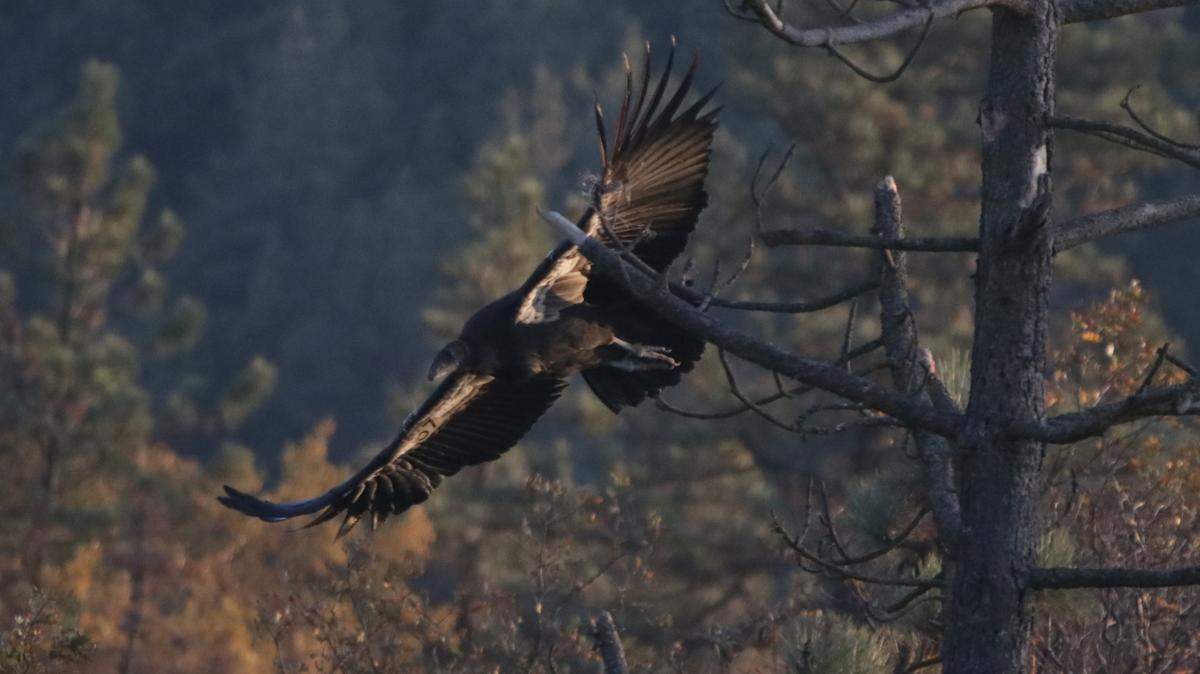
Wildfires and lead poisoning are the foremost threats to the California condor population – and those dynamics continue to thwart progress in reestablishing the critically endangered species.
As tracked by the California Condor Recovery Program in Central California, which spans Big Sur, Pinnacles and San Simeon, six condor pairs are currently nurturing chicks. However, the lives of nine giant birds with 9 1/2-foot wingspans have been lost.
According to the Ventana Wildlife Society (VWS), five of the birds that have perished in 2021 were victims of the No. 1 cause of condor deaths – lead poisoning. The cause of death for the other four is pending necropsy results.
In 2019, lead poisoning killed seven of the nine condors that died that year.
In 2020, nine of the 24 birds that perished that year suffered from lead poisoning. And nine condors were killed in the Dolan Fire, which burned 124,924 acres acres near Big Sur.
“Really, lead poisoning is the major thing we are working to overcome in order to restore the condor population,” Darren Gross of VWS explained during a June condor Zoom chat.
VWS will release up to 10 juvenile condors from the rugged mountains above San Simeon later this year. The young birds were raised in captivity.
Out of the 13 condor eggs laid in 2020, eight hatched but only five of the chicks fledged, the VWS reported.
A total of 10 condor nests were discovered this spring in Central California, offering the possibility that 10 chicks could fledge. But only six nests have produced chicks.
Eggs that were laid in three of those 10 nests did not hatch.
One egg that successfully hatched in 2021 was produced by parents Ferdinand (No. 652) and a Pinnacles condor, No. 550, in a redwood tree cavity in Big Sur.
That chick, No. 1095, was hatched on April 17, and is expected to fledge “around six months of age,” lead VWS biologist Joe Burnett said.
The chick’s gender is not known at this time, but at six months it will begin to grow flight feathers — primaries and secondaries — and it become “more active, walking and wing-stretching,” Burnett said.
The redwood tree cavity sheltering condor No. 1095 is estimated to be four to five feet in diameter, giving it “ample space to stretch out,” Burnett wrote in an email. Condors don’t build nests; they find caves or hollowed out portions of trees.
The Big Sur redwood tree nest is about 75 feet off the ground, and is approximately 150 feet tall, Burnett wrote.
When the bird is 1 year old, it will be trapped “and a blood sample will be taken” to determine its gender, he wrote.
Why are California condors vulnerable to lead poisoning?
California condors (Gymnogype californianus) are not raptors, meaning that they do not kill for food. Instead, they feed on animal carcasses, or, carrion.
When that carcass has been shot with lead bullets, the condor eating it may suffer from lead poisoning.
“When a lead rifle bullet traveling at almost three times the speed of sound strikes an animal tissue, it quickly begins to expand and loses hundreds of tiny pieces as it continues its journey,” VWS explains.
The organs and other areas of the animal are thus contaminated with lead fragments. Since condors’ meals come from dead animals, they are more frequently exposed to lead hazards than most wildlife.
Assembly Bill 71, which became law in July 2019, requires the use of non-lead ammunition when killing wildlife with a firearm anywhere in California.
The Ventana Wildlife Society has been providing copper ammunition to hunters and ranchers since 2012. To date, the nonprofit organization has provided 10,772 boxes of non-lead ammunition at no cost.
To be eligible to receive one 20-round box of non-lead ammo per calendar year, you must be 21 years old and a California resident living in one of the following counties: San Luis Obispo, Santa Barbara, Monterey, San Benito, Ventura and Kern. Fresno County residents are only eligible if they live west of Interstate 5.
Additionally, in order to receive the free non-lead ammunition, recipients must pass a standard or basic eligibility check issued by the California Department of Justice.
To apply for non-lead ammunition, email nonlead@ventanaws.org with your choice of caliber, a scanned photo or copy of your California driver’s license and additional personal information.
This story was originally published July 12, 2021 at 5:05 AM.