
Can California condors recover after Dolan Fire? Here’s how birds have ‘bounced back’
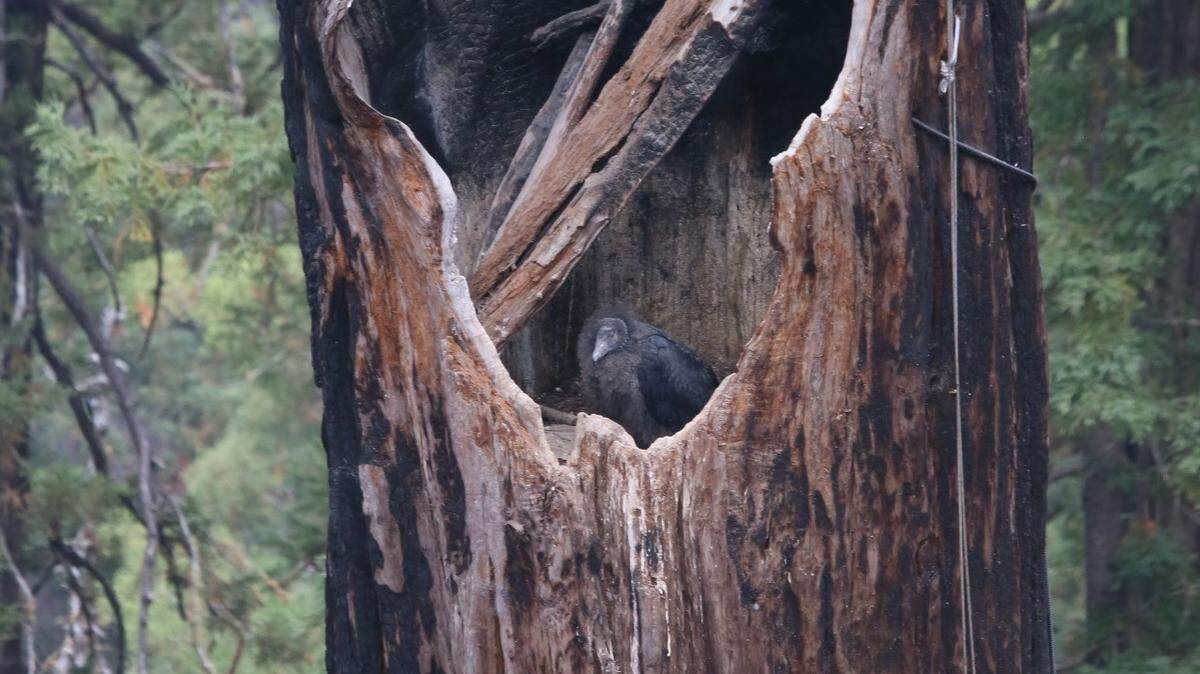
Giant endangered birds with 9 1/2-foot wingspans are pairing up — and producing eggs — during this critical nesting period for the California Condor Recovery Program.
According to Joe Burnett, Ventana Wildlife Society’s lead condor biologist, up to 10 California condor nests have been spotted in the wild in central California thus far this spring.
“We suspect one Big Sur pair (Condor No. 663 and Condor No. 438) has hatched an egg in the last week,” Burnett said, based on changes in GPS activity from the female bird. “However we haven’t actually seen the egg yet.”
The egg in the nest shared by Redwood Queen and Phoenix, which can be viewed on the Ventana Wildlife Society’s nest cam, is due to hatch on April 24. But that is only an estimate and the chick could hatch earlier or later by a couple days, Burnett explained in an email.
The 10 nests witnessed thus far in 2021 embolden hope for the recovery of the Ventana Wilderness condor population, but those 10 fall short of matching the 13 eggs produced in 2020.
Of those 13 eggs laid in 2020, eight hatched and five of the chicks fledged, Burnett said.
Iniko was among those five chicks, and her story is an authentic wildlife drama. (Her name means “born during troubled times.”)
The disastrous Dolan Fire raced through the Big Sur condor sanctuary in August and Iniko’s father, Kingpin, was lost in the fast-moving flames. But Iniko hunkered down and survived in her cavernous nest, according to VWS.
However, she became ensnared in some serious conflict as an unmated male condor “attacked the nest, possibly seeing an opportunity to claim a vacant territory,” the VWS website said.
During that wildlife scuffle, “Iniko was force-fledged from the nest,” the group said.
Her mother, Redwood Queen, battled with the intruder as Inko, extremely vulnerable huddled on the ground, showing a slight limp when she moved.
On October 19, 2020, the VWS field crew moved in, rescued Iniko and she was subsequently transported to Los Angeles Zoo for treatment and care, where she resides today.
She will be returned to the wild in 2021, along with Eva, a chick who was evacuated before the Dolan Fire torched her nest cave. (Her name is short for “evacuate.”)
Meanwhile, Burnett made clear that the 10 nests “is a higher number than we had anticipated, (but) after losing so many birds (nine) in the fire last year, we are overjoyed with how well they bounced back. Condors are so incredibly resilient.”
The condor population in Central California, particularly Big Sur and Pinnacles, is now recorded as 90 birds.
For information on the condor recovery program and on the Ventana Wildlife Society, or to make a donation, visit www.ventanaws.org.
View the nest cam at ventanaws.org/condor_cam.html.