Cal Poly researcher is studying rattlesnake nests — and she needs your help
When you’re hiking, the last sound you likely want to hear is the buzzing of a rattlesnake vigorously shaking its tail.
That is, unless you are Emily Taylor.
The Cal Poly reptile biologist researches rattlesnakes in their native habitat. In addition to her academic work, she catches and relocates backyard rattlers in San Luis Obispo County through her Nipomo-based company, Central Coast Snake Services.
Her latest research, Project RattleCam, puts crowd-sourced citizen scientists and snake enthusiasts around the world to work studying thousands of images of the mysterious creatures.
Taylor, a biology professor at the San Luis Obispo university, and her collaborator, Scott Boback, a biology professor at Dickinson College in Pennsylvania, aim to answer questions about rattlesnakes that have eluded scientists — until now.
“Snakes are really secretive,” Taylor said.
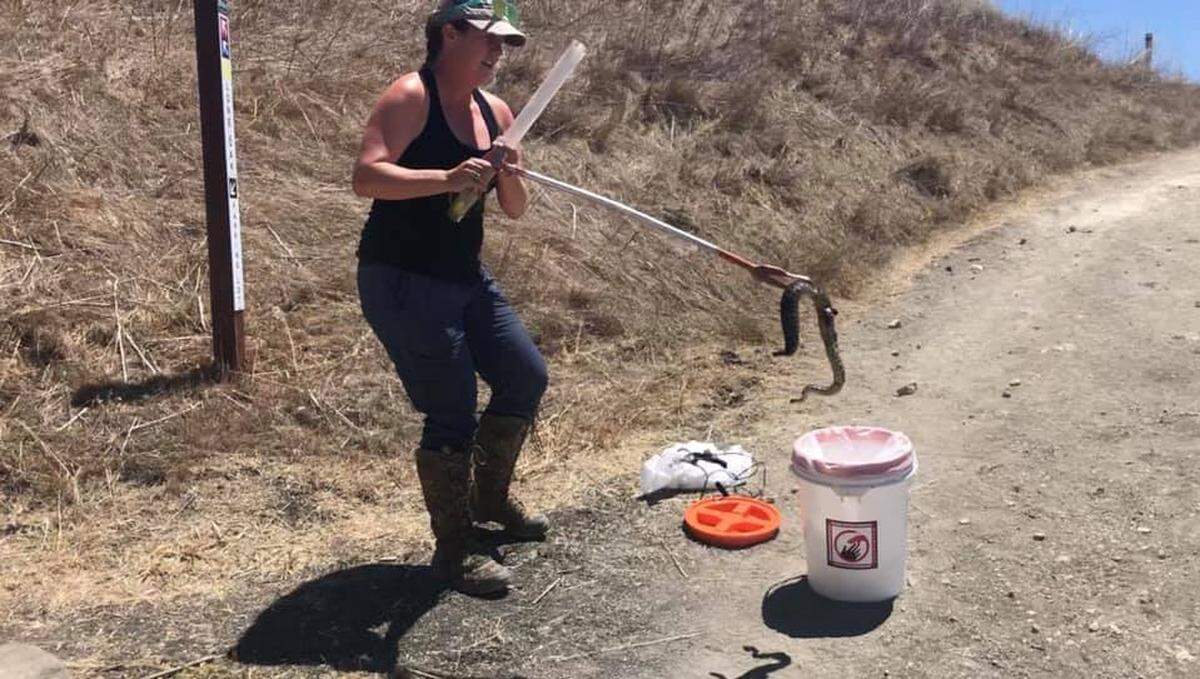
Studying rattlesnakes is a challenge
Getting close enough to snakes to study them can be difficult.
Rattlesnakes can launch themselves up to one third of their body length when they strike, according to the federal Centers for Disease Control and Prevention. Although a bite is rarely fatal, it can cause serious issues such as tissue damage and bleeding problems, notes a California Poison Control System info sheet on rattlesnakes. More than 300 bites are reported to the agency per year, according to the document.
“Clearly rattlesnakes are an extremely dangerous animal,” Taylor said.
They are also scared of humans, she said.
“The minute we get up there (to the snake’s nesting place), they start acting defensive and unnaturally,” Taylor said.
Researchers sometimes use cameras to observe snakes without influencing their behavior. “Having cameras on them allows us to be able to see what they are doing in a natural setting,” Taylor said.
By capturing time-lapse images of rattlesnakes, Taylor and Boback want to study their behavior more closely.
What is Project RattleCam?
Specifically, the scientists hope to answer questions about the social dynamics of rattlesnakes in groups and how mothers interact with their babies and other snakes.
“We know very little about rattlesnakes,” Taylor said.
Taylor and Boback decided to bring their research questions to the public via Project RattleCam.
The pair installed cameras on a hilltop located on a Colorado ranch.
The difficult-to-access peak is home to hundreds of female rattlesnakes and their babies — making it an ideal location to observe how mothers care for their young and how baby snakes navigate the harsh environment.
The cameras operate mostly during daylight hours and take close-up photos of three of the peak’s rattlesnake nesting places every five minutes. The researchers want help in counting snakes and predators in the images, along with making other observations.
Volunteers study images of snakes
Anyone can sign up to participate in Project RattleCam, and no experience is needed.
“It’s very very simple,” Taylor said.
Volunteers watch a tutorial and read a field guide on how to identify rattlesnakes and other animals in the images. They are then shown an image from a Project RattleCam camera and asked a series of questions about what they observe.
Each rattlesnake image is shown to at least five people.
Taylor and Boback will use the data collected to answer questions such as how many baby rattlesnakes survive into adulthood, what eats the snakes and how often they drink water.
Project RattleCam’s cameras have captured photos of rattlesnakes flattening their coiled bodies like pancakes to collect rainwater for drinking. With the images, the researchers have already discovered that babies instinctively do this not long after birth.
So far Project RattleCam has collected around 65,000 images, and more are coming, Taylor said.
Since the photos went live a couple months ago, 143 volunteers have sorted through more than 10,000 images.
The project will expand to include a camera capturing live video of a nesting site on California’s Central Coast later this year or next year, Taylor said. The exact location won’t be revealed so as to protect the snakes and equipment.
A big challenge, said Taylor, is to get people to appreciate rattlesnakes.
“People who learn about these animals are much less likely to have a negative interaction with them,” she said, adding that her mission is to “help rattlesnakes and people coexist easily.“
Those interested in joining Project RattleCam can sign up at the project’s Zooniverse page at www.zooniverse.org/projects/projectrattlecam/project-rattlecam.
This story was originally published July 1, 2021 at 11:30 AM.