Off-roading groups sue Coastal Commission, State Parks over Oceano Dunes ban
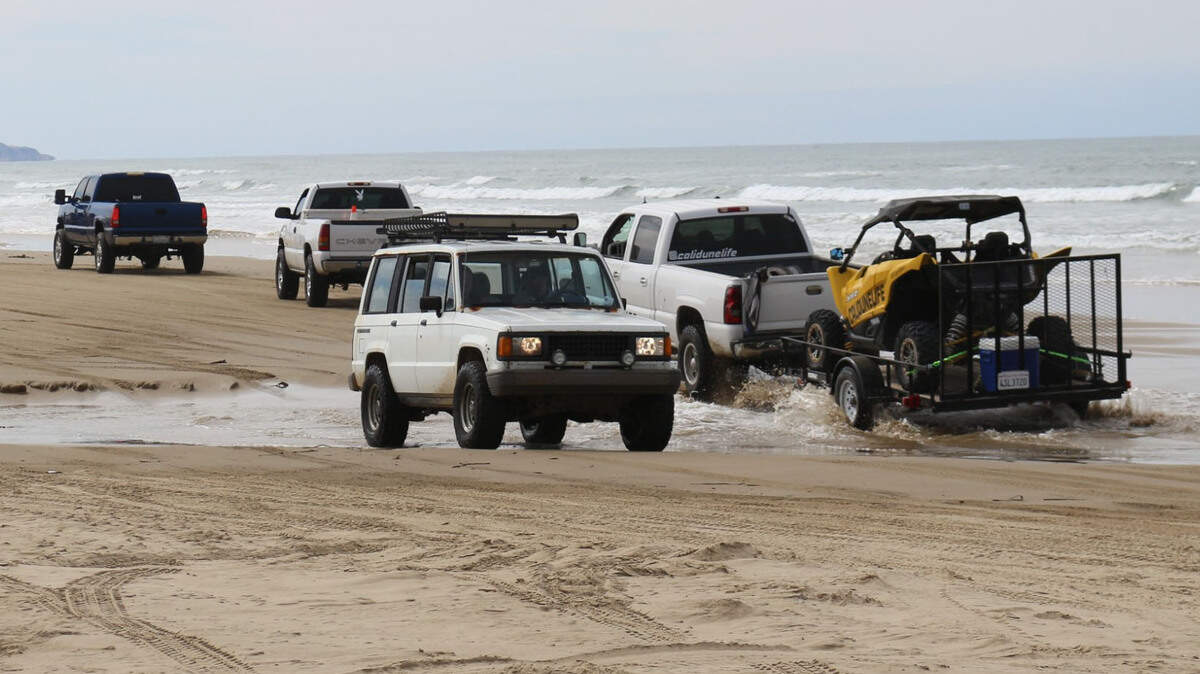
The California Coastal Commission violated state environmental law by ordering California State Parks to phase out off-highway vehicle use at at Oceano Dunes State Vehicular Recreation Area by 2024, according to a lawsuit filed against both agencies by an off-road riding group.
State Parks also violated the California Environmental Quality Act, the lawsuit alleges, because it was mandated to comply with the Coastal Commission’s ban of OHV use without proper environmental review.
The lawsuit, filed April 12 by an attorney for the nonprofit Friends of Oceano Dunes, may be the first in a string of lawsuits against the two entities following the Coastal Commission’s unanimous vote on March 18 to ban off-highway vehicle use and limit street-legal vehicle access and camping at the Oceano Dunes by 2024.
It was one of two filed this month by riding enthusiasts looking to stop the closure of the Dunes.
Jim Suty, Friends of Oceano Dunes president, said in a video posted to Facebook on April 1 that his group was working on four separate lawsuits.
The April 12 lawsuit alleges that the Coastal Commission violated CEQA’s “stable project description requirement” and failed to study the environmental impacts of its vote to ban OHVs at the Oceano Dunes.
The Coastal Commission and State Parks declined to comment on the case because it is ongoing litigation. Suty had not responded to a request for comment by Monday afternoon.
Friends of Oceano Dunes claims that the Coastal Commission did not comply with CEQA because it did not assess the environmental impacts to the “coastal recreational resources” at the Oceano Dunes nor allow adequate time for the public to comment on staff recommendations regarding vehicle use and camping at the popular park south of Pismo Beach.
However, the Coastal Commission is considered a “certified regulatory program,” and therefore is exempt from certain CEQA requirements, such as environmental impact reviews on certain projects, that are mandatory for other agencies.
Under CEQA, Coastal Commission plans or other documents for projects that may have significant adverse environmental effects must include a description of the proposed activity with alternatives, mitigation measures to “minimize any significant adverse effect on the environment,” and be available for a reasonable time for review and comment by other agencies and the public.
Did Coastal Commission fail to study environmental impacts of OHV ban?
In its lawsuit, Friends of Oceano Dunes says that the Coastal Commission “failed to analyze under CEQA the significant environmental impacts of eliminating 1,500 acres of OHV coastal recreation area, beach driving and camping that has served the community and the state for 40-plus years.”
“The Coastal Commission has to comply with environmental review if there are significant, adverse environmental impacts to an action that they are approving,” said Doug Carstens, an attorney at Chatten-Brown, Carstens & Minteer, an environmental law practice with offices in San Diego and Los Angeles.
The Coastal Commission staff report, however, did not find that eliminating OHV use at the Oceano Dunes would negatively impact the environment. Therefore, its revision to the Oceano Dunes permit did not require an environmental impact review, Carstens said.
Recreational access is protected under CEQA, but the law doesn’t prioritize one use over the other, Carstens said.
“There has to be access — which might include walking, biking, camping — but it doesn’t mean it has to be OHV use over other uses,” he said. “Prohibiting a particular type of recreation is not a negative recreational impact, it’s a reasonable limitation. So if the commission had prohibited human usage of the beach altogether, that might be problematic. But limiting one type of usage ... that is not a negative recreational impact that is cognizable by CEQA.”
Did Coastal Commission allow public review before ban?
The Friends of Oceano Dunes lawsuit alleges that the Coastal Commission “blind-sided” State Parks with its decision in March to ban OHV use in the park.
The Coastal Commission first approved the coastal development permit for Oceano Dunes State Vehicular Recreation Area in 1982. That permit was drawn up with temporary parameters that allowed State Parks to operate the OHV park.
Since 1982, the permit has been amended six times — most recently in March — and reviewed on an annual basis to ensure the use of the park was still compatible with protecting the environmentally sensitive habitat area in the park.
OHV use at the Oceano Dunes had been limited in the past with the possibility of a complete ban never off the table. But commissioners never took forceful action on the matter until its vote in March.
Even before March, staff put in writing the possibility of necessitating an OHV ban in the park.
At a July 2019 meeting, Coastal Commission staff presented a report to commissioners stating that the park and its Coastal Development Permit “cannot continue to operate as it has in the past, and that the range of coastal resource issues and constraints affecting ODSVRA together suggest that it is time to start thinking about ways to transition the park away from high-intensity OHV use to other less intensive forms of public access and recreation.”
That letter directed State Parks to consider phasing out OHV use at the park. However, commissioners voted at the July 2019 meeting to allow the Oceano Dunes to operate as is, so long as State Parks returned to the Coastal Commission with a Public Works Plan that incorporated five-year OHV phase-out at the park.
“At its July 11, 2019, (Coastal Commission) public hearing on Oceano Dunes SVRA, the (Coastal Commission) never mentioned closing the SVRA to OHV recreation,” Friends of Oceano Dunes’ lawsuit alleges.
As part of its Public Works Plan for Oceano Dunes State Vehicular Recreation Area and Pismo State Beach, which was released in December 2020, State Parks considered the Coastal Commission’s recommendation to phase out OHV use.
Friends of Oceano Dunes alleges this was “the first time that the public was informed of the (Coastal Commission’s) request to eliminate OHV” at the Oceano Dunes, according to the lawsuit.
But the agency ultimately denied such an option for the park, saying that it simply was not compatible with the purpose of the vehicular recreation area, and would hinder accessible recreation at the Oceano Dunes.
Therefore, Coastal Commission staff created another staff report for commissioners, this time suggesting that commissioners mandate OHV use be prohibited at the park by 2026 by amending the park’s coastal development permit. Commissioners voted to changed that name to 2026.
That staff report was released on Feb. 16 prior to a scheduled March 18 hearing, which gave members of the public and State Parks 23 days to comment on the matter.
The Coastal Commission received hundreds of written comments from community members, elected officials, tribal representatives, State Parks representatives and others in advance of the March 18 hearing. At the meeting, a total of 182 individuals signed up to speak.
Because the staff report and subsequent coastal development permit revisions do not fall under the same CEQA requirements as State Parks’ Public Works Plan and are completely separate documents, the Coastal Commission was not required to give any additional time for public input on its revision to the Oceano Dunes permit.
The Coastal Commission and State Parks had not filed responses to the lawsuit as of Monday afternoon. A case management conference has been set for 9 a.m. June 3 in San Luis Obispo County Superior Court.
Second lawsuit against Coastal Commission alleges CEQA, Coastal Act violations
A second lawsuit filed in the San Luis Obispo County Superior Court against the Coastal Commission and State Parks alleges similar CEQA violations as the first lawsuit, but also says commissioners violated the California Coastal Act by banning OHV uses in the Oceano Dunes SVRA.
The lawsuit was filed on April 19 by the nonprofit corporation EcoLogic Partners, a consortium comprised of the American Sand Association, the American Motorcyclists Association District 37 and the Off-Road Business Association.
EcoLogic is “dedicated to protecting and preserving public access to recreational venues, including designated OHV parks, throughout California and the western United States,” according to the lawsuit.
Aside from making similar CEQA violation allegations that the first lawsuit purports, EcoLogic’s says that “nothing in CDP 4-82-300 lawfully give the Commission the right or authority to eliminate OHV use at the ODSVRA or to order State Parks to do the same.”
“The Commission, which is an unelected body,” the lawsuit continues, “has no power under the Coastal Act to eliminate a State-created, legislatively-confirmed state vehicle recreation area such as the ODSVRA.”
A report by the Mills Legal Clinic at the Stanford Law School found that the Coastal Act mandates the elimination of OHV use at the park.
“Staff’s recommendation to phase out OHV use on the fragile dune system and protected coastal resources of (the Oceano Dunes) constitutes sound public policy and is entirely consistent with applicable state law, including the Coastal Act, the Off-Highway Motor Vehicle Recreation Act and the California Endangered Species Act,” the report said.
The Stanford report asserts that OHV use has continuously degraded the dune ecosystem and therefore violates the Coastal Act and Off-Highway Motor Vehicle Recreation Act — both of which put the protection of natural resources above economic and recreational benefit.
State public resources code “indicates that permanent closure may be necessary to restore damaged areas to their pre-OHV condition,” the Stanford report says.
This story was originally published April 20, 2021 at 9:08 AM.