Will the gray wolf survive if it stays in SLO County? Will it eat my dog? Here’s a Q&A
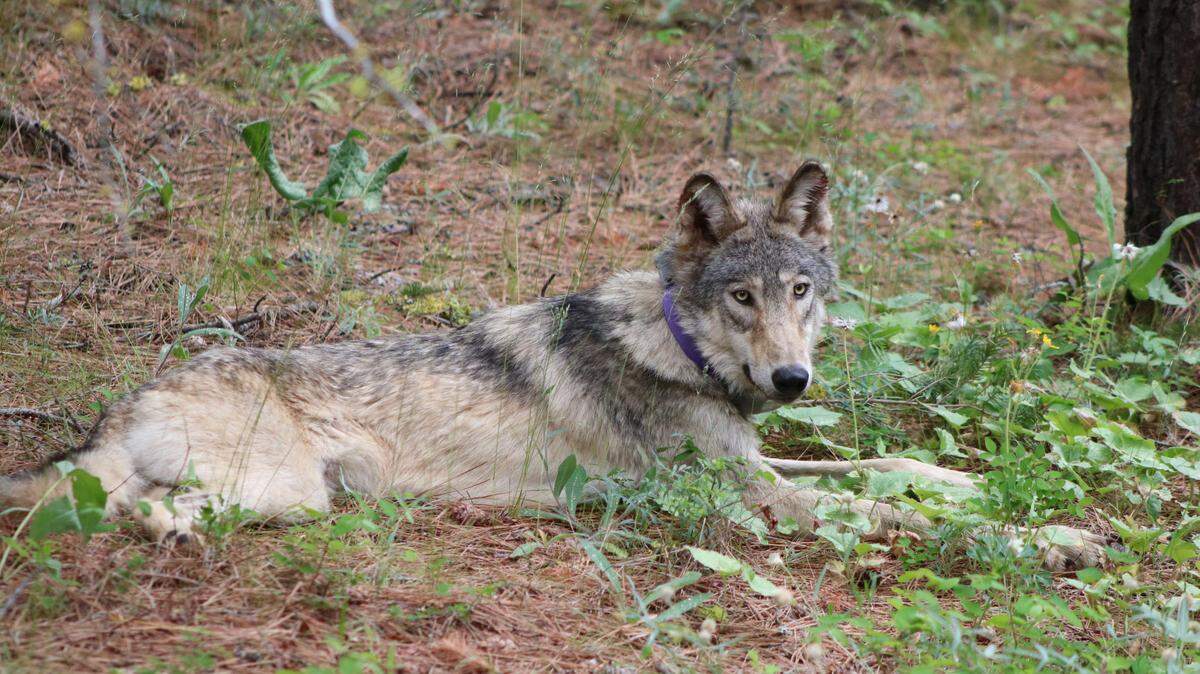
News of a gray wolf making its way into San Luis Obispo County surprised many in the local community.
It is the first time in nearly 200 years that a gray wolf has been confirmed on the Central Coast of California. Normally, the wolves stick to the far northeastern part of the state.
But OR-93, named because he is the 93rd Oregon wolf caught and fitted with a GPS collar, has traveled about 1,000 miles from his birthplace near Mt. Hood in Oregon to San Luis Obispo County, the California Department of Fish and Wildlife announced on April 6.
To get here, OR-93 had to cross several busy highways, trekking through farmland and near densely populated areas across several California counties after he passed the Oregon border.
His long journey may continue, experts say, because the wolf is likely on the prowl for a mate or new pack. There are no other known gray wolves in San Luis Obispo County, according to the CDFW.
Since first writing about the wolf, The Tribune has received several questions from readers about OR-93, his journey and what his stay on the Central Coast may mean for pets. Here are answers with help from the CDFW and Amaroq Weiss, the senior West Coast wolf advocate for the Center for Biological Diversity.
Why has OR-93 come to San Luis Obispo County?
OR-93 is a 2-year-old gray wolf. At that age, it’s very typical for gray wolves to leave their birthplace with their original pack and to find a new one.
“When wolves are about 1-1/2, 2-1/2 years old, that’s a really typical age for them to leave their family,” Weiss said. “That’s what a wolf pack is — it’s a family. It’s the mother and a father wolf.”
Weiss said that gray wolves are considered teenagers at about 1-1/2 years old. When they reach that age, it’s in their instincts to leave and search for a new mate or pack to live with and perhaps have puppies with, she said.
Wolves are social animals, Weiss said, and although he may be on the trail of good food sources in San Luis Obispo County — like deer — it’s more likely he’s here to search for a mate.
“For such social animals, we’d certainly at least like to see him find a buddy, right?” she said. “A female, a male, somebody to pal around with because they really thrive when they can interact with each other.”
Do gray wolves usually travel this far?
Yes, gray wolves can travel thousands of miles in search of a new pack or mate.
For example, in 2018, a female gray wolf made a round trip of almost 9,000 miles — looping back and forth from Oregon to California as far south as the Lake Tahoe Basin to find a mate or pack, Weiss said.
Other gray wolves have made the journey a few hundred miles from Oregon to the northern parts of California.
Typically, experts don’t interfere with the wolves as they make their journeys.
“It’s not normally something for us to interfere with,” Weiss said. “There are hundreds and possibly thousands of wolves who take these voyages every year. We’re just not aware of each one that does because not every wolf has a radio collar.”
Weiss said that OR-93’s search for a mate or new pack could have ended earlier because there might be other lone wolves further north.
“How far (wolves) travel is going to depend on, first of all, whether or not there’s an already-established wolf pack in the land where they’re traveling through,” she said. “It’s not going to stop there because packs are pretty territorial, it’s going to move on to look for another place to set up a home.
“But also, he needs to run into another mate. And so if there aren’t other lone wolves that are the opposite sex that are in the area where he’s roaming, he’s going to keep roaming.”
Are there any other gray wolves on the Central Coast?
There are no other gray wolves on the Central Coast that experts are aware of or have fitted with a GPS collar, according to the CDFW.
There’s a very small sliver of a chance that there could be another gray wolf prowling around somewhere on the Central Coast, but experts say they would be shocked if that was the case.
Will OR-93 survive in San Luis Obispo County?
Even if OR-93 does not find a mate or new pack to settle down with, he may still survive.
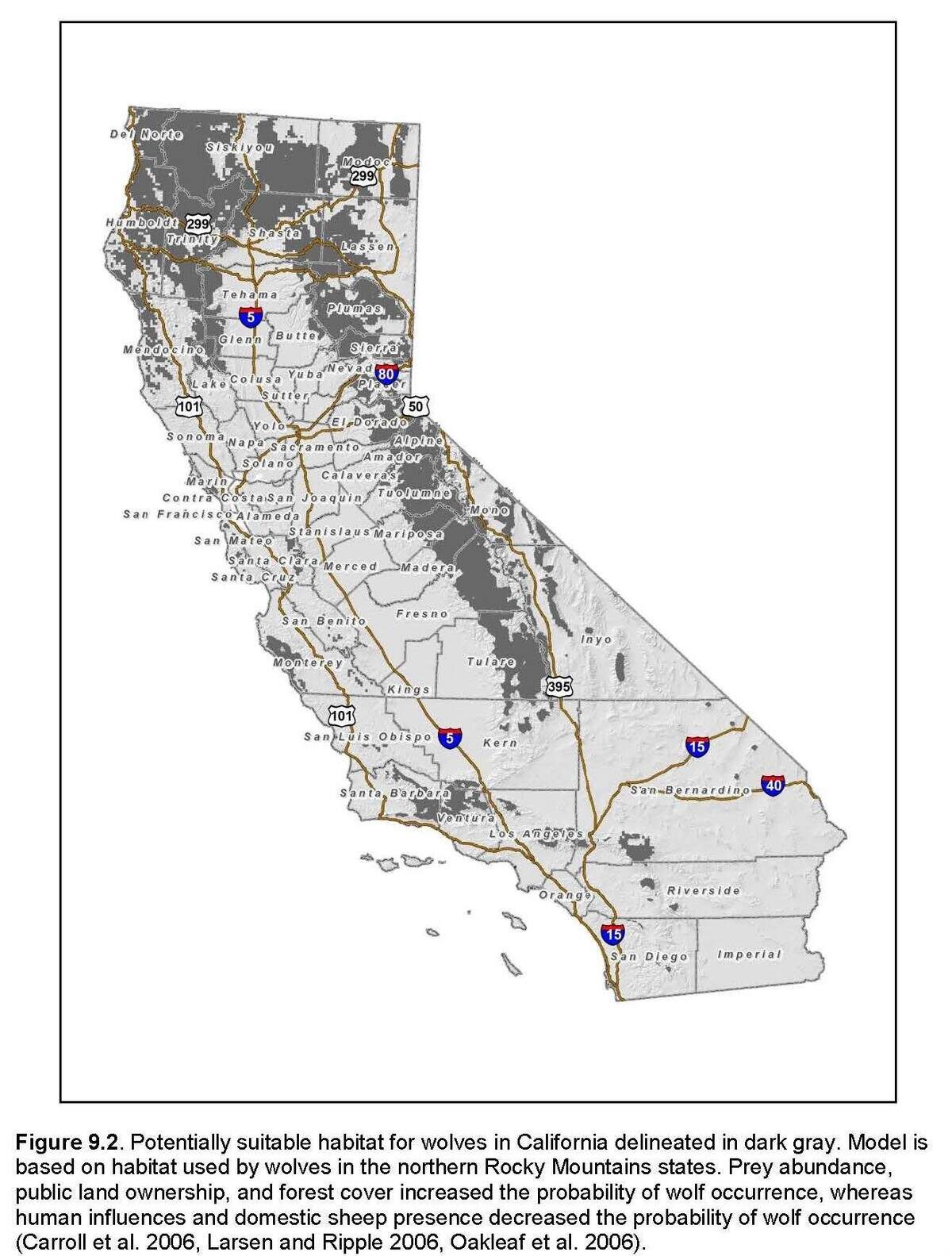
A very small portion of San Luis Obispo County is suitable habitat for gray wolves, according to a map included in the 2016 Conservation Plan for Gray Wolves in California. However, it’s a tiny area compared to other parts of the state, especially the Sierra Nevada Mountains and northern regions.
Jordan Traverso, a spokesperson with the CDFW, said that OR-93 “could settle without a mate,” perhaps if he finds a viable food source in the county.
That food source would likely be deer, Weiss said, which lone gray wolves can hunt by themselves.
Gray wolves usually rely on larger prey, like elk that roam in the Carrizo Plains Ecological Reserve.
However, it would be very difficult for a lone wolf to take down an elk by itself, Weiss said.
“His survival is also not a certainty,” Traverso told The Tribune in emailed comments. “We will have to wait and see what happens.”
Likely the greatest threat to OR-93 are humans, Weiss said.
There are several busy roadways in San Luis Obispo County, namely Highways 1 and 101, and OR-93 could be struck and killed by a car, she said.
Someone also could mistake OR-93 for a coyote and shoot him — though that would be unlikely since a gray wolf is much larger than a coyote and isn’t likely to be seen by humans.
It is illegal to kill gray wolves in California because they are protected under the California Endangered Species Act.
OR-93 may also contract a disease from dog poop on trails, Weiss said, which could cause him to die.
Why don’t experts capture OR-93 and relocate him to an area where there are more wolves?
It’s very unlikely that OR-93 will be captured and relocated.
Capturing and relocating a gray wolf — or any animal, for that matter — is risky and puts the animal under an extreme amount of stress, Weiss said.
Plus, it’s incredibly complicated and expensive.
First, CDFW doesn’t know the exact location of OR-93. The latest the agency knows is that, as of April 6, he had crossed Highway 101 and entered San Luis Obispo County from Monterey County, Traverso told The Tribune.
But should the agency decide to trap and relocate OR-93, the CDFW would likely need to contract a helicopter pilot who knows the county very well so they could search for the wolf by air without putting human lives at risk by possibly crashing in unknown terrain.
If they find him, it’s a chase would probably ensue. Then, someone would need to shoot the gray wolf with a tranquilizer. Then, crews would need to put the wolf into a cage and transport him hundreds or thousands of miles to a completely different area.
The entire process would be stressful and could kill the wolf, Weiss said.
“Just the stress of being tranquilized and captured can result in the death of a wild animal,” Weiss said. “There’s a phenomenon called capture myopathy, where the stress of what has happened to the animal causes very rapid tissue degeneration, and the animal dies.”
Plus, experts aren’t sure where exactly OR-93 would be taken.
“As far as relocation, we are still discussing it (we have discussed a number of things and many options are still on the table) but have not decided to take that action at this time,” Traverso told The Tribune in an email. “Where would we relocate him to? How can we assume we know what he’s looking for, where he would find it and where to put him?”
Are my pets at risk?
It’s very unlikely that your household pets are at risk of being eaten or attacked by OR-93. And it’s even more unlikely that your large dogs are at risk of mating with OR-93.
“A lone wolf poses very little threat to humans and other animals,” Traverso wrote to The Tribune. “The most at risk from a wolf are prey species, like deer. Gray wolves are carnivores. Their primary prey sources are large native species, mainly elk and deer.
“Wolves will also consume other mammals, birds and reptiles. They will opportunistically scavenge carrion, and may prey on large livestock under certain circumstances. That said, we always recommend ensuring pets and livestock are secured or in enclosures at night, and that they are monitored. The potential for mating with a dog is unlikely.”
If you’re still worried, here are some tips from CDFW to keep your pet safe:
- Place a bell or beeping collar on dogs that roam.
- Talk loudly to the dog and/or use whistles.
- Control the dog so that it stays close to you; this should cause wolves to associate dogs with humans.
- Place the dog on a leash if wolves or sign of wolves are seen.
- Keep pets and their food indoors, especially at night.
- Remember, it is illegal to shoot at or attempt to injure or kill a wolf even if it is attacking your dog.
Are my livestock at risk?
Gray wolves are known to eat large livestock, though it’s very uncommon, Weiss and Traverso said.
However, the CDFW has several recommendations for how to discourage livestock depredation by wolves:
- Remove diseased or dying animals from areas where they can attract wolves. Do not leave these animals out in the open.
- Dispose of carcasses in properly constructed and maintained carcass pits.
- Carcass pits should be routinely burned or covered with dirt.
- Carcass pits should be at least 8 feet deep and located away from livestock, homes, outbuildings, etc.
- Surround carcass pits with predator-resistant fencing to further reduce the chance of attracting wolves.
- Haul away carcasses to a rendering facility or commercial landfill.
- Fence or pen livestock at night using permanent or portable fencing.
The agency also suggests using a fladry line, a series of cloth flags hung at intervals along a rope or fence line. Wolves can be reluctant to cross fladry lines for 30 to 60 days, the CDFW said.
In addition, the CDFW says landowners can install flashing lights, triggered by motion sensors, on the perimeter of sensitive locations such as calving areas. Lights should be moved regularly to increase effectiveness.
Livestock owners should use multiple dogs to guard livestock, the agency said.
“In most situations, livestock guarding dogs can be effective at alerting people to the presence of wolves but not in actually keeping wolves away,” the CDFW said, adding that the “effectiveness of livestock guarding dogs is dependent on breeding and training.”
What should I do if I see OR-93?
It is incredibly unlikely you will see OR-93 out on a hike or in your neighborhood while he is roaming the Central Coast.
Wolves “don’t want anything to do with humans,” Weiss said.
“They’re afraid of humans,” she said. “If a wolf sees or smells or hears you before you see it, it will be gone before you do see it.”
If you’re out hiking with your dog, however, it may be safer to keep it on a leash, she said. That’s because a wolf may see the dog as a threat to its territory.
The CDFW says that wolves, like all wild animals, should never be fed or approached.
Should you have a close encounter with a wolf, which is exceedingly rare, the CDFW advises the following:
- Do not run. Maintain eye contact.
- Act aggressively. Make noise while retreating slowly.
- If the wolf does not retreat, continue acting aggressively by yelling or throwing objects.
How can I learn more about gray wolves?
Weiss is hosting a Zoom webinar on April 17 about the current situation with wolves in California and the West Coast.
The talk is hosted by the Friends of San Pedro Valley Park, and anyone is welcome to join.
According to the event’s website, Weiss will discuss “these remarkable animals and the politics, laws, social issues and science of wolf protection and recovery, and how you can get involved.”
For more information on how to register for the webinar, go to bit.ly/WeissWolfWebinar.
This story was originally published April 13, 2021 at 5:00 AM.