How tough is it to get into Cal Poly? One major has room for only 2% of its applicants
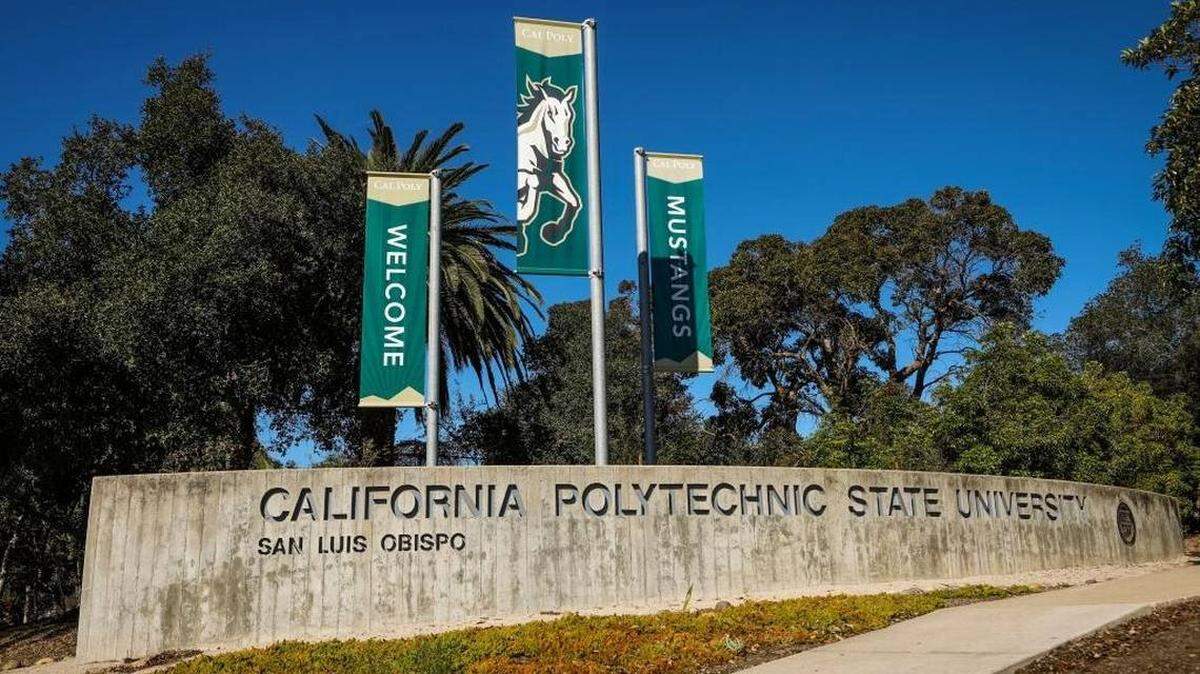
Cal Poly received a record number of applications during the COVID-19 pandemic, and demand is so high, it has room for fewer than one in 10 of those hopeful students.
Competition is so fierce in some areas, thousands of students apply for what amounts to a handful of spots.
The major that’s the most difficult for freshmen to crack based on those metrics isn’t even in a department from one of Cal Poly’s prestige colleges. It’s in Liberal Arts.
Overall, demand varies greatly from one college or program to another, recently released data show.
For example, Cal Poly has room to enroll only one in 16 students who applied to the College of Science and Mathematics compared to one in five at the College of Agriculture, Food and Environmental Sciences.
In total, about 66,000 first-time freshman and new transfer students applied to Cal Poly for the fall 2021 term as of this week.
The university has space available for about 5,900 new students total — or just 8.9% of those who applied.
Cal Poly has sent out acceptance letters to about 30% of its first-time freshman applicants, and 15% of its new transfer student applicants, according to the university.
Acceptance letters were sent out beginning in March and continuing through April and beyond as commitments from students come in.
Students have a deadline of May 1 to confirm whether they will accept an offer from Cal Poly.
How Cal Poly balances acceptances and enrollment
As the university works to meet its enrollment targets, it banks on many of those acceptances getting rejected or ignored by students, said Jim Maraviglia, Cal Poly’s vice president for enrollment management. That helps the university ensure it meets but does not exceed its capacity, he said.
If too many students don’t accept their offer for a particular program, the university uses a waitlist to backfill open spots.
For example, if 15 acceptance letters are sent out for 10 opens slots, but only eight of those students actually enroll, then the enrollment office may tap into its waitlist to find more students to fill the program.
The university’s overall capacity depends on certain numbers of students regularly leaving Cal Poly — typically by graduating, Maraviglia noted.
“Capacity means a lot of things,” Maraviglia said. “That doesn’t just mean room. It means having enough faculty and staff, classroom space, office space for faculty and overall funding to support students.”
In an emailed statement to The Tribune, Cal Poly’s Director of Media Relations Matt Lazier said that the university is state funded, and that “student tuition and private and industry support help to bolster Learn by Doing and make it the best it can be for our students.
“But unfortunately, we are limited in how many students we can enroll by the extent to which we are funded by the state — which in turn limits the university’s physical campus capacity as well as personnel necessary to support students with sufficient course offerings and services they need to graduate in a timely manner.”
One thing is sure: The record-breaking number of applications means that the university will have another year of high enrollment.
Last fall, Cal Poly projected that 20,740 undergraduate students would enroll for fall 2020, though 22,287 actually did. For fall 2021, the university is projecting that 21,042 undergraduate students will enroll.
Compared to the previous year, the university received about 3,800 more applications, but has about 110 fewer spaces available for students, according to university data.
“There’s tremendous demand for a Cal Poly education, and that’s what the numbers prove,” Maraviglia said.
The high demand is “not necessarily a bad thing,” he added. “What’s unfortunate is that you have to say no. That’s the hard thing.”
Some Cal Poly colleges, programs more competitive than others
The spaces available for incoming Cal Poly students vary by college and by major.
The College of Science and Mathematics has the smallest number of spaces available compared to how many applications the college received. A total of 12,618 students applied for the fall 2021 term, while the college has only 789 spaces available, or 6.2% of the overall demand.
The College of Engineering is the most popular college by raw numbers, receiving 21,047 applications. It has 1,547 spaces available, or 7.3%.
Cal Poly’s College of Liberal Arts is the second most popular, and it received 13,217 applications with 1,013 spaces available (7.6%) for those students.
The Orfalea College of Business saw 10,184 applicants and has 850 spaces available (8.3%).
Cal Poly’s College of Agriculture, Food and Environmental Sciences received 5,614 applications with 1,220 spaces free (21.7%).
And the College of Architecture and Environmental Design received 3,329 applications with 460 spaces available (13.8).
For first-time freshmen applying to Cal Poly’s 64 majors, the most difficult major to get into based on sheer number of applicants vs. space available was not engineering or architecture.
It was psychology. The university received 3,222 applications but has space for just 66 students — or just 2% of the hopeful applicants.
That is followed by computer science, biological sciences, kinesiology, marine sciences and aerospace engineering, all of which have space for just 4% of the total applicants.
Business administration is the most popular major at Cal Poly for applicants, with 8,733 applicants. There are 719 spaces available in that major.
The majors at Cal Poly that received the smallest number of applications are dairy science, Spanish, agricultural systems management, manufacturing engineering, comparative ethnic studies and bioresource and agricultural engineering. All of those programs saw fewer than 100 applicants.
See how demand compares to availability among Cal Poly’s majors or colleges by searching this table:
This story was originally published March 30, 2021 at 11:42 AM.