SLO County school could add ethnic studies course. A critic called it ‘classically racist’
The Spanish version of this article is available here.
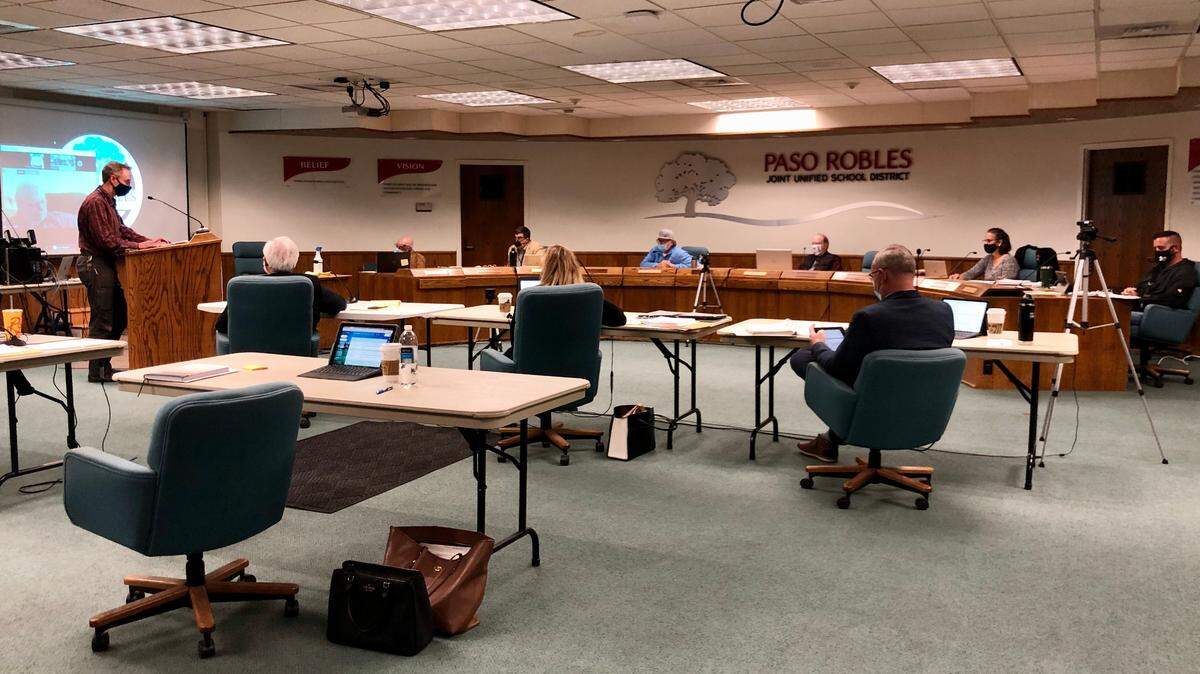
After hours of public comment and heavy debate at a meeting Tuesday evening, the Paso Robles Joint Unified School District’s board of trustees approved a new ethnic studies course to be taught at Paso Robles High School starting in the fall.
The course, “Ethnic Studies: Multicultural America,” was widely lauded by parents, students, teachers and even Cal Poly officials.
Board members, however, were concerned about the new course and criticized what they say was a lack of “balance.” Trustee Lance Gannon worried that “the students who elect to take this class are going to look at the white students differently.”
Another board member, Dorian Baker, shared a now-deleted post to her personal Facebook page before Tuesday’s board meeting that called the new ethnic studies curriculum “poison.”
The trustees voted 6-1 in favor of the proposed course, with trustee Lance Gannon dissenting.
The North County school previously had an ethnic studies class, but it was discontinued when the teacher who taught it retired in 2013.
The Paso Robles board decision comes less than a week after the state Board of Education approved an Ethnic Studies Model Curriculum for high schools, a decision that was four years in the making.
Students at Paso Robles High School are not required to take the ethnic studies course, as it will be offered as an elective. Other districts in the state, such as Fresno Unified School District and Los Angeles Unified School District, have recently announced they will require students to take an ethnic studies class.
Gov. Gavin Newsom has proposed $5 million in the 2021-22 state budget to help prepare educators to teach the subject.
Although class registration has already begun for students at Paso Robles High School for the 2021-22 school year, district officials said during Tuesday’s meeting that they will advertise the class as soon as possible so students know it is now an option.
The school will need at least 20 students to fill the class or it will not be taught, according to district officials.
The course is broken into eight main units that dive into the history and experiences of major ethnic groups and genders and other topics — including African Americans, Native Americans, Latino Americans, Asian Americans, women’s studies and Muslim and Arab Americans.
Community members praise new ethnic studies course
Community members who submitted public comments in favor of the course included Denise Isom, vice president for diversity and inclusion at Cal Poly in San Luis Obispo.
Isom, a Paso Robles resident, wrote that ethnic studies courses have been found to improve students’ overall grade point averages and attendance — and bring benefits beyond academics. Kim Holmes, interim executive assistant to district Superintendent Curt Dubost, read Isom’s public comments aloud to the school board at Tuesday’s meeting.
“As students find themselves in the story of America, they also find validation, voice, and value,” Isom wrote in her public comments. “In the complex history of the United States and analytical examination of our social world, young people become inspired to build a better future, and become invested in their own growth and development. In short, it helps them dream.”
Two students at Paso Robles High School called in to Tuesday’s meeting offer their own opinions on the course.
Mel González, a junior at the school, said she fully supports the ethnic studies course, and that racist incidents at the school could be prevented if students were better educated.
“Many students at PRHS have suffered and been put down just because their culture and or ethnicity is not shared by the majority population,” González said. “The history we learn is still dominated by white Anglo-Saxon Protestant culture, and all of us will benefit greatly from a deeper and richer understanding of America’s multicultural past.”
Following González, Paso Robles High junior Sharon Elmer spoke.
Elmer at first said she had written her comments in Spanish, and indicated that she did not have an English version on hand.
Board president Chris Arend said that since Elmer seemed to speak fluent English, that she would need to say her comments to the board in that language, which she did.
“The community of Paso Robles has such a rich, rich history,” Elmer said. “This course would help us study and celebrate that.”
Carey Alvord, a marriage and family therapist, spoke at length about the substantial benefits the course would have on students and the community. She’s a co-chair of the Paso Diversity, Equity and Inclusion Committee, a group of Paso Robles parents, community members, teachers and administrators that advocate for the importance of education on creating racial healing in the community.
Alvord said that the committee has identified many accounts of racism from the Paso Robles High School student body over the years and added that the ethnic studies course is a “step in the right direction” for teaching students the relationships between different ethnic groups.
After Alvord was done speaking, Susana Lopez, a clinical psychologist, lecturer at Cal Poly and co-chair of the Paso DEI Committee, summarized Alvord’s comments in Spanish.
But Arend protested when Lopez started speaking in Spanish during the board meeting.
“No, no, Susana, you’re out of order,” Arend said. “We have a policy here that we will accommodate people who want to address the board if they’re not fluent in English.”
Dubost and trustee Chris Bausch interjected, saying that there was no such policy banning public commenters from speaking in Spanish to the board and that the board should vote whether to allow Lopez to continue speaking in Spanish.
Although Arend dissented, six trustees agreed to allow Lopez to give her comment in Spanish.
Arend has previously resisted allowing commenters to speak Spanish during board meetings, asking, “If you have sufficient command of English, please speak in a language that we understand.”
Following Lopez’s comments, seven additional people called in or showed up to the board meeting to give their opinions on the proposed course curriculum.
Though most speakers supported adding the course, one commenter, Peter Byrne, was fiercely opposed to the ethnic studies curriculum.
“I saw no mention (in the curriculum) of the positive contributions whites have made over the past hundreds of years,” he said.
Byrne continued to say that the proposed curriculum modeled so-called critical race theory, which he called “classically racist” against white people.
Critical race theory is “the view that the law and legal institutions are inherently racist and that race itself, instead of being biologically grounded and natural, is a socially constructed concept that is used by white people to further their economic and political interests at the expense of people of color,” according to Tommy Curry, an associate professor of philosophy at Texas A&M University.
Paso Robles board members critical of proposed curriculum
On Tuesday, board members largely seemed to agree with Byrne, and worried that students were going to be taught about racism in America in an unbalanced manner that would pit white people against other ethnicities.
Baker took issue with the proposed core text of the course: “A Different Mirror for Young People: A History of Multicultural America” by Ronald Takaki.
“The author pulls out many very truthful and very negative and hurtful racist items from our past. They are often despicable,” Baker said. “And while it’s reasonable to want to use these things to improve the situation for all people, and I’m not saying they shouldn’t be brought up and discussed and taught, but they should be taught within the historical context in which they occurred.”
Baker continued to say she wanted to see a curriculum that is “thoughtfully and collaboratively written to include a balanced, truthful account of not only the ethnic struggle of our people, but also the story of their amazing successes. The best lessons are those of success, of overcoming hardship ... and I didn’t see that here.”
Geoffrey Land, who will teach Paso Robles High’s new ethnic studies class should enough students sign up in the fall, responded to concerns by Baker and other board members about balance and historical context — saying that the course is “not about bashing America.”
“History is as much about the present and the future as it is about the past,” Land said. “I think it would be so interesting (in the class) to talk about how we are a product of this past, and how do we move forward without ignoring all the different viewpoints and perspectives on that past.”
In her now-deleted Facebook post, Baker was critical of the ethnic studies curriculum — noting that she is a Paso Robles school board member and urging members of the public to “weigh in on the matter.”
She shared a social media post from conservative radio talk show host Glenn Beck, who advocated against the new ethnic studies courses being introduced in California schools.
“As critical race theory spreads across the country, California has approved a new ‘ethnic studies’ curriculum for K-12 students that’s chock full of it,” Beck wrote in his post. “But at least one state is standing up against this poison. Florida Governor Ron DeSantis sharply (and in my opinion, very accurately) condemned this push to ‘teach kids to hate our country and to hate each other based on race.’ ”
Throughout Tuesday’s meeting, board members asked that works by Thomas Sowell, an economist, author and political theorist, be added to the curriculum. Sowell is seen as writing from a libertarian conservative perspective on racism and racial disparities.
They also asked that the district come back to the board during its next meeting with revisions to the curriculum that show the course will be taught in a more balanced manner.
Land said he will consider their concerns, and that they should trust him to teach the course well.
“We all in these United States of America are experiencing a period of political polarization, of cultural divisions, racial tensions, economic stresses and we in our town of Paso Robles are a microcosm of this national dynamic,” Land said. “My hope for the United States, as a government teacher and history teacher, is that we can learn to listen to each other, respect our differences, find common ground and confront the hard questions before us.”
Land added that he truly believes “this course will contribute to civic education and community dialogue in a way that honors the many diverse perspectives and lived experiences of our Bearcat students.”
Land will return to the board’s next meeting on April 13 with possible revisions to the curriculum and course materials at the board’s request. You can view the current course curriculum approved by the board during Tuesday’s meeting at bit.ly/PRHSethnicstudies.
This story was originally published March 24, 2021 at 10:32 AM.
CORRECTION: Correction: This article formerly identified Carey Alvord and Susana Lopez as members of the Paso Diversity Panel. That has been corrected to properly identify them as co-chairs of the Paso Diversity, Equity and Inclusion Committee instead.