Spanish speakers clash with Paso Robles school board president over lack of interpreter
The Spanish version of this article is available here.
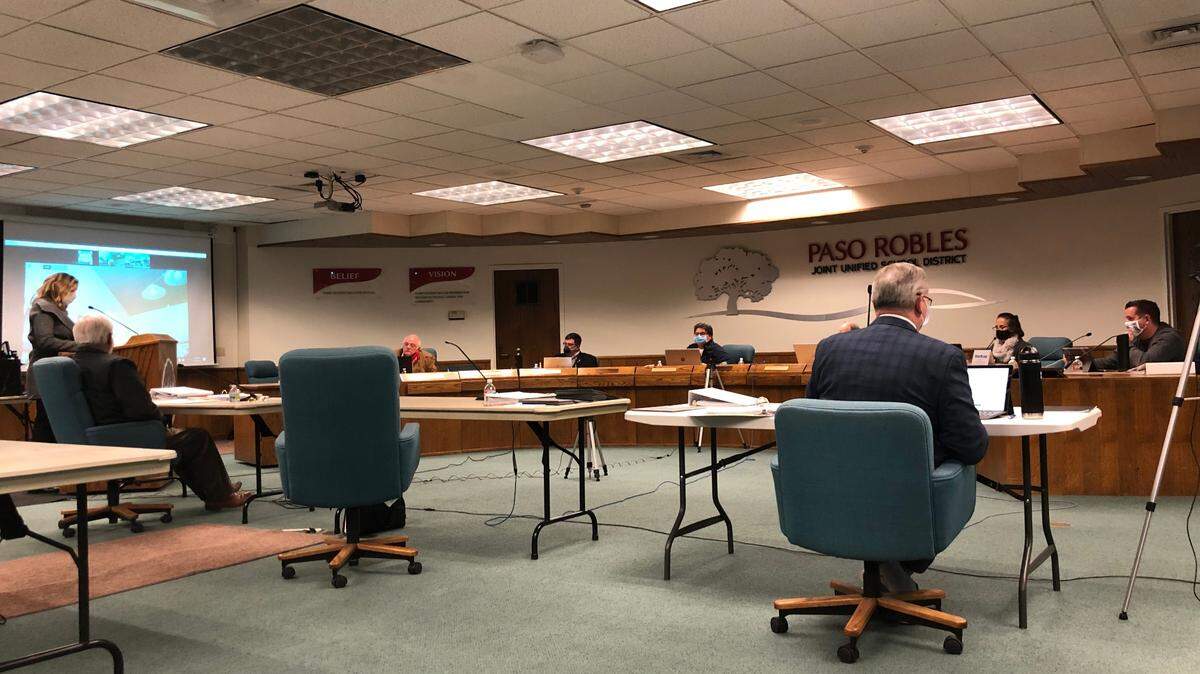
Community members called out the Paso Robles Joint Unified School District board of trustees on Tuesday for its lack of interpreters during meetings, raising concerns about discrimination against Spanish language speakers.
In response, the president of the school board argued against the use of any language other than English during board meetings.
The commenters called into Tuesday’s meeting, which took place virtually and in person at the district’s headquarters in Paso Robles, to speak out about the lack of transparency regarding a district advisory committee’s decision to recommend to the school board that it close down Georgia Brown Elementary School to save district costs.
The school board will hear a report from that advisory committee during its meeting on Jan. 26.
Commenters wanted to speak about those plans in Spanish, with a certified interpreter then relaying their comments in English. However, the district did not have a certified translator ready to translate the comments.
“I called, hoping to speak in Spanish and have a certified translator through the school district translate what I was saying,” said Yessenia Echevarria, a Paso Robles resident who advocates for the Hispanic population. “Now, we are a school district that serves a major portion of Spanish-speaking families, to not have someone on staff that is certified by the school district as a translator ... is problematic.”
After the commenters spoke, board president Chris Arend responded — which trustees are typically not allowed to do for public comments — and asked people to “please speak in a language that we understand.”
“Under the California Constitution, the official language of the state of California is English, and we conduct our business in English,” Arend said. “We tried to accommodate speakers who do not have sufficient command of English, but I want to remind everyone out there: If you have sufficient command of English, please speak in a language that we understand.”
Just after Arend’s comment, district Superintendent Curt Dubost said that the district will have a certified interpreter available at future board meetings.
“I wish to point out, again, what the law is on that,” Arend interjected after Dubost.
Later in the meeting, district trustee Chris Bausch said that the board has received similar calls asking for Spanish interpreters in previous meetings during his eight-year tenure on the board.
Elena Garcia, a social worker in Paso Robles, said during public comment at Tuesday’s meeting that having no certified Spanish-language interpreter posed problems for the community.
“If our Spanish-speaking community members want to speak during public comment, it would technically be going on deaf ears for those who don’t understand Spanish,” Garcia said. “That’s not welcoming to our Spanish-speaking community. And how do we ever expect them to be involved?”
About 35% of the Paso Robles school district is comprised of English-language learners whose primary language is Spanish, according to data from the California Department of Education.
Public schools in California with 15% or more their population who speak a primary language other than English are required by law to provide all “notices, reports, statements or records” in that language to parents or guardians. That does not cover requiring language translation during school board meetings, however.
But school board meetings must follow the Ralph M. Brown Act, most commonly referred to as the “Brown Act.” This law is considered the state’s “sunshine” law for local government, and requires local government business to be conducted at open and public meetings in a way that is accessible to the public.
Members of the public who predominately speak Spanish may have a hard time accessing and understanding the Paso Robles school district’s meetings because there is no one to interpret the meetings.
After Tuesday’s meeting, Arend told the Tribune that “if we start turning this into a bilingual event, we’re going to bust the budget.”
San Luis Coastal Unified School District is one of the districts in San Luis Obispo County that provides comprehensive interpretation services during its school board meetings.
Interpretation services cost San Luis Coastal about $24 per hour, according to Ryan Pinkerton, the district’s assistant superintendent for business and support services. Sometimes, Pinkerton wrote in an email to The Tribune, school board meetings may have two interpreters working during a meeting if it lasts for a long time.
Pinkerton wrote that providing interpretation during board meetings “may be more of an issue in finding translators than the cost.”
At the conclusion of the Paso Robles board meeting, some trustees noted that there had been Spanish interpretation services at meetings in the past.
Dubost, the district superintendent, told The Tribune after Tuesday’s meeting that providing interpretation just “fell through the cracks” that time.
“It’s a valid complaint,” he said of those asking for interpretation services. “Efforts are being made to ensure we can provide translation at future meetings.”
Even so, Echevarria said that the complaints raised at Tuesday’s meeting represent a “rude awakening” for the Paso Robles district.
“It’s just really sad that they had to be put on the spot to do the right thing,” she said.
This story was originally published January 13, 2021 at 10:40 AM.