Number of failing grades soar as SLO County students struggle with distance learning
More students than usual are receiving failing grades in schools across San Luis Obispo County, with some districts seeing the number of F’s or D’s double among high school and middle school students.
Administrators, parents, teachers and students credit the coronavirus pandemic and distance learning for the devastating number of bad grades.
“Distance learning has exacerbated everything,” said Cristi “Cris” Andrade, a sixth-grade teacher at Grover Heights Elementary School in Grover Beach. “So those kids who usually had bad grades, are doing worse. And those who usually had straight A’s are now struggling.”
The three largest school districts in the county — Lucia Mar Unified, San Luis Coastal Unified and Paso Robles Joint Unified — have all seen class grades worsen in the first months of distance learning for the 2020-21 school year.
At Lucia Mar — the largest district in the county with a total of roughly 10,200 students — the number of failing grades more than doubled from the previous school year across the district’s high schools, and nearly doubled in the middle schools, according to district Assistant Superintendent Hillery Dixon.
The same trend is evident in Paso Robles.
About 1,000 high schoolers, or half the district’s high school student population, had at least one failing grade in their first progress report of the current school year, according to deputy superintendent Jen Gaviola. That’s double the usual number, she said at a district board meeting on Oct. 6.
San Luis Coastal saw the number of high school and middle school students with a failing grade increase by an average of 12%, according to data provided to The Tribune by Rick Mayfield, the district’s director of learning and achievement.
Receiving bad grades in classes often impacts students’ mental health, according to the American Academy of Pediatrics. And poor report cards could affect high school students’ chances of getting into college.
“I’m frustrated,” said Hunter Wooldridge, a sophomore at Central Coast New Tech High School in Nipomo. “I have expectations for myself. I’ve always been a 4.0 (grade point average) student and I don’t want that to go down now. ... I want to get into a good college.”
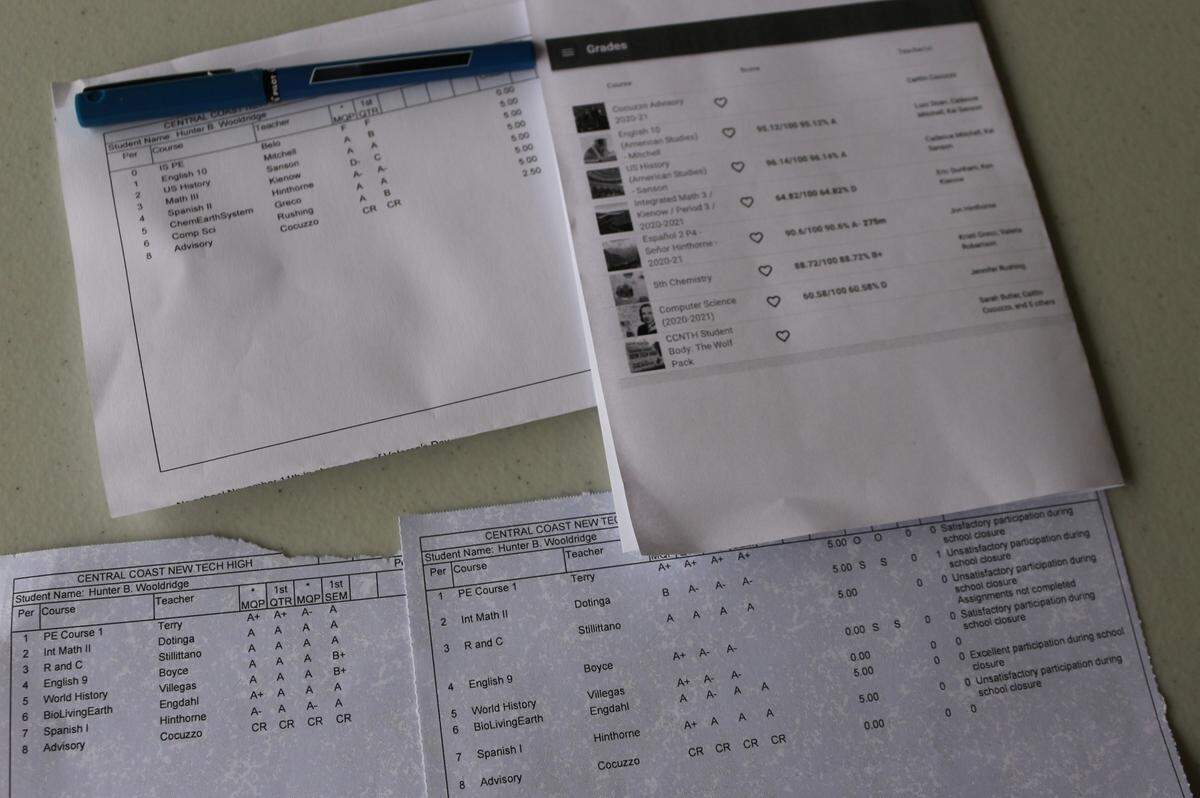
Failing grades on the rise in SLO County districts
In the 2019-20 school year, Lucia Mar teachers gave about 500 F grades to middle schoolers and about 970 to high schoolers for their first-quarter grade reports, according to district assistant superintendent Dixon. That’s out of about 1,670 middle schoolers and 3,400 high schoolers in the district.
This school year, middle school students received a total of about 940 F’s, and high school students received about 2,100 F’s total, according to Dixon.
At San Luis Coastal, about 300 middle school students and 610 high school students received at least one D or F on their first progress reports in the 2019-20 school year, according to Mayfield.
This school year, about 480 middle schoolers and 870 high schoolers received at least one D or F grade, according to Mayfield.
And at Paso Robles Joint Unified, about 1,000 high school students have at least one F grade — double the number the previous school year, according to Gaviola. That’s about half of the district’s high school population.
What led to increase in bad grades for students?
Every student has a unique story and set of circumstances that may increase their chances of receiving bad grades, Dixon said.
“Some students are living in situations that aren’t conducive of online learning,” she said.
Wooldridge finds sitting down at a computer for hours on end during classes difficult.
“I have really bad ADHD,” the 15-year-old said. “But it’s harder to get distracted in an actual classroom. At home in my room there’s just so much (distraction).”
Wooldridge said his dog comes in his room occasionally, and the kitchen is near so that he sometimes makes breakfast during his first class.
Additionally, Wooldridge said most of the work done in classes is through the computer, so he’s hardly touched his textbooks.
That makes class less engaging, he said, noting that many of his fellow students have their cameras turned off.
“It’s way more interesting for me to do hands-on stuff,” Wooldridge said. “Like sometimes teachers will have us do whiteboard exercises online. ... Those are better than just having someone talk through the blank computer screen.”
Andrade, the Grover Heights Elementary teacher, has two daughters at Nipomo High School. She said that her kids have bad weeks and good weeks of learning online.
During the bad weeks, their motivation tanks and they can’t concentrate, she said.
“They get into this funk,” Andrade said. “They’re both so social, too, so it’s been a struggle for them to really connect with their teachers and the other students. I think that really affects how they’re able to get the concepts being taught and just be motivated to do the classwork.”
Andrade said she finds that some of her sixth-grade students have not turned in most of their work. This causes them to have failing grades, she said.
“It’s relatively easy to turn in the work — all they need to do is upload it,” she said. “But I have a chunk of kids who don’t do that.”
Failing grades may also be the result of a clerical error by the teacher or late assignments that haven’t been graded after they are turned in, Wooldridge said.
“This year, I have more missing assignments,” Wooldridge said. “It’s just easier to forget they’re due.”
Are all local kids seeing grades drop due to distance learning?
While many students are seeing their grades drop, others find distance learning hasn’t adversely affected their grades.
Alicia Salgado said her daughter, Sarah, has been able to find a rhythm with distance learning. Sarah Salgado is in seventh grade at Mesa Middle School in Nipomo and has been able to maintain straight A’s, her mom said.
“At first she was really falling behind and just needed to get used to the new routine,” Salgado said. “She’s had to really work hard to connect with her teachers, but now she’s got that and it really helps.”
Other students have been able to adjust to online learning by building detailed to-do lists, being monitored by their parents or simply thriving in the virtual environment, several parents told The Tribune via Facebook.
Many parents said teachers have reached out to them to talk about how to help their children if their grades dip below passing, while others said they have to take initiative to find tutoring options for their kids.
Nicole Stephens, whose daughter, Ella, attends third grade at Ocean View Elementary School in Arroyo Grande, said the teacher grades every assignment by the end of each week and sends out detailed progress reports.
“That’s really helped me, as a parent,” Stephens said. “I can go in to the parent portal and see how she’s doing and if she’s hitting standards.”
Stephens said that has helped her stay on top of her daughter’s grades while she works full time from home.
What are districts doing to help students with failing grades?
Students’ current grades reflect where they are about two months into distance learning, and aren’t final, district officials told The Tribune.
Lucia Mar Unified, San Luis Coastal Unified and Paso Robles Joint Unified school districts have put new efforts into figuring out how to better serve students who are struggling to maintain good grades.
For example, Lucia Mar has created in-person learning pods. Students can go to their school’s campuses and sit in a room with a few other students and a supervising adult while they do their homework, Dixon said.
At San Luis Coastal, students have more than an hour of small-group instruction with their teachers to go over confusing topics or missed concepts, Mayfield said. Additionally, some students may return for in-person instruction, and those with failing grades would be prioritized to return to classrooms, Mayfield said.
The Paso Robles school district has formed a task force to find viable interventions to allow students to bring their grades up, district Superintendent Curt Dubost wrote in an email to The Tribune. These interventions include things similar to the other district’s options: small in-person learning cohorts and extra study sessions, Dubost wrote.
However, all three districts said the best way to improve grades may be bringing students back into classrooms for in-person instruction.
As of Tuesday, all of the districts planned to bring some or all elementary students back to in-person instruction before December upon approval by the San Luis Obibspo County Public Health Department.
None of the districts plan to bring middle or high school students back into classrooms until January if approved by the county health department.
This story was originally published October 28, 2020 at 5:00 AM.