SLO County creek project buckled under a historic storm. Why some see it as a success
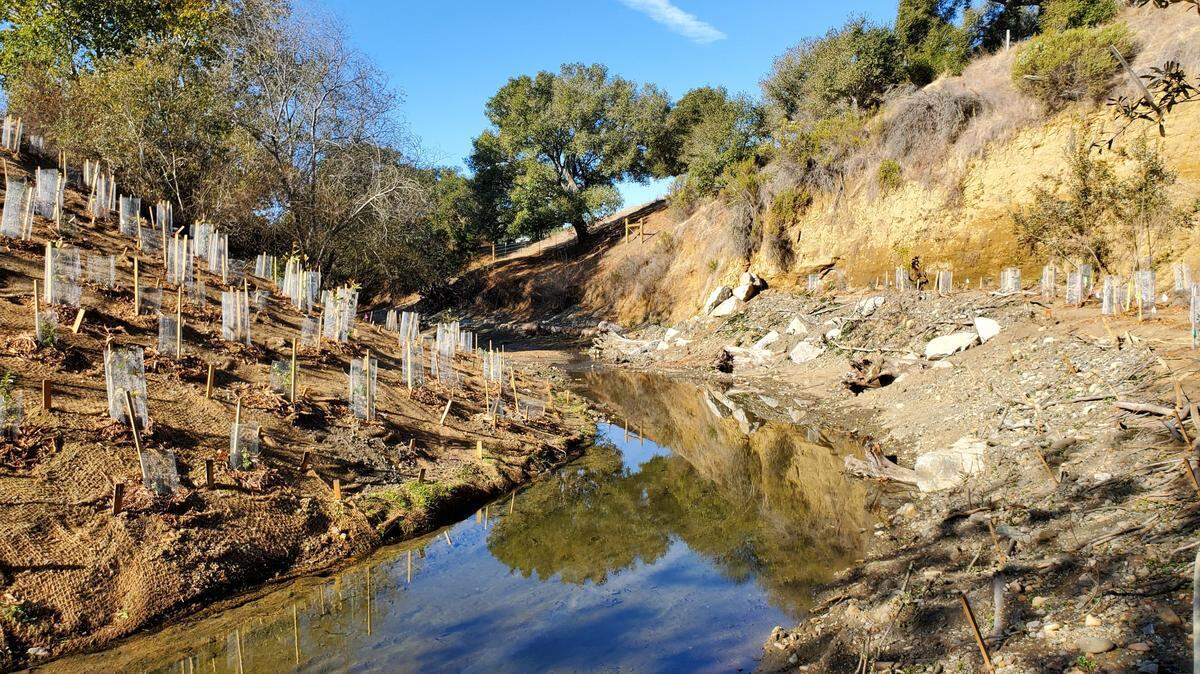
Mother Nature proved again in late January that the force of torrential rainfall and surging water can undo about a decade’s worth of difficult, expensive habitat conservation work.
The Santa Rosa Creek project completed in October in Cambria was designed to stabilize the path of the creek in a vulnerable North Coast area, while protecting its bank and its eponymous roadway.
Devin Best, executive director of the Upper Salinas-Las Tablas Resource Conservation District (RCD), said the district worked with landowners “to preserve their property and also maintain the road so it doesn’t wash away.”
January’s storm was far from the first time the creek had threatened the roadway and nearby habitat. Through the years, parts of the long rural road have been damaged, undermined and simply washed away in previous onslaughts.
However, the results from January’s devastating three-day storm, which was powered by a so-called “atmospheric river,” were among the most frustrating along the creek road in recent memory, given the work that had been done to prevent them.
“The project was designed to withstand a 100-year storm. What we got was more like a 110-year storm,” Best estimated.
“These 100-year storm events are happening more frequently now,” he added, so project planners have to consider whether “they really are 100-year storms now, or more the norm.”
John Waddell, a deputy director of the San Luis Obispo County Public Works Department, said that the storm “was a 200-year rain event” in terms of rainfall.
That’s significant, he said, explaining that “it means there’s a half of 1% chance” there’d be that much rain in one storm during any given year.
“As far as runoff and flooding” rates during and after the storm, he said, “that depends on where you were in the watershed.”
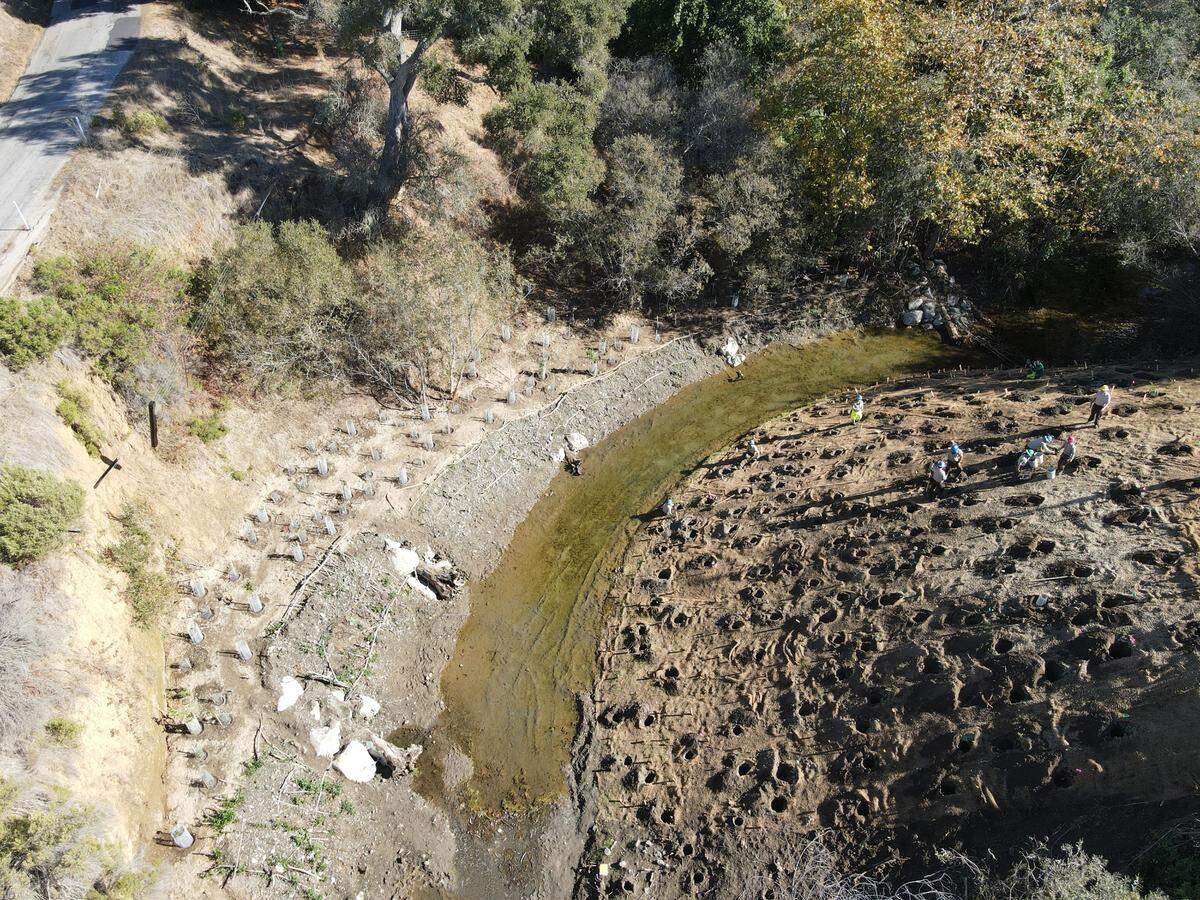
The project’s engineering strategy — undertaken by RCD and the California Conservation Corps and paid for with grants from the National Fish and Wildlife Foundation, PG&E and county Public Works — was to sway the creek flow away from its northern bank, where the water was chewing away at the ground supporting Santa Rosa Creek Road.
Then came that torrential January storm, which dumped up to 18 inches of rainfall along the Cambria watershed.
It all had to flow downhill, past and through the project area.
Santa Rosa Creek project protects road
While the project didn’t keep the stream bank from eroding, it did protect the creek road, and some neighbors consider the work to have been successful.
Michael Broadhurst is an alternate member of the North Coast Advisory Council, representing agriculture, and co-owner of Dragon Springs Farm, which is about 2 miles up the road from RCD’s project.
He said that, even though the raging creek water chewed away at the project site, “I consider the project to be a success, because Santa Rosa Creek stayed in the place where they wanted it to stay, and we wouldn’t still have Santa Rosa Creek Road if we hadn’t done that project.”
“We had 14 inches of rain in 30 hours,” Broadhurst said, adding that, despite the deluge, he’d gone down several times during the storm to check on the project and the flooding, including when the rushing creek water was about 10 feet deep.
“Yes, there was some bank erosion on the road side, he said, “but I don’t think I’d call that a failure. The road side was the county’s responsibility, and people need to understand that.”
Waddell said he and his roads manager, Tim Cate, who grew up in Cambria, didn’t receive any reports of significant damage to the creek road this time. However, they’ll continue to check the area as part of their regular road maintenance monitoring.
Neighboring landowner Wayne Gerhardt declined to comment on the project.
Project aimed to fix eroded stream bank
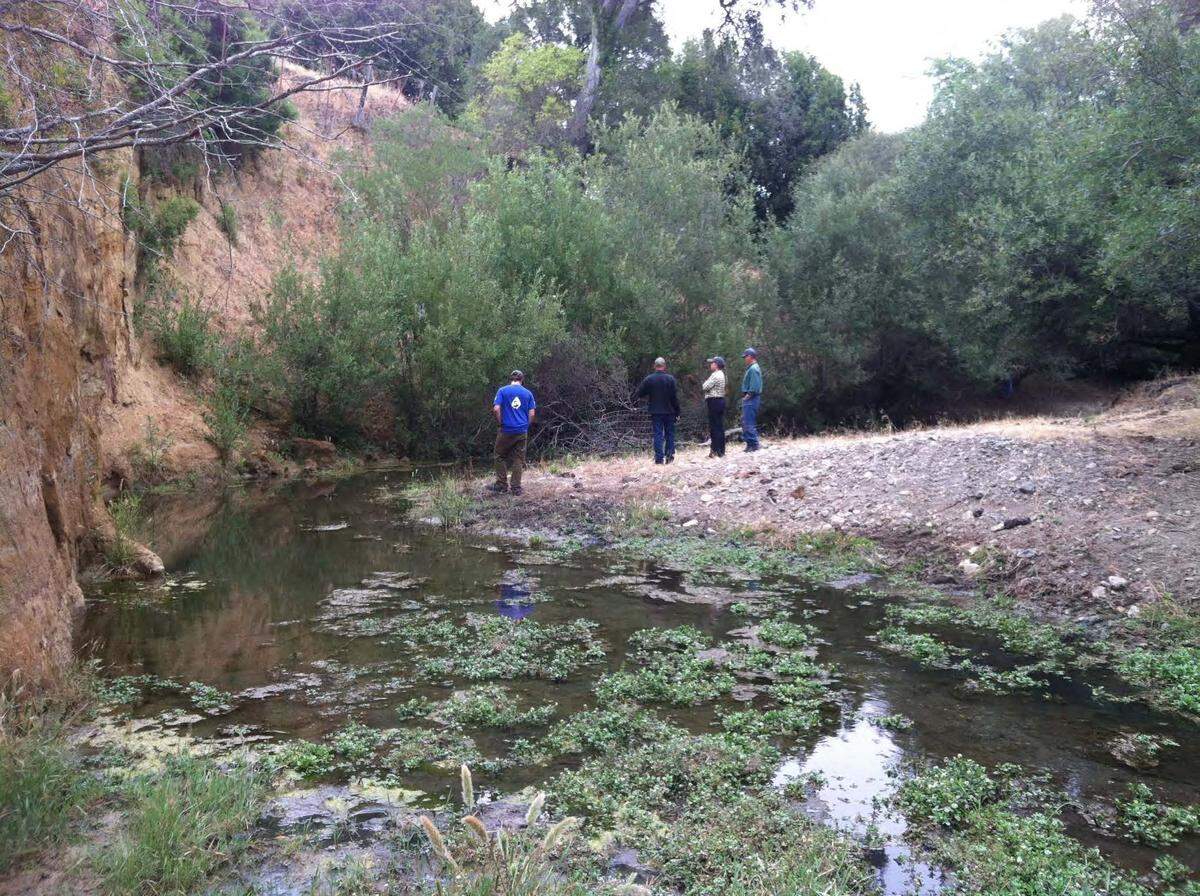
According to RCD’s program manager Andrew Johnson, Gerhardt approached the agency about a decade ago, hoping to find the most effective way “to fix a very eroded streambank on Santa Rosa Creek, the continuation of which would end in the inevitable collapse of Santa Rosa Creek Road.”
While there were many options, Johnson said in a series of email interviews, “the RCD approach would mean a focus not only on halting the erosion but doing it” in a way to produce “increased steelhead habitat. Our solution should in fact coerce the creek to deposit sediment on the previously eroded bank side, continually moving the channel away from the road.”
The project, he said, used 11 large in-stream structures linking woody debris and boulders “engineered to withstand the 100-year flow and emulate natural riparian features with complex habitat.”
Johnson said another key partner was Oly Fiscalini, a neighbor whose property was used as a staging area for equipment.
Johnson called Fiscalini, “a paragon of local wisdom and the few days that passed at the project site without a visit from Oly were worse off for it.”
Best said the project area received up to 14,000 cubic feet per second (CFS) on one afternoon during the late January storm. The project was designed for up to about 10,000 CFS, he said.
As far as weather patterns go, he said, “this was a bigger and more intense storm” than other major events, such as those in 1995, 1983 and 1969.
Part of the problem was timing.
The concrete used in the project hadn’t had enough time to settle before the storm hit, he said, and the water flow “compromised the structures” designed to protect the stream bank.
Now “we’re making plans to get emergency plans to make fixes,” he said.
As usual, the first step is finding the money to do the repairs.
Best said the project was a “lesson learned for the whole community, that we can go from drought to 18 inches of rain in 24 hours.”
What’s more, he said, “If we hadn’t done the project this summer, would the road even still be there?”
He doesn’t think so. “It would have washed out like Rat Creek,” Best said, referring to a section of Highway 1 near Big Sur that’s likely to be closed due to slip-out repairs until early summer.
About 150 feet of roadway there slid toward the sea after being undermined by torrents of rain from the late January storm.
This story was originally published March 15, 2021 at 1:02 PM.