
Wild turkeys flock to Cambria in time for Thanksgiving. Here’s what you need to know
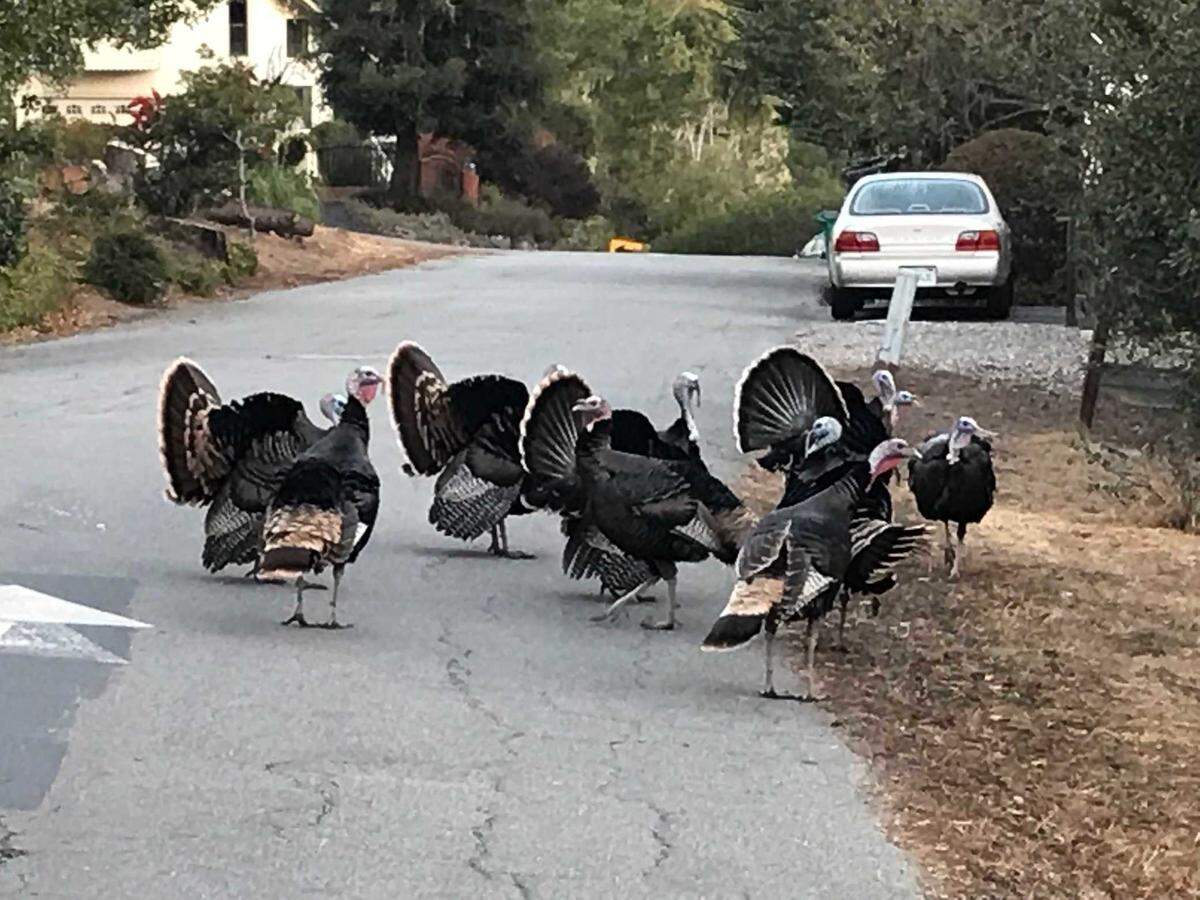
As the predawn darkness transitions into the first glow of daytime, the ever-expanding flock of wild turkeys in our Cambria neighborhood make their presence known.
The loud yelps, staccato clucks and the shrill, throaty gobbler calls cascade up from the forested canyon across Wilton Drive near Blythe Place.
Since I’m an early riser, the racket amuses me, but neighbors attempting to sleep longer assuredly are awakened on a regular basis.
As the sun pushes the darkness aside, the flock often crosses the street to scratch for food in an empty lot, or linger on the street, daring drivers to slow down.
This neighborhood flock has grown from a few turkeys a couple years ago, to a flock that numbers in the high 20s.
How many other flocks are setting down roots around Cambria?
The National Wild Turkey Federation estimates there are about 7 million wild turkeys in the United States.
Katherine Miller, upland game biologist for the California Department of Fish and Wildlife, writes in an email that the most recent estimate indicates there are about 242,000 wild turkeys in California, “encompassing 18% of the state.” That figure is from 2004, so numbers are likely higher now.
Wild turkeys seen roaming North Coast
Observes have spotted a wild turkey flock on the East Ranch of the Fiscalini Ranch Preserve. They “come down some mornings and evenings … but there are none that I know of on the West Ranch,” according to Kitty Connolly, executive director of Friends of the Fiscalini Ranch Preserve.
Connolly doesn’t see the turkeys on her Happy Hill home, either. “But that might be seasonal,” she wrote in an email.
Walt Andrus, Friends of the Fiscalini Ranch Preserve board member, agrees turkeys are not seen on the West Ranch, but can be spotted near his home
“The flocks on Lodge Hill do seem to be larger this year,” Andrus wrote in an email. “It could be a greater scarcity of food that has moved them more into our neighborhood.”
“The interesting thing is that they seem to disappear a couple weeks before Thanksgiving and return a short time after,” he added. “Perhaps they are better adapted to humans than we give them credit for.”
Lodge Hill resident Karen Dean reported on Cambria’s Nextdoor site that she has counted “as many as 49 turkeys in a flock at one time.”
This year, young turkeys are abundant, Dean writes. “I don’t know how many survive with the other wildlife in our area … (with) coyotes, mountain lions, and bobcats sharing Lodge Hill.”
Todd Tognazzini, retired Fish and Wildlife Department captain for San Luis Obispo and Monterey counties, said that “people think they’re doing a good thing by feeding the turkeys.” But it doesn’t help the birds, he added.
“The turkeys get acclimated to being around town, get used to being around people … with no natural predation” in neighborhoods flocks often expand, Tognazzini added.
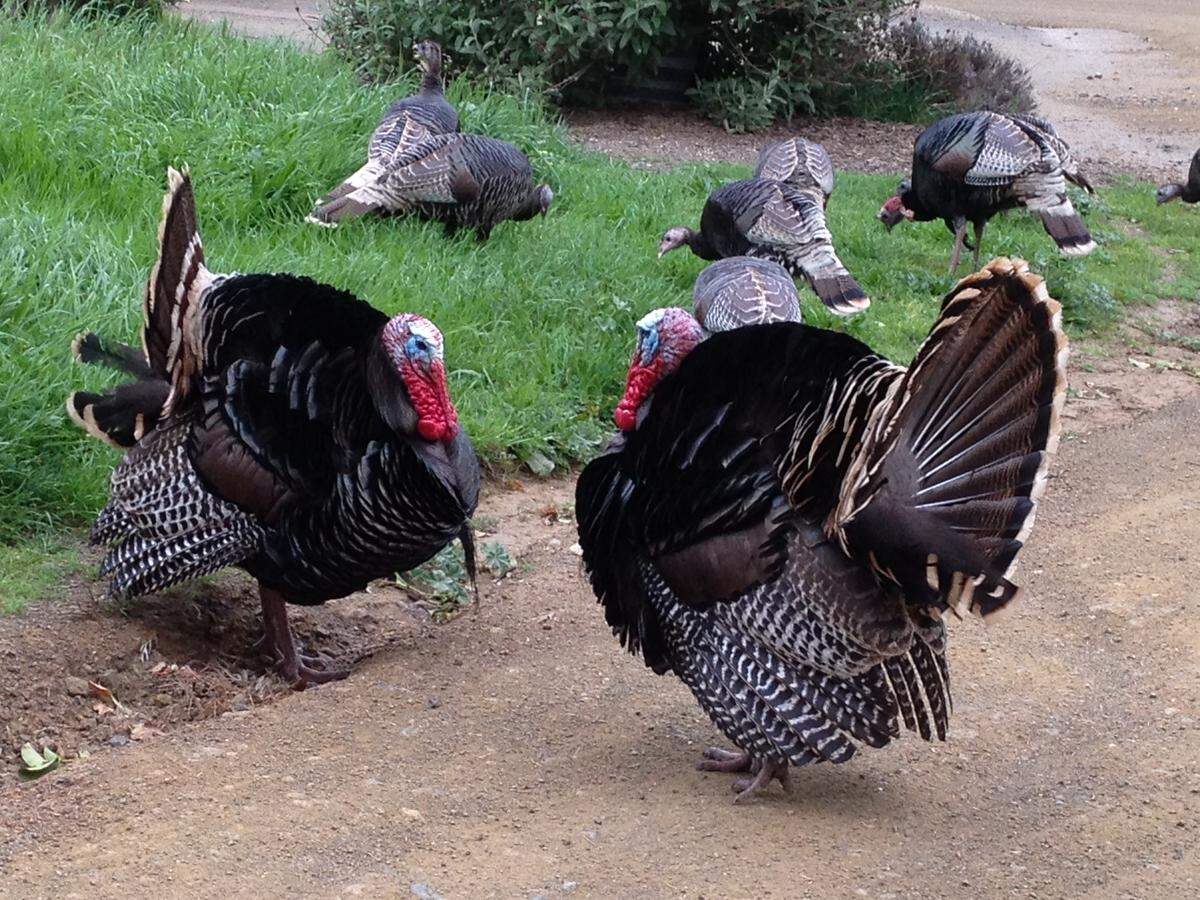
Cambria naturalist and writer Christine Heinrichs said turkeys are “abundant here,” and problems they may create reflect the fact that people feed them. “As if they don’t have enough to eat!” Heinrichs wrote via email.
Wildfires, drought affect California turkey population
While the statewide turkey population increased between 1990 through 2011, there was a “subsequent decrease … (which was) likely due to the severe drought,” Miller said.
When more wild turkeys are located in a given area, “it does not necessarily indicate population explosion,” she explained.
Seasonal changes provide changes in turkeys’ search for food.
“The population may have reached carrying capacity,” leading to “an intermittent flow of individuals into other areas,” Miller said.
In the past 10 years wild turkeys have faced “an increase in human development, drought and some very severe wildfire seasons, and the birds have dispersed into other areas as a result,” Miller explained.
The Chimney and Soberanes fires of 2016, and 2020’s Dolan Fire burned a total of 302,865 acres in the area. So Miller expects that “the birds have moved from lost habitat into new habitat.”
As the California Fish and Wildlife Department continues to “monitor climate change and the related effects of precipitation and wildfire,” a better understanding of whether the turkey population is increasing or decreasing may be clear.
Folks who feed turkeys are violating the California Code of Regulations, Title 14, Section 251.1, Miller said. The code states that “No person shall harass, herd or drive any game of nongame bird or mammal or furbearing mammal.”
Harassment is defined as “an intentional act which disrupts an animal’s normal behavior patterns,” which includes “breeding, feeding, and sheltering,” the code points out.
When turkeys are provided food, this can cause them to be more aggressive, Miller noted.
Can you hunt wild turkeys in Cambria?
So, can you nab a nice, fat wild turkey for your Thanksgiving dinner table?
First of all, San Luis Obispo County ordinance prohibits the use of weapons for legal game hunting — by shotgun, air rifle or bow — in Cambria.
Secondly, a hunting license and upland game bird stamp are required before setting out to shoot a turkey outside Cambria’s boundaries.
The legal season for hunting wild turkey is Nov. 14 to Dec. 13; hunting is allowed daily during that period from half an hour before sunrise to 5 p.m. Hunters can harvest up to two turkeys per season — one male, one female, according to the CDFW website.
Homeowners experiencing property damage from wild turkeys may obtain a depredation permit from the Central Region of the CDFW. Call 559-243-4005 or email reg4sec@wildlife.ca.gov.
As to eating the bird, the wild turkey is smaller, has darker meat and has a “slight gaminess and firmer texture” than domestic turkey, according to Exotic Meats USA.
The wild turkey has a “lot less breast meat” than domestic turkeys because the wild birds’ breasts are designed to help them to fly. When the bird is overcooked, the meat becomes dry.
Generally, wild turkeys have substantially less meat per bird than domestic turkeys, which may not be a bad thing. That’s because, according to the Natural Resources Defense Council, 204 million pounds of turkey meat is wasted during Thanksgiving each year.