SLO County real estate mogul John King accused of ‘massive fraud’ in RICO lawsuit

One of San Luis Obispo County’s largest real estate moguls, John King, has been accused in a federal lawsuit of orchestrating a years-long fraud scheme that allegedly shielded the family-run property empire from tens of millions of dollars in unpaid debts.
In an interview with The Tribune, Tony O’Neil, a principal of one of the companies suing King, described the matters alleged in the complaint as either “the most brilliant asset protection scheme” or “one of the greatest frauds we’ve seen on the court, in my opinion.”
John King and other defendants named in the lawsuit, however, uphold the allegations outlined in the suit are false, with two King lawyers saying it was part of “years of predatory and meritless litigation.”
King Ventures has been in business on the Central Coast for decades, amassing a rich portfolio of boutique hotels and other properties over the last 40 or so years, at various times including the Cliffs Resort in Shell Beach, the Sea Venture Resort in Pismo Beach, the Inn at Morro Bay, the Apple Farm Inn, Sycamore Mineral Springs Resort and Fremont Theater in San Luis Obispo.
At its peak, King Ventures’ portfolio valued in the hundreds of millions of dollars, the lawsuit said.
“His road to success was winding, and like many developers, he incurred substantial debts along the way. Many were paid. Others were not,” the lawsuit alleged. “And John will stop at nothing to shield his assets from those unpaid debts.”
The civil Racketeer Influenced and Corrupt Organizations — or RICO — lawsuit was filed against the King family and over 20 related entities on Dec. 17.
The complaint alleges these entities formed “a web of shell and insider-controlled companies” — some it claims are owned by John King’s son — that the family used to “launder” money through to avoid paying its debts and cover their personal living expenses and luxuries, like the mortgage on the family’s Hawaii vacation condo.
No criminal charges are alleged in the civil complaint.
The lawsuit, brought by Wolverine Endeavors VIII LLC and Coronitas Holdings LLC — two judgment creditor companies allegedly owed a total of over $20 million by King-controlled entities — alleged the property owner “fabricated insider liens, issued sham levies and executed fake foreclosures against itself.”
“This action arises from an asset protection scheme so extreme that it may only be described as a massive fraud upon the courts and the legitimate creditors of a prominent San Luis Obispo family,” the lawsuit said. “The family bought two judgments against itself, became its own sham ‘creditor’ and uses that position to unlawfully control and shield millions of dollars in assets from lawful collection.”
Several long-standing employees and associates of the high-profile hotelier were also named in the lawsuit as members of a “syndicate of confidants,” including Paul Metchik, who the suit identified as John King’s lawyer, and developer Rob Rossi, identified as John King’s business partner.
“For more than a decade, this syndicate ... has acted in concert — lying, concealing, perjuring, falsifying records and manipulating courts — to achieve a single goal: keeping the money in the family and protecting King family assets, at all costs, from legitimate creditors,” the lawsuit alleges.
Both Metchik and Rossi denied any wrongdoing in court filings and statements to The Tribune by their representation.
O’Neil, whose company Wolverine Endeavors is allegedly owed north of $10 million, believes John King has successfully executed this “scheme” for decades, defrauding creditors and preserving the empire for his son, John G. King, who is also accused of being largely involved, as was King’s late wife, Carole King.
“It’s an egregious manipulation of the court system, from our point of view,” O’Neil told The Tribune.

Wolverine Endeavors and Coronitas Holdings are suing for a combined total of $21 million, but treble damages potentially available under the RICO allegations could triple that amount — before also adding attorney’s fee and interest.
All in all, John King, his family, companies and business partners named as defendants could be liable for over $63 million if the lawsuit succeeds, and the “scheme,” if proven, would be broken up by court orders.
Lawsuit a part of ‘years of predatory and meritless litigation,’ King lawyers say
Six court documents filed on June 23 by the various RICO defendants answer to the complaint, wholly denying the fraud allegations and arguing the King family’s business dealings have all been above board.
“The formation of limited liability companies, assignment of interests, restructuring of ownership, capitalization decisions, payment of operating expenses, tax planning and estate planning described in the complaint constitute ordinary business and family financial planning activities undertaken by owners and managers of closely held entities,” John G. King’s answer to the complaint said. “Such activities are presumptively valid exercises of business judgment and property rights.”
“Defendants acted in good faith and without fraudulent intent,” the filing said.
John King and his son’s answers to the complaint both allege that Wolverine and Coronitas failed to establish the essential elements of a RICO claim and that, even if they had, the four-year statute of limitations on such claims had expired.
“The purported ‘enterprise’” — the so-called “syndicate of confidants” including the King family, employees and companies alleged in the complaint — “merely repackages pre-existing family relationships, long-standing business relationships and ordinary, coordinated litigation activity, and plaintiffs allege no decision-making structure, hierarchy or organizational framework separate and apart from the alleged wrongdoing,” John King’s answer to the complaint said.
On June 9, a federal judge denied the defendant’s eight motions to dismiss the complaint, according to court records. The case is set to go to trial on July 27, court records show.
John King did not respond to The Tribune’s multiple attempts to reach him for comment via King Ventures. A personal contact of John King’s said he declined to comment.
A hearing was held in SLO County on July 9 for an associated civil case involving Wolverine. The attorney representing John King in the case said he could not speak on the matters when asked for comment by The Tribune at the hearing.
The Tribune emailed detailed lists of questions to each of the attorneys representing John King, his son, Metchik and Rossi in the RICO case, to which the legal teams sent statements and court documents in response. The Tribune also hand-delivered the questions to King Ventures in person.
“The plaintiffs have engaged in years of predatory and meritless litigation,” Eliot F. Krieger, John King’s lawyer in the RICO case, responded in an emailed statement. “This is just the most recent example. The allegations are false and Mr. King will rebut them in court.”
Krieger also referred The Tribune to a tentative ruling issued July 7 by the U.S. Bankruptcy Court for the Central District of California in Carole King’s bankruptcy case, in which the judge wrote that she was “involuntarily forced into bankruptcy” and that the case was a “litigation tactic” by Wolverine. The judge concluded Wolverine’s conduct — along with that of another creditor company and a bank — was “at times, questionable, and for some, amounted to bad faith.” Wolverine was ordered to pay over $100,000 in incurred legal fees to Carole King, according to the ruling.
“Wolverine’s actions before the petition date, on the petition date, and after work in concert to make clear that this case had no proper purpose,” the filing said.
John G. King’s lawyer, Karineh Darbinian, responded with the same statement verbatim and referred The Tribune to the same July 7 ruling.
The law firm representing Metchik referred The Tribune to his motion to dismiss and reply in support of the motion, in which his lawyers wholly denied all allegations against him and claimed the RICO complaint “suffers from a myriad of fatal flaws.”
Rossi’s representation had a similar stance.
“In more than 40 years in real estate, Rob Rossi has always conducted his business honestly and within the law,” Scott D. Tenley, Rossi’s lawyer, responded in an emailed statement. “He is confident in his position and looks forward to his day in court.”
Carole King passed away on July 8, according to court records. One court filing said she had advanced Alzheimer’s disease, which “negates any specific intent to defraud attributable to her and any inference that she knowingly directed or participated in the alleged conduct.”
SLO County developer perpetrated alleged fraud scheme through ‘sham creditors,’ lawsuit says
This is not the first time John King has come under legal fire.
In 2009, Rhode Island-based lender Textron Financial Corp. sued John King twice in federal court over two separate properties — a Price Canyon property called Spanish Springs II LLC, and another, Vaquero de los Robles LLC, in Paso Robles — claiming he had defaulted on loans of more than $14 million, The Tribune reported at the time.
Around the same time, Wells Fargo Bank foreclosed on the Inn at Morro Bay due to what it claimed was an unpaid $9 million loan.
The court issued judgments that Textron was owed a total of over $16 million in unpaid loans, interest and attorney’s fees across both cases, the RICO complaint said.
The complaint also claimed these judgments have acted as the core mechanism for John King’s alleged fraud scheme.
A money judgment in a lawsuit is a court order that legally determines whether money is owed and to whom. Money judgments can be treated like assets that can be bought and sold, giving the holder the right to collect a debt through judgment liens.
When multiple creditors seek payment from the same debtor, the law often follows a “first in time, first in right” rule, meaning secured creditors who get in line first are generally paid before those who came later. The oldest outstanding and enforceable judgments usually have priority over other, newer judgments.
John King accrued many creditors seeking to collect over the years, including the companies now suing him, according to the lawsuit.
Wolverine was assigned a judgment from a loaning bank against Fresno Pacific Towers Inc. — a King-owned property company headquartered at the King Ventures offices at 285 Bridge St. in San Luis Obispo, according to OpenCorporates — and renewed the debt for $7 million in 2021, the RICO complaint said.
Coronitas was similarly assigned a judgment against Spanish Springs LLC — also King-owned and headquartered at the King Ventures offices — in 2021 and renewed it for $9.9 million in April 2025, the complaint said.
The whole time, however, the Textron judgments allegedly loomed over them as the senior-most, outstanding judgments. With interest, Wolverine and Coronitas’ judgments now exceed $20 million total, and both remain unpaid, the lawsuit said.
Here is the crux of the complaint: Even though they are not recorded as paid on paper, the RICO lawsuit alleges that the original $16 million Textron judgments were materially satisfied.
Instead of recording them as such, however, the lawsuit alleged those judgments are being kept alive fraudulently with the intent to block other junior debts from being paid.
Back in 2010, John King and Textron settled, with the developer agreeing to pay out $4 million over the next decade to satisfy both judgments, the complaint said. By December 2015, it said, various King entities had paid Textron a total of $3.4 million — almost completely satisfying the judgments.
But instead of John King paying the last $600,000 to Textron to close the judgments, on Jan. 13, 2016, a company called ORKA Real Estate Partners LLC wired $600,000 to Textron to “purchase” the bundled judgments, keeping them alive, the lawsuit said.
Registered at 750 Pismo St. in San Luis Obispo, ORKA is owned and controlled by John G. King and Rossi, the lawsuit said.
The company was formed in 2015, according to OpenCorporates. The lawsuit claimed this was after John King allegedly told Rossi and his son, “If they wanted to protect their interest in what they had, they better check and get involved in this thing ... they better find out and see what they can do to help themselves.”
The lawsuit alleges that John King financed ORKA — which it called an insider-controlled entity — with the $600,000 ORKA then used to assume the Textron judgments.
The judgments were later reassigned to AKRO Real Estate Partners LLC in 2020 — another “sham creditor” owned by Rossi and John G. King and headquartered in SLO, the lawsuit said. AKRO’s OpenCorporates profile also lists Metchik as an agent.
“The King Family never intended that payment to satisfy the Textron judgments or release Textron’s liens, charging orders or assignment orders,” the lawsuit said. “Instead, acting through their long-time partner and counsel, Metchik, the King Family executed a plan to keep Textron’s enforcement rights alive but under their own control. Rather than allowing that final payment to extinguish Textron’s claims, they engineered a paper transfer of the judgments to an insider entity they directed.”
Thus began the King family’s “insider-controlled self-lien scheme,” the lawsuit claimed.
This meant John G. King essentially controlled the senior-most judgments against his parents, the complaint said. Any new creditors holding junior liens — such as Wolverine and Coronitas — were “effectively blocked by the senior Textron judgments — which, on paper, still appeared to total nearly $16 million,” the complaint said.
Additionally, the lawsuit pointed to a previous John King testimony in which he said under oath he did not intend to pay one of the junior judgments.
In a Feb. 25, 2022, judgment debtor examination, King said that he wouldn’t file for bankruptcy because he thought the judgment in question — now held by Wolverine — was “unfair” and “I don’t intend on ever paying it,” according to a certified copy of the exam transcript attached as an exhibit to the lawsuit.
The lawsuit noted other examples where it said this same strategy was repeated.
For example, John G. King formed a company in 2022 to acquire the senior-most $1 million judgment lien against the King’s Maui vacation condo, walling it off from other valid asset collection liens, the complaint alleged.
The lawsuit also claimed the King family similarly “conspired” with a close friend to protect their $4.2 million San Luis Obispo home from debt collection.
Despite the complexity of the alleged “scheme,” the lawsuit said John King has not necessarily attempted to hide it.
According to the complaint, John King had told the president of Monterey County Bank in a Feb. 13, 2024, email that “’for tax reasons, etc., my attorneys advised that my son buy the (Textron judgments), which he did,’” and “’over the past 15 years, JG (John G. King) has purchased almost all of my wife’s and my interest in our major assets.’”
By Sept. 30, 2023, John G. King’s net worth was more than $270 million, according to a financial statement attached to the lawsuit as an exhibit.
The junior creditor companies have recently made progress in the courts.
On July 9, SLO County Superior Court Judge Craig Van Rooyen made a ruling in Wolverine’s favor in a related case to terminate AKRO’s Order for Appearance and Examination — or ORAP — on one of the Textron judgments, which was the primary enforcement tool blocking the King family’s personal property from collection by junior judgment holders.
As a result, Wolverine and other junior creditors, like Coronitas, may now have an opportunity to start collecting on its $10 million debt, Armen Manasserian, one of the attorneys representing Wolverine in the RICO case, told The Tribune.
“This top layer of protection has now been, kind of, blown up,” Manasserian said.
King company used as ‘washing machine’ to launder money, lawsuit says
While the King family owed millions to Textron and had pledged its assets to the banking company, it used one King-owned entity as a “washing machine” to quietly redirect its cash to cover the family’s personal living expenses, the complaint alleged.
In 2012, the court assigned charging orders in Textron’s cases that required a long list of King-affiliated companies to turn over any profits or payments from their businesses to Textron until the $4 judgment settlement was satisfied, the complaint said.
But instead of doing so — and in violation of the charging orders — nearly $5 million was transferred from various King-owned entities to pay for the family’s expenses, the complaint alleged.
When the Textron judgments were assigned to ORKA in 2016 and later AKRO, those charging orders were still in effect, but they were put into the hands of John G. King who did not enforce them the way a real creditor would have, the complaint alleged. John G. King denied the allegations in his answer to the complaint.
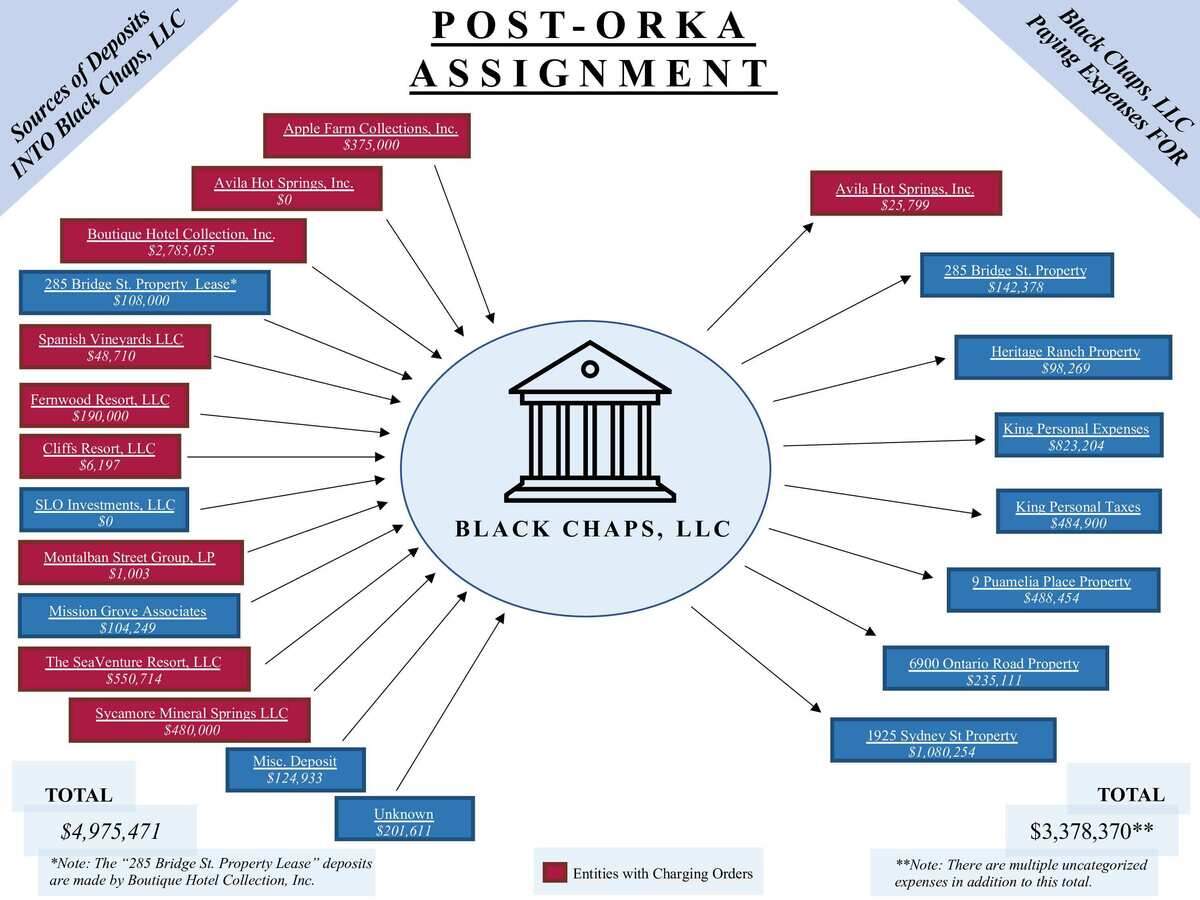
From 2016 through 2022, nine “complicit entities” paid a total of $4.88 million into a King-owned company called Black Chaps LLC, the complaint alleged.
Registered in 2008 and headquartered at the King Ventures offices in SLO, according to OpenCorporates, Black Chaps was the “washing machine” that operated as “the cornerstone of the King family’s money laundering scheme,” the complaint said.
“This structure has enabled the debtors to have nearly all their life expenses covered without ever depositing a dollar into their own personal bank accounts,” the complaint said.
During the same time frame, Black Chaps paid out nearly $3.7 million worth of personal expenses for the King family, including over $1.5 million in mortgage and other payments on the Kings’ San Luis Obispo residence and Maui vacation condo, $1.1 million in healthcare expenses for the King family and relatives, $142,000 in property taxes for the King's Bridge Street office and $485,000 to the IRS and California Franchise Tax Board for John King’s personal taxes, the complaint alleged.
“The fraudulent scheme, initiated by John himself, has worked as designed,” the complaint said. “His companies continue to pay all his living expenses in flagrant disregard of charging and assignment orders entered by this court against those companies.”
However, not all “fraudulent” transfers were made through Black Chaps, the complaint alleged.
Between Feb. 15 and 17, 2022, five entities transferred more than $1.5 million into the bank accounts of King Ventures, which was then wired to the IRS and California Franchise Tax Board to pay John King’s 2021 taxes, the complaint alleged.
The complaint alleged that some of the companies also issued credit cards used by King family members to make thousands of dollars worth of purchases at auto shops and furniture stores in Hawaii, the Five Cities Veterinary Hospital and a Big 5 Sporting Goods.
The complaint also points to A.J. Spurs, Inc. — a now-dissolved corporation tied to the King Ventures office address — as another conduit for personal spending.
Despite dissolving in 2007, according to OpenCorporates, the complaint attached copies of multiple checks drawn on A.J. Spurs’ account in 2020 and 2021 to pay the Kings’ personal living expenses that were allegedly filled out in Carole King’s handwriting and signed by John G. King.
All of this financial information came from the King family’s general ledger, which was willing given to O’Neil, he told The Tribune.
“I think they genuinely believe there’s nothing wrong with it,” O’Neil said.
John King denied the allegations in his June 23 answer to the complaint, which also responded on behalf of Black Chaps.
“Defendants acted in good faith and without any intent to defraud,” the filing said. “The transactions, transfers and entity, tax and family-succession decisions challenged in the complaint were undertaken for legitimate purposes, and defendants reasonably believed their conduct was lawful and proper.”
‘Fake’ foreclosures kept property within the family business, lawsuit says
Another way the lawsuit alleged the King family used the Textron judgments was to execute “fake foreclosures against itself to keep the money ‘in the family.’”
In 2017 and 2019, right after ORKA acquired the Textron judgments, ORKA used those judgments to secure court orders to “foreclose” on two valuable properties John and Carole King each held 50% interest in: the historic Fremont Theater and surrounding buildings, and the Apple Farm Inn, the complaint said.
Despite being valued around $10 million and over $20 million, respectively, both King properties sold to ORKA for a mere $6,000 in credit each, the complaint said.
To do so, the complaint alleged that Metchik misrepresented the Textron judgment balances to the court at more than $5 million, when in actuality the $4 million settlement had been materially satisfied, the complaint said.
Overstating the debt on the properties had “a chilling effect on bidding,” essentially icing out all other legitimate bidders so that ORKA was guaranteed to secure the properties at a price far-below market value, the complaint said.

The Fremont Theater and nearby properties — including the addresses 1009 through 1025, odd numbers only, and 1037 Monterey St. — were valued between $7.3 million and $10.1 million around the time of sale in July 2017, and the Apple Farm Inn located at 2015 and 2121 Monterey St. was valued between $21.1 million and $25 million at the time of sale in May 2019, the complaint said.
They were each acquired by ORKA for $6,000.
“These values were severely depressed as a result of the insider transactions,” the complaint said. “Had they been sold to satisfy a legitimate creditor, they would have sold for much more.”
What’s more is the $6,000 bids were not made with cash but using the “debt” from the Textron judgments as a credit toward ORKA, the complaint said.
The credit purchase extinguished all junior liens against the properties — including Wolverine’s and Coronita’s, blocking their ability to collect “between $5 and $6.3 million in assets” on their judgments, the complaint said.
John King and John G. King both denied the allegations in court records.
What happens next?
The federal lawsuit is set to go to trial in front of a jury in California’s Central District Court on July 27, according to recent court filings.
The case will be heard before Judge John F. Walter in courtroom 7A at the Felicitas and Gonzalo Mendez United States Courthouse at 350 W. First St. in Los Angeles, court records said.