Advocates want more oversight of ECHO’s homeless shelter practices. Is it needed?
On a pleasant mid-October morning in Paso Robles, Adan Chavarria-Estrada’s day was already off to a poor start.
The day before, the 36-year-old homeless resident of Paso Robles had been kicked out of the El Camino Homeless Organization’s 90-day shelter program for allegedly possessing drug paraphernalia — a hollowed-out pen he said he used as a straw.
After that, Chavarria-Estrada left the shelter, intent on returning to the spot in the Salinas Riverbed where he had been living prior to entering ECHO’s program — only to be critically injured blocks from the shelter when he was hit by a car.
Chavarria-Estrada said he doesn’t remember being hit by the car but does remember waking up in the hospital following surgery that placed a stent in his heart to circumvent a blood clot. The collision crushed his left leg in several places, broke multiple ribs and tore the ligaments in his right knee, which he said will require an extensive surgery at UCLA if he wants to walk again.
The exit from ECHO didn’t come as much of a surprise to Chavarria-Estrada, who said he had voluntarily quit the program once in the past but was committed to following through with his housing plan on his second attempt.
He acknowledged that he has a recent history of methamphetamine and fentanyl use but said he was making a concerted effort to change his ways when he was enrolled with ECHO.
“I don’t have any resentments toward (ECHO),” Chavarria-Estrada told The Tribune at his hospital bed at Adventist Health Sierra Vista hospital in San Luis Obispo. “I just kind of feel like I should have been given more of a chance.”
ECHO doesn’t work for high-need clients, advocates say
Chavarria-Estrada’s story is not the only account of ECHO clients who fell through the cracks in the 90-day program, which guarantees a client a bed for three months while they work with case managers to resolve their housing needs.
Grassroots activist Kimberlee Booth often interacts with the homeless community in the Salinas Riverbed and can frequently be found passing out food and clothing or coming and going from ECHO’s Paso Robles shelter, trying to help clients sort out paperwork.
Booth’s history with homelessness is deeply personal. Her daughter Ashlynn Miles, who suffers from schizophrenia, was frequently the target of sexual assault while she was homeless in San Luis Obispo County and is currently in the custody of a mental health facility in Fresno County.
Through her Facebook page “Hope for Ashlynn,” which she uses to share updates on homeless residents she helps such as Chavarria-Estrada, Booth has criticized ECHO’s approach to care — sometimes calling out specific case managers by name and painting a picture of a shelter system that doesn’t serve everyone equally well. She’s also galvanized some homeless residents against ECHO, creating distrust between some residents and the nonprofit.
Marsha Bailey, 70, a friend of Booth, sought help through ECHO after she lost her housing in January but got little guidance from her case manager when it came to actually applying for things such as housing and Social Security Disability Insurance.
Bailey, who’s had a stroke and a variety of health issues that cause memory loss, said she was given phone numbers for Social Security and other services but little direction on how to actually get the benefits she needs.
“I’d go in and I’d sit down and just a little bit of talk — ‘How you doing?’ — and then she’d look at me and go, ‘Marsha, do you have anything to say to me?’” Bailey said. “And I’m thinking, since she is the one who’s supposed to be telling me stuff, I go, ‘No,’ and she goes, ‘OK, then I have nothing to say to you, so you can go.’”
Another older client, who has early onset Alzheimer’s Disease and asked not to be named because she feared retaliation by the shelter, said she was initially hopeful that ECHO could get her into housing.
“When I got there, it was like I could breathe,” the client said. “I felt safe.”
But as her time at the shelter went on, the woman said she encountered several barriers to successfully finding housing.
She was initially matched in August with Transitions-Mental Health Association to find placement in the nonprofit’s housing, but that opportunity fell through because she failed to mention that she owns dogs without knowing they wouldn’t be allowed.
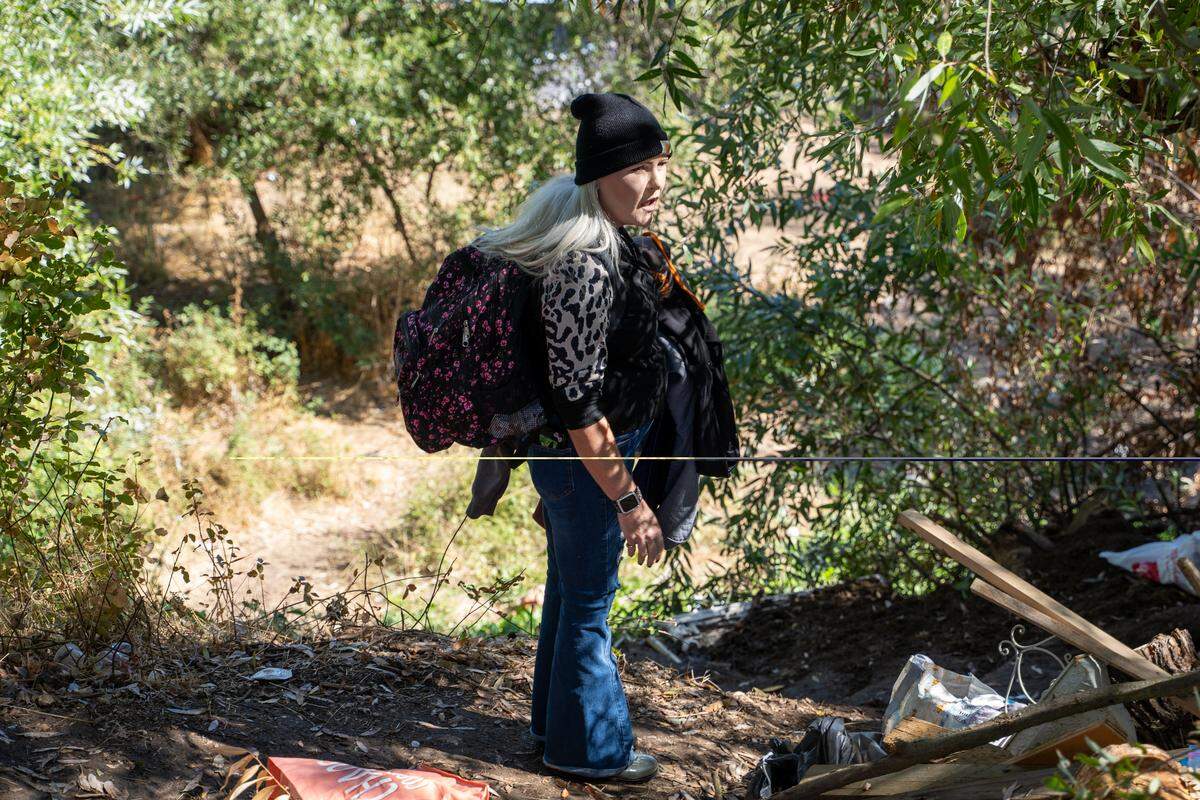
With no income and little progress made on her housing goals, the client — who has suffered multiple strokes and seizures and has limited mobility — was told she would be exited from the shelter in early November.
The woman said she lost out on housing opportunities not because she didn’t want them, but because her case manager didn’t put her in a position to succeed.
“She’s supposed to be my case manager. She has information that I don’t know how to get,” the client said, trailing off. “I don’t know how to use it if I have it, so to speak.”
Advocates, former ECHO director call for oversight
At the Nov. 5 Paso Robles City Council meeting, several homeless residents and advocates took to the podium during public comment to express their displeasure with ECHO’s practices.
During her speech, Booth said that while ECHO describes its shelters as “low-barrier” — meaning they accept people struggling with addiction, mental illness and disabilities — there isn’t actually enough support for individuals living with those conditions.
Booth repeated her claim that ECHO’s case managers are not responsive to individuals with more substantial health and medical needs, who are often subjected to being kicked out into homelessness.
“In San Luis Obispo County, we are unique for having three homeless shelters,” Booth said. “This is almost unheard of for a county of our size, yet despite this, we do not have one single emergency bed in this entire county.”
“What we are seeing is a revolving door, people cycling in and out of shelters without real help and permanent solutions,” Booth said.
Booth and other advocates concluded their criticisms by asking for more independent oversight in the name of holding ECHO’s case managers accountable.
Aurora William, ECHO’s former executive director when it was still a faith-based organization, said the organization’s new approach through the 90-day program is a generally good a way to tackle homelessness, but it has laid bare some of the flaws in the way ECHO’s case managers deal with clients.
William said ECHO’s case management staff does not have a sufficient background in social services or mental health to serve high-need clients enrolled in a low-barrier program.
She called Booth’s pitch to introduce independent oversight “brilliant” and referred to Chavarria-Estrada’s exit and subsequent injury as a clear case of ECHO’s case managers being unable or unwilling to deal with individuals with higher needs.
“I don’t know that he was caught, but I know that his behavior could be indicative of using, or it could be indicative of withdrawal,” William said. “He was taken in as a low-barrier, and to throw somebody to the street, where they can be a hit by car and end up on life support, in my opinion, is criminal.”
William also spoke at the Nov. 5 City Council meeting, adding her voice to other advocates’ requests for more oversight of ECHO’s day-to-day practices.
“I don’t think there’s anything wrong with (independent oversight), and I would think that somebody who’s running the shelter would fully appreciate that added level of support,” William said.
ECHO denies need for more oversight, lack of adequate training
In an email, current ECHO executive director Wendy Lewis said the nonprofit does not need additional oversight beyond what it already gets from its board, the county’s Homeless Services Division, the Homeless Services Oversight Council and municipalities that provide funding.
She said ECHO’s reliance on a mix of federal, state, county, city and private funding already comes with extensive oversight, such as a recent independent external financial audit that ECHO passed.
“Because multiple layers of thorough oversight are already in place throughout the year, adding additional oversight would strain staff capacity,” Lewis said in the email.
Lewis said all ECHO staff participate in ongoing professional development, including training in trauma-informed care, homelessness best practices, and mental health support, as well as training through CAPSLO, Transitions-Mental Health Association, Ryan Dowd’s Niche Academy, and other partners specializing in behavioral health and supportive services. She did not specify whether case managers have an educational background in social work.
“We recognize that homelessness is complex and often intersects with mental health and substance-use challenges,” Lewis said. “While we are not a clinical treatment provider, we are deeply committed to connecting clients with the experts and agencies best equipped to support their needs.”
ECHO’s 90-day program is intended to help individuals and families successfully transition back into housing using a 70/30 model, which tasks clients with taking an active role in their housing plans while providing case management to take care of the things a client cannot, including after they’re housed, Lewis said.
Lewis pointed to ECHO’s 60% overall success rate with the 90-day program, which she said has placed more than 355 individuals and families into secure housing this year — the most in ECHO’s history — as a sign that the approach works better.
She added that 90% of individuals placed into housing though the 90-day program stay housed after the fact, though advocates such as Booth and William dispute the accuracy of these figures.
For its most vulnerable clients, ECHO works with the county’s Behavioral Health Department, Transitions-Mental Health Association, Adult Protective Services, Veteran Services, Social Security, Lumina Alliance, and others, Lewis said.
“We do not claim to specialize in all areas of need, but we are proud to connect clients with expert resources throughout San Luis Obispo County,” Lewis said. “For elderly clients experiencing cognitive decline, for example, we partner with agencies such as APS (Adult Protective Services) to ensure they receive comprehensive wraparound support.”
Still, that’s not enough to bridge the county’s “critical gap” in shelter beds for people who need them, even as ECHO has grown from a single 60-bed shelter to operating a total of 140 beds in two locations, not counting a planned Family Wing expansion in Atascadero that will add 30 more, Lewis said.
ECHO’s current waiting list for shelter is 300 individuals and families long, and that represents the hardest part of ECHO’s job: turning people in need away when the shelter is full, she said.
“One of the hardest parts of our work is telling someone we do not have a bed available that night,” Lewis said. “But we never let that be the end of the conversation.”
This story was originally published December 3, 2025 at 10:14 AM.