Grover Beach’s wastewater rates to go up after protests fall short. What to know
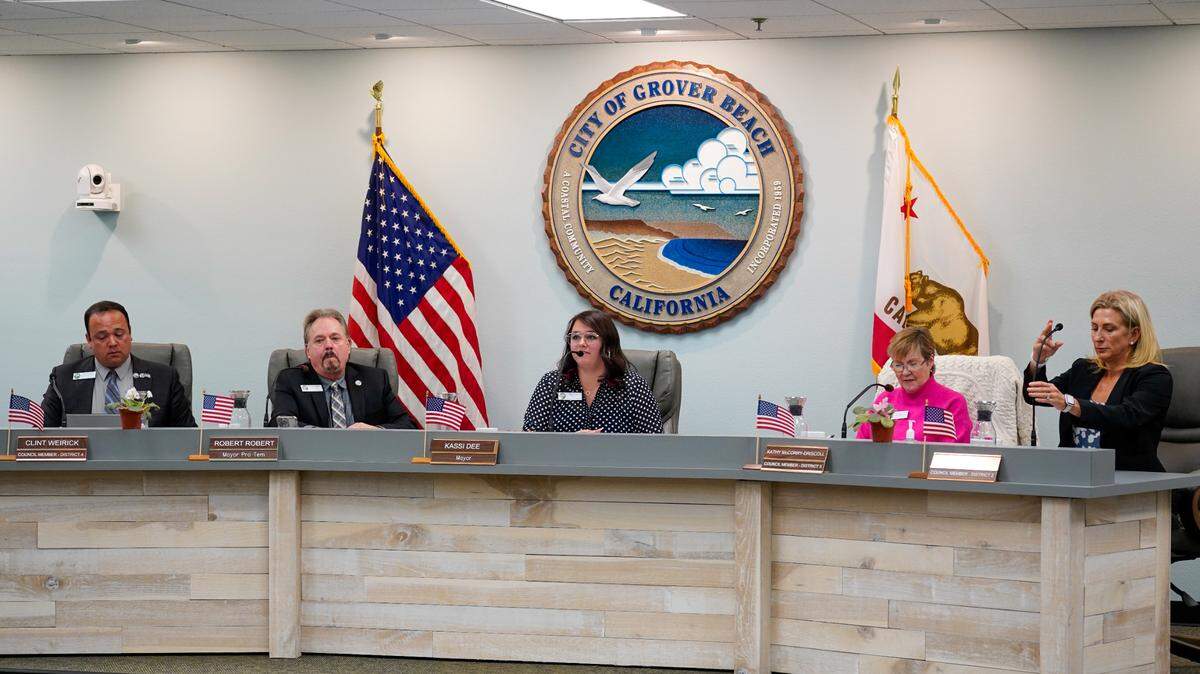
Disputes over whether Grover Beach should raise its wastewater rates to pay for infrastructure upgrades continued on Monday evening as the Grover Beach City Council unanimously voted to approve a new wastewater rate structure that will see sewer costs increase by 90% by 2030.
On Monday, the Grover Beach City Council heard a final report from city staff on whether increasing wastewater rates was needed to pay for sewer maintenance and infrastructure costs as the Proposition 218 public protest period came to a close.
The protest period, which started April 14, required the council to send notices to every customer of the wastewater system explaining the rate change, why it was needed and giving them an option to send in a protest ballot.
Had the city received protests from more than 50% of customers — or a minimum of 2,681 votes — the rate structure change would have been off the table.
However, when the tally was conducted during Monday’s meeting, just 382 protest votes were received, well short of the 50% required to stop the rate structure change outright.
Council member Clint Weirick said while he understood the public’s thoughts on wastewater rate raises, if the council did not address the aging sewer infrastructure now, it would only incur a higher cost to the city 10 years down the line.
“People always say, ‘Why don’t act more like a business?’” Weirick said. “What’s one business that I go to that has not raised their costs to the customers in 10 years?”
Water and sewer rates drive political discussion in Grover Beach
For the past two years, raising water and sewer rates has been at the focal point of politics in Grover Beach, starting with the City Council’s December 2023 vote to raise water and sewer rates to pay for the Central Coast Blue water recycling project and other capital improvements.
That vote led to the creation of citizens grassroots group GroverH2O, which opposes water and sewer rate increases and spawned a batch of procedural and legal issues for the city, which ran the gamut from a successful lawsuit to get the repeal of the new water and wastewater rates onto the 2024 ballot through Measure G-24 to the successful recall of District 2 City Councilmember Dan Rushing.
While the council partially walked back the rate structure adjustment in 2024 due to public backlash, it acknowledged at the time that it would have to attempt to raise rates again down the line to pay for capital improvement projects including sewer upgrades.
As the dispute has raged on, city officials have repeatedly said the higher wastewater rates are needed to pay for infrastructure projects and capital improvements that have been in the city’s plans for the past decade.
At Monday’s meeting, city Administrative Services Director Nick Szamet said the 2021 wastewater rate structure that the city reverted to in 2024 simply does not meet the maintenance costs of the sewer system or the cost of making around $15 million in infrastructure improvements needed to update the city’s 60-year-old sewer lines and Measure K-14 projects.
Effectively, the new rate structure calls for the bi-monthly bill for single-family residential wastewater customers to increase from $25.64 to $30.20, Szamet said.
Several residents who have participated with GroverH2O’s efforts said by approving a new wastewater rate structure, the City Council is going back on an issue that the majority of voters already voted against through Measure G-24 in November.
“The people won — they won a lawsuit, the people won the recall, the people won the repeal, and now you’re just slapping us in the face,” GroverH2O member Brenda Auer said during public comment.
Budget decision coming later this month
Prior to the City Council’s hearing on the Proposition 218 protest, the Council received a presentation on the proposed 2025-27 fiscal year budget and capital improvement program through the 2030 fiscal year from city staff.
In the 2025-26 financial year, the city is projected to spend $37.57 million against a projected revenue of $44.4 million, and is projected to spend $30.17 million against a projected revenue of $28.6 million.
The five-year capital improvement program includes $7.94 million in funding for projects in the 2025-26 financial year and $3.85 million in the 2026-26 financial year.
Around 31% of the city’s 2025-26 budget is allocated for supplies and services and another 31% for staff salaries and benefits — figures that will rise to 39% for supplies and services and 41% for staff salaries and benefits in the 2026-27 fiscal year.
During public comment on the budget, District 3 Supervisor Dawn Ortiz-Legg said she felt “embarrassed” by the conduct of members of the public who directly called for the firing of staff members such as city manager Matt Bronson as a way to slim down the budget.
She estimated that not paying staff adequately cost the county between $28 and $60 million between 2014 and 2023 in turnover, training and recruitment costs alone.
“We had the same kind of thinking at the county for what I would call the ‘dark decade’ where we did not give raises, we nickel and dimed every piece, where we didn’t want to spend,” Ortiz-Legg said. “What happened from 2014 through 2023 is that we got way behind on being able to keep good quality people.”
What’s next for water and sewer rates in Grover Beach?
With the City Council’s approval, the new wastewater rate structure will go into effect July 1 this year, with wastewater rates set to rise 17.8% in each of the next five years.
In March, Bronson indicated that the city will try to raise water rates next year to further increase funding for the water system and capital infrastructure improvements.
A hearing on whether the city will approve the the financial year 2025-27 budget and financial year year 2025-30 capital improvement program is also planned for June 23.
“I know it’s hard for all of us to be up here and ask for more money,” Mayor Kassi Dee said in her closing comments. “I mean, I know I use this a lot, but the infrastructure is two times my age, and some people have infrastructure that’s three times my age, and again, I also don’t want to be the the council that decided to — we keep saying this — kick this can down the road, and it’s time to pick up the can and take it off the road and do something with it.”
This story was originally published June 10, 2025 at 1:23 PM.