SLO County city will ask residents for a wastewater rate hike this year. Why?
The city of Grover Beach is gearing up to revisit a controversial topic that cost a City Council member his seat in the most recent election.
For the past two years, raising water and sewer rates has been at the focal point of politics in Grover Beach, starting with the City Council’s December 2023 vote to raise water and sewer rates to pay for the Central Coast Blue water recycling project and other capital improvements.
That vote led to the creation of citizens grassroots group GroverH2O, which opposes water and sewer rate increases and spawned a batch of procedural and legal issues for the city, which ran the gamut from a successful lawsuit to get the repeal of the new water and wastewater rates onto the 2024 ballot through Measure G-24 to the successful recall of District 2 City Councilmember Dan Rushing.
Now, the city is once again looking at raising its wastewater rates to pay for infrastructure repairs including sewer system upgrades — and discussions of a new rate structure are already reviving old tensions about the issue.
“The community spoke — they didn’t want it, but the council at the time didn’t listen, so we had to do a (Measure) G-24, and that passed,” GroverH2O member Brenda Auer said during public comment. “So I ask you, don’t take this back to the streets. Listen this time.”
But city officials said the higher wastewater rates are needed to pay for infrastructure projects and capital improvements that have been in the city’s plans for the past decade, indicating last week that water rates would also be revisited next year.
“Sewer systems are designed and built to work within a range, and eventually with population growth, any city will outgrow the size of the pipes, which is why it is standard for cities to upgrade their systems,” city manager Matt Bronson said in an email. “In our case, the city outgrew the size of the pipes many years ago and the city has been replacing them over time, as available funding allows, but much more work is needed and the current rates will not support the recommended projects to meet these existing deficiencies.”
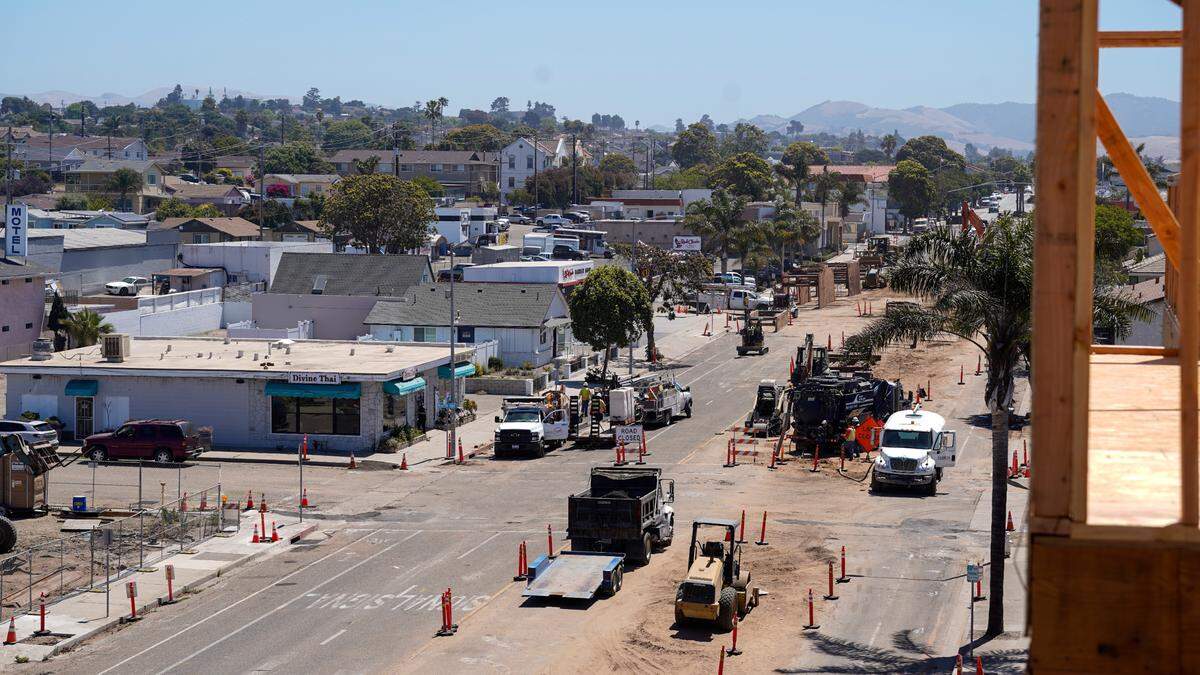
Why is Grover Beach trying to raise wastewater rates?
While the council partially walked back the rate structure adjustment in 2024 due to public backlash, it acknowledged that it would have to attempt to raise rates again down the line to pay for capital improvement projects including sewer upgrades.
As is, the sewer system — initially installed in 1965 — isn’t dealing with structural issues or breaks, but is struggling to maintain adequate flow as Grover Beach’s population has grown, Bronson said.
Grover Beach wastewater customers currenlty enjoy the third-lowest wastewater rates in the county, with only the neighboring Oceano Community Service District and Arroyo Grande wastewater customers paying less.
Though the system itself is one of the smallest in the county, by the end of the rate structure adjustment in 2030, Grover Beach customers will be paying more on average for wastewater services than Atascadero and Pismo Beach customers, according to data provided in the staff report.
Because pipes are flowing at a higher capacity than intended, the risk of a clog or backup is higher, meaning the longer the pipes go without update, the more likely they are to fail, Bronson said.
Bronson highlighted the sewer main running from the Nacimiento sewer lift station all the way to the sanitary district’s trunk main west of Manhattan Avenue as one piece of infrastructure that’s in need of upgrades.
As is, that sewer main — which carries sewer flows from around 85% of the city north of Grand Avenue — has been operating over the acceptable flow range for many years, Bronson said.
“There are a number of other undesirable potential consequences of failing to upgrade the system,” Bronson said in an email. “For example, when a sewer pipe does flow completely full, there is no air space in the pipe to move sewer gases and, as a result, sewer odors begin to build up and permeate the neighborhoods throughout town.”
In addition to the cost of making upgrades, the city must also pay off inter-fund loans made in the 2008-09 and 2011-12 fiscal years, when the city loaned funds collected from wastewater rates to other projects, including the Building and Planning Fund and a city initiative to increase broadband access, Bronson said.
Those loans will be paid back to the wastewater fund from the city’s General Fund within the rate structure period, offsetting the rate increases and giving the wastewater fund additional revenue, according to deputy city manager Kristin Eriksson.
All told, the city has around $1 million to pay back in past inter-fund loans, along with the $15 million in capital projects that need to be addressed through rate structure changes, Bronson said.
How much could wastewater rates increase?
According to the wastewater rate study conducted by consulting firm Tuckfield & Associates, to meet the financial needs of capital improvement projects, wastewater rates must increase by 17.8% for each of the next five years, starting July 1.
In practice, the average bi-monthly wastewater bill for a single-family residential home would increase from an average of $25.64 to $30.20 — essentially an average increase of $4.56 every two months or $2.28 per month.
By the end of the rate adjustment in 2030, an average bill with the standard $50.96 wastewater treatment charge imposed by the South San Luis Obispo County Sanitation District would jump from around $76.60 to $109.12, according to the staff report
The $50.96 wastewater treatment rate, which is administered by the sanitary district, will not change as a result of the rate structure change, according to the staff report.
Following Monday’s discussion, there are still ways for the public to provide feedback on the increased rate structure.
The issue is set to appear before the City Council on April 14 to get authorization to move forward with the noticing and protest letter period required by Proposition 218, which mandates that the city mail notices to all property owners within the service area.
In 2023, the city faced backlash by sending out the notices to utility account holders rather than property owners, sending out a wave of corrected notices shortly after the issue was brought to the city’s attention, Bronson said.
This time, the city will communicate with the public through legally required notices containing a protest ballot in both English and Spanish, along with mailers for property owners and wastewater customers. It also will create a webpage for more information, Bronson said.
Anyone who wants to comment on the rates can call 805-321-6639 and email gbadmin@groverbeach.org.
After at least 45 days, the city can hold a public hearing on the rate structure change, at which time any protest votes against the rate increase will be tallied.
Under those requirements, the new rate structure could be in place by early July.
This story was originally published March 26, 2025 at 2:45 PM.