Neon sign on SLO parking garage recalls Chinatown past. What was Chong’s Home Made Candies?
In downtown San Luis Obispo, a vibrant neon sign serves as a nod to the city’s once bustling Chinatown.
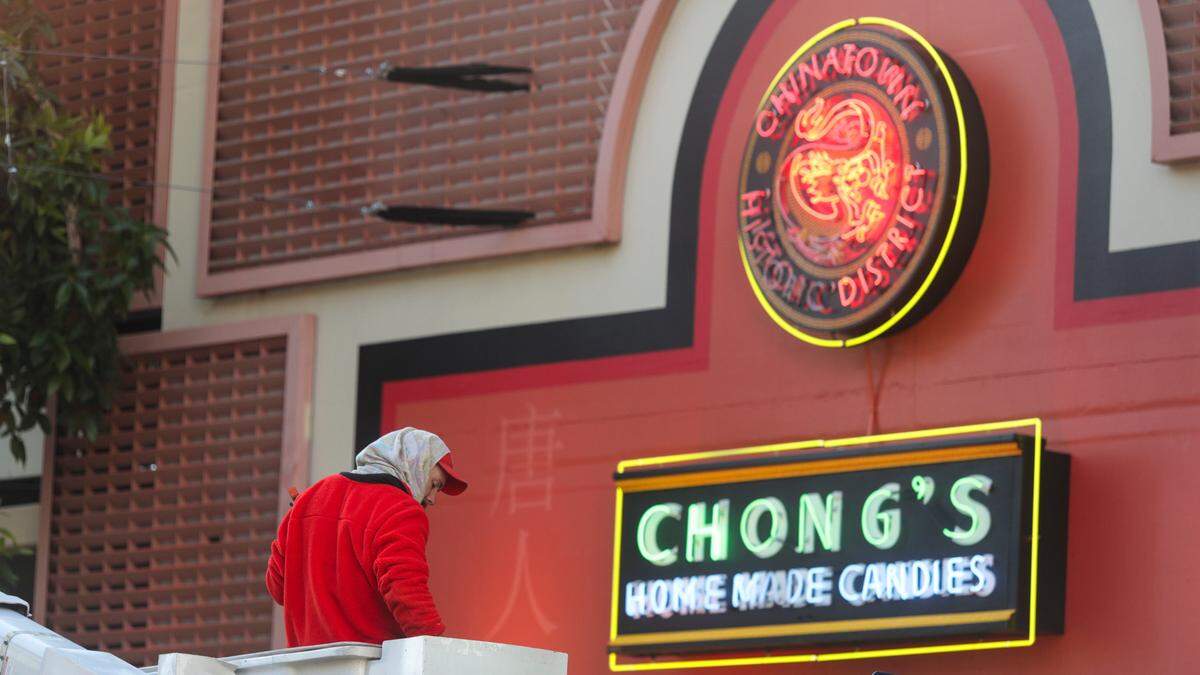
The glowing 75-year-old emblem is hard to miss, blazing in shades of light green and pale blue as soon as the sun sets on the Palm Street parking garage at 812 Palm St.
The sign reads “Chong’s Home Made Candies.”
Who was Richard Chong, the man behind Chong’s candy store? And what was Chinatown like during its heyday?
The Tribune followed its sweet tooth all the way to the 1800s.
What’s the history of Chinatown in San Luis Obispo?
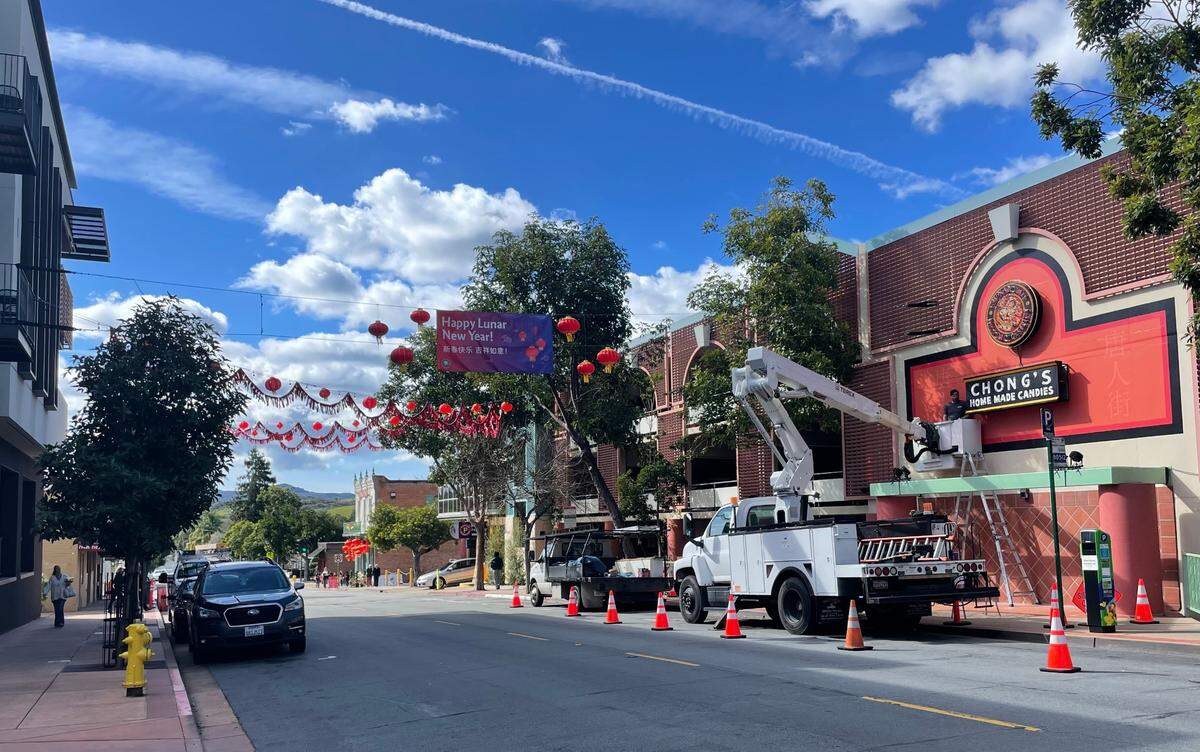
Palm Street became the core of SLO’s Chinatown district in the late 1800s.
The bustling neighborhood was once a cultural hub home to hundreds of Chinese immigrants and their descendants, many of whom who were building roads, working on railroad projects and running downtown shops, said Thomas Kessler, the executive director of the History Center of San Luis Obispo.
Within an area the size of a city block, SLO residents bought groceries and household goods from the Ah Louis store, dined at family-run restaurants and worshiped at shrines dedicated to Buddhism and Taoism.
Over time, the neighborhood’s population dwindled due in part to the Chinese Exclusion Act of 1882, which banned all Chinese laborers from immigrating to the United States for a decade, and a surge in anti-Chinese sentiment along the West Coast.
Downturns in the local economy also led many residents with Chinese roots to move to bigger cities such as Los Angeles and San Francisco, Kessler said.
Many of the buildings on Palm Street eventually changed ownership or were bulldozed in the early 1950s.
“There’s no dramatic story,” explaining why a large portion of Chinatown essentially disappeared, Kessler said, “other than it was eventually knocked down and a parking garage got built on top. It does show a certain disregard from certain generations of city leadership here.”
In 1995, the San Luis Obispo City Council designated the block of Palm Street between Morro and Chorro streets as the Chinatown Historic District.
Who was the owner of downtown SLO candy store?
One of the businesses in the center of SLO’s Chinatown was Chong’s Home Made Candies.
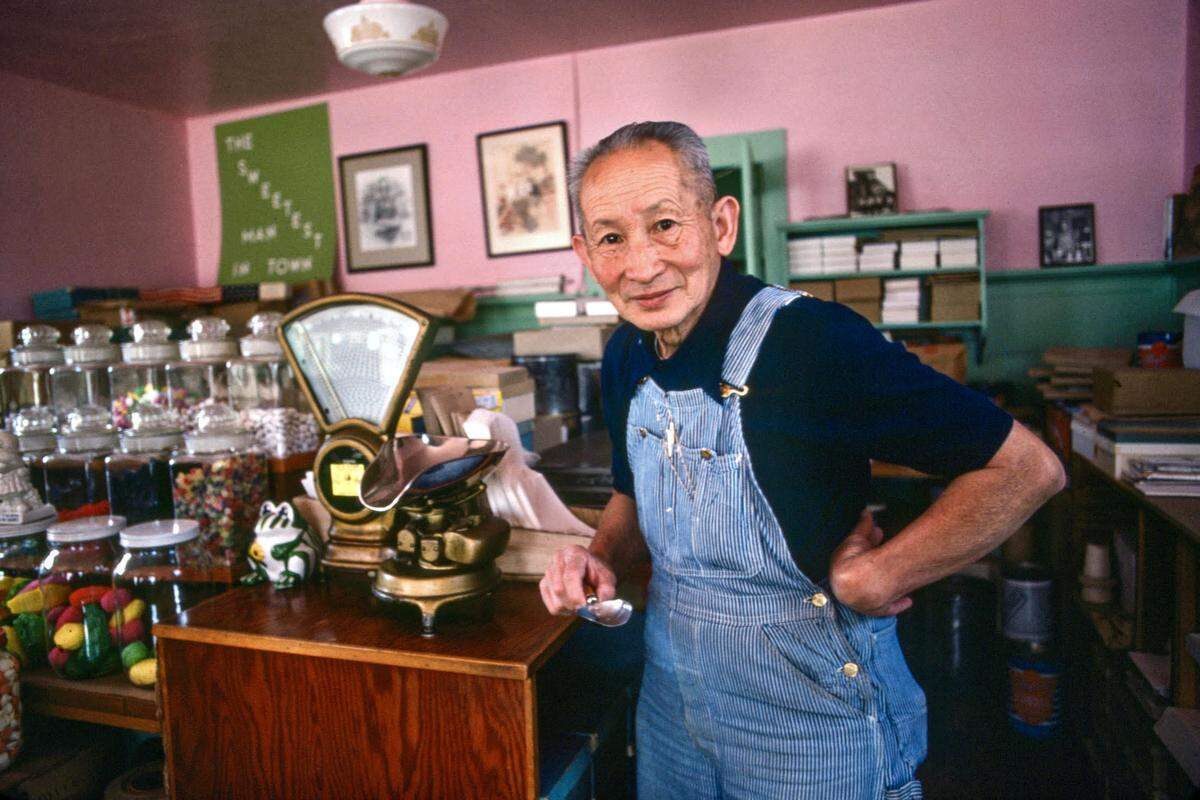
Richard Chong owned and operated the candy store at 798 Palm St. for 28 years.
Chong was born Gin Quon on Aug. 3, 1903, in his parents’ Chinese grocery store. The shop once stood on Palm Street between Chorro and Morro streets in an area that’s since been turned into a city parking lot.
He was one of 12 children born to Chinese immigrants Quong and Yip Shee Chong, who moved to San Luis Obispo in the late 1800s, the San Luis Obispo Telegram-Tribune reported in 1967.
Chong started going by “Richard” after his second-grade teacher thought it was unbecoming for him to have a Chinese name, said Brian Lawler, one of Chong’s longtime friends.
Chong learned the candy business during high school while working part-time at Austin’s Candy Store on Monterey Street in San Luis Obispo.
Post-graduation, he stayed on at the shop before being drafted into the U.S. Army Air Corps in 1942.
“That was pretty crazy,” Chong told the Telegram-Tribune in 1967. “I was 39 at the time but apparently that didn’t matter.”
Chong ended up serving a six-month stint in the military. He wandered around California for several years before returning home to San Luis Obispo, the Telegram-Tribune reported.
After running into his former boss from Austin’s Candy Store, Chong bought the shop’s old equipment and opened his own store at the corner of Palm and Chorro streets in 1950.
Chong’s Home Made Candies was one of the last one-man sweet shops on the West Coast to sell confections made from scratch, according to a 1974 Telegram-Tribune article.
“The tiny brick shop with its dated neon sign and rows of jars filled with colorful sweets became a landmark in San Luis Obispo and for the state,” the Telegram-Tribune wrote in 1978.
.JPG "01.01.0702-1 (1).JPG")
Chong’s Home Made Candies a local institution
Chong was known for his high-pitched voice, gentle demeanor and denim blue overalls, according to Lawler.
The candy maker could always be found sitting on the windowsill outside his store or cooking up confections inside.
Chong made scotch kisses, stick candy, taffy, rocky road, nut rolls and nougats. He stretched and hand-rolled coffee lozenges into wax paper and dipped chocolates filled with walnuts, almonds and caramel.
“He made handmade coffee candies that were so delicious, just unbelievable,” Lawler said.
Lawler struck up a friendship with Chong after making dozens of visits to the shop for almond chocolates.
“People would stop in, and he would always complain about the price of things: ‘Oh, those almonds are expensive. Nobody can afford them, they’re like diamonds,’ ” Lawler said of Chong.
“He would then hand me a little bag of chocolate with almonds, and I’d sneak them out the door,” Lawler recalled. “He never took (my) money, which was pretty funny. That was sort of the basis of our friendship.”
Chong’s one-man candy store was featured in newspapers and magazines across California, including The Los Angeles Times.
Chong complained to the Telegram-Tribune in 1974 that he was “too darn old to be famous,” despite the praise he received from locals and tourists alike.
“I’m doing what I am because I want to show the people what an old-fashioned candymaker can still do,” Chong told the Telegram-Tribune in 1967.
Although business declined as time went on, Chong continued to make a living running his sweet shop.
He never married, telling the Telegram-Tribune, “I couldn’t stand the nagging.”
Chong suffered a stroke in March 1978 and died at age 74 on Oct. 13, 1978.
How did neon sweet shop sign survive?
Chong’s Home Made Candies shut down after its owner’s death.
The neon sign advertising the business came down in 1979 when the sweet shop was replaced by Archimedia, an architectural book and supply store.
In 1980, the storefront changed ownership again, serving as home to Lynda Flynn’s women’s clothing store before housing a realty business.
According to Lawler, the “Chong’s Home Made Candies” sign was kept in a narrow backyard behind the Palm Street building for many years. While the building was under renovation, painters used the sign’s surface to clean off their brushes.
“All but one of the tubes got shattered, either in taking it off the roof or just from abuse,” Lawler said.
Chong’s family offered to give Lawler the sign, which weighed 75 pounds and measured 9 feet wide and 4 feet tall.
He decided to fix the massive sign, seeking help from Cal Poly faculty and San Luis Obispo County specialists to refurbish it.
“I took it on as a challenge, and my objective was to restore it to like new condition,” Lawler said. “I didn’t want it to be different. I wanted to just put it back.”
Once the restoration project was complete, Lawler hung the sign in his home office for a decade, calling it a “gigantic testament to my friendship with Chong.”
Sign gets a new life at Palm Street parking garage
Lawler donated the neon “Chong’s Home Made Candies” sign to the city of San Luis Obispo in 2005 after downsizing to a smaller house.
“I did not want the sign to fall into private hands,” Lawler said. “I wanted it to belong to the people of San Luis Obispo.”
The city kept the sign in storage for nearly two decades, he said.
In 2023, the city began a $47,000 restoration project to embellish the sign with neon yellow tubes and hang it on the Palm Street parking structure, Natalie Harnett, a policy and project manager for the city of San Luis Obispo, told The Tribune.
Southpaw Sign Co. installed the historic Chong’s Candy Store sign on Feb. 9 just in time for the city’s 2024 Lunar New Year block party.
The city recently finished the final phase of the restoration project — a display panel underneath the neon sign that features historical photographs and information about SLO’s Chinatown district.
“I think it’s important to have the whole picture and enrich that storytelling experience,” Harnett said.
Ribbon-cutting ceremony coincides with Lunar New Year party
The city is hosting a ribbon-cutting ceremony for the restored Chong’s Home Made Candies sign and new informational panels.
It will held at 5:30 p.m. Thursday at the Palm Street Parking Garage, according to a news release.
The ceremony will be followed by the Lunar New Year block party, which runs 6 to 8:30 p.m. Thursday on the 800 block of Palm Street. The event will feature food vendors, activity booths, live performances and a special film screening at the Palm Theatre.
“I’m so grateful to them for doing this because it met my original objective that people could enjoy it,” Lawler said of the city. “It celebrates a man who was a wonderful part of the community.”
This story was originally published January 30, 2025 at 5:00 AM.