Did SLO County change because of Black Lives Matter protests? Here’s what activists say
San Luis Obispo has been called the “happiest city in America” by the likes of Oprah Winfrey and others.
But is it the happiest city for everyone?
“Maybe it is for somebody who is a well-off white citizen who doesn’t have to think about the lack of diversity here, the lack of accessible resources for many of our community members and the lack of comfortability for people of color in this city,” Cal Poly student and activist Michael Guiffre said.
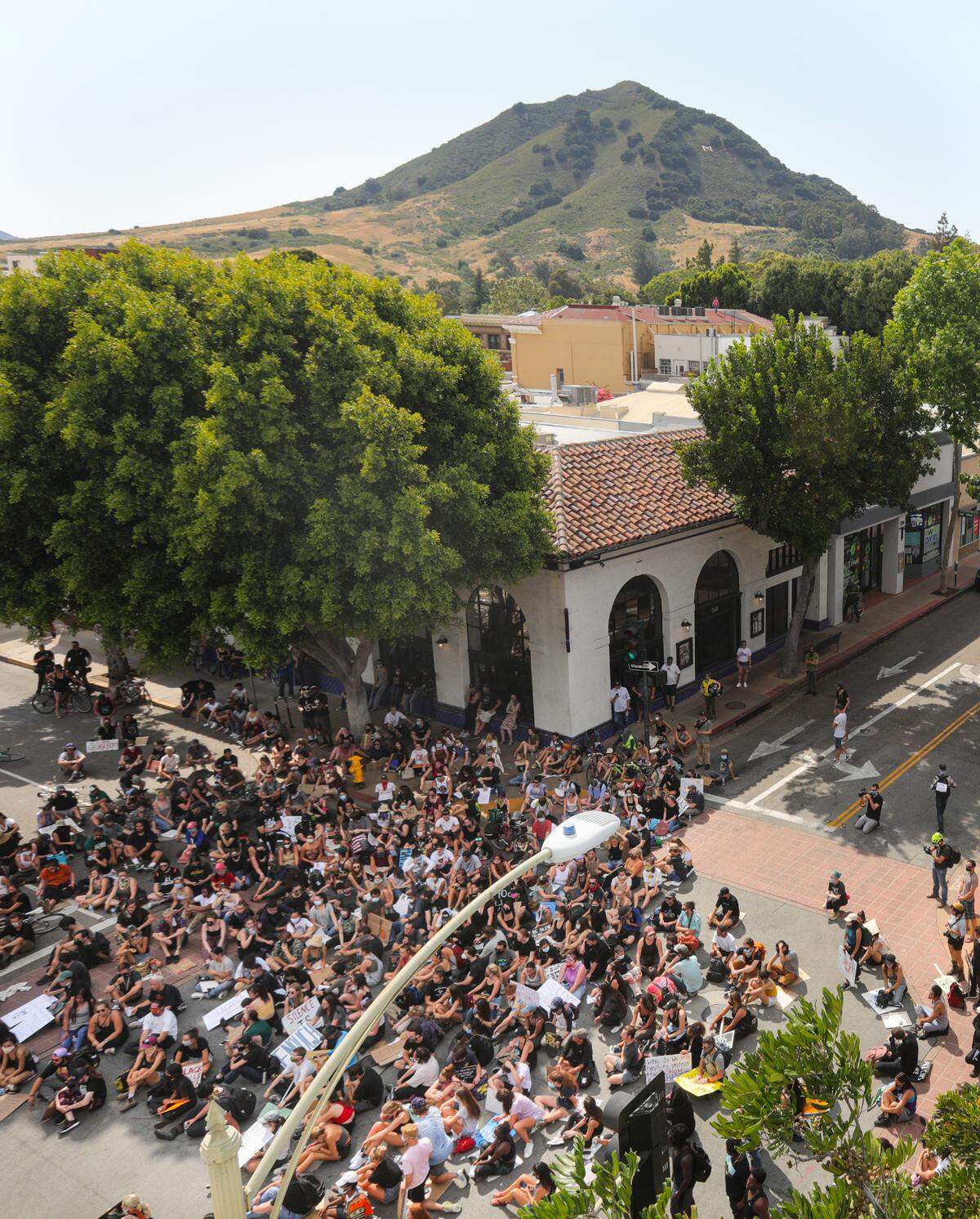
Local activists organized a series of Black Lives Matter protests in the summer of 2020 after George Floyd, an unarmed Black man, was murdered by Minneapolis police, spurring a global movement.
Thousands of community members took to the streets of San Luis Obispo to call for local politicians to divest funds from law enforcement agencies and reallocate that money for community services. They also asked San Luis Obispo officials to make diversity, equity and inclusion a main goal for the city.
The city responded by creating a Diversity, Equity and Inclusion Task Force that would examine ways San Luis Obispo could become a more welcoming place that actively denounces systemic racism and discrimination.
San Luis Obispo also established diversity, equity and inclusion as a major city goal — dedicating more than $2 million over the next two years to diversity issues.
“I am proud of how much work we’ve done on this issue,” Mayor Heidi Harmon said. “You know, we get pushback from community members on this. And we are steadfast in our commitment to making San Luis Obispo a more welcoming and inclusive community in really substantive ways.”
Adoption of the latest fiscal year budgets in June revealed, however, that local politicians’ response to the Black Lives Matter protests stopped short at divesting from the police.
In fact, the San Luis Obispo Police Department and San Luis Obispo County Sheriff’s Office both saw their budgets grow — mainly to help with regular pay increases.
When asked why law enforcement agencies’ budgets weren’t reduced to reinvest funds into alternate community services, local politicians said doing so would be contrary to their public safety objectives.
“The City Council has the responsibility to the residents of the city of San Luis Obispo to keep them safe, as safe as possible,” San Luis Obispo Councilwoman Jan Marx said. “And it would not have helped the safety of the general population to understaff the Police Department.”
But some local activists disagree and say the law enforcement agencies in fact don’t keep them safe. Many Black people have left the community out of fear for their safety after receiving threats and generally feeling unwelcome in the majority-white community, activists say.
“There was no change in San Luis Obispo that made any Black person want to stay here,” said Nalah Loman, a Cuesta College student and community organizer with Black Lives Matter Community Action. “I know many people who up and left the city, or have been forced to leave the city after what’s happened.”
Court cases as result of protests still ongoing
One of the people who has left San Luis Obispo following 2020’s protests is prominent Black Lives Matter organizer Tianna Arata.
Arata, 21, was arrested on July 21, 2020, following a rally in which protesters marched onto Highway 101 and clashed with motorists — exactly two weeks after the creation of the Diversity, Equity and Inclusion Task Force.
San Luis Obispo police originally booked Arata, the protest’s main organizer, into San Luis Obispo County Jail on five misdemeanor charges.
The Police Department then asked county prosecutors to charge Arata with five felonies and three misdemeanors.
The county District Attorney’s Office is now pursuing 13 misdemeanor charges against Arata — including counts of false imprisonment, obstructing a public thoroughfare and resisting arrest.
Prosecutors allege the protesters, led by Arata, held residents “hostage” on the highway and elsewhere around the downtown area during their demonstration on July 21.
Another protester, Elias Bautista, was captured on video kicking an officer in the groin during the July 21 protest before being chased down by police and subsequently arrested. Bautista faces one felony and two misdemeanor charges.
Additionally, six other local protesters — Sam Grocott, Robert Lastra, Marcus Montgomery, Joshua “JP” Powell, Jerad Hill and Amman Asfaw — were arrested shortly after Arata and Bautista on suspicion of various criminal charges related to the protests.
Arata and three of the other activists charged in connection to the protests are Black. Asfaw is the chair of the city’s Diversity, Equity and Inclusion Task Force.
In September, Black Lives Matter activist LeiYahna Jefferson was hit by a motorcycle as she crossed a street in downtown San Luis Obispo during a march. Motorcyclist David Medzyk, who is white, has plead not guilty to two misdemeanor charges filed against him.
Local activists say the ongoing court cases are just one example of how things have not changed enough in San Luis Obispo.
City creates DEI task force, funds more social workers
The city of San Luis Obispo’s main responses to the Black Lives Matter protests were to create the Diversity, Equity and Inclusion Task Force on July 7, 2020, and fund more social worker positions.
The task force’s mission was to direct grant money to local organizations for “proven or promising impactful, sustainable projects” and create a framework or potential scope how diversity, equity and inclusion would become a major city goal.
Task force members also provided a recommendation on the role and function of the city’s Human Relations Commission to diversity, equity and inclusion efforts.
In January, the task force brought five recommendations and additional “high-impact opportunities” to the San Luis Obispo City Council.
The city has since implemented three of those recommendations — including adopting diversity, equity and inclusion as a major city goal and developing and implementing a DEI strategic plan. Others may be in progress.
The city’s budget includes more than 75 line items that secure funding for diversity, equity and inclusion priorities over the next two years.
In addition, San Luis Obispo allocated a total of $109,800 in the task force’s grant money to eight local organizations and is spending $40,000 for a feasibility study on a multicultural center.
The city has also allocated $600,000 over the next two years to create a Mobile Crisis Unit staffed by an emergency medical technician and a social worker. The team, once created, will be dispatched instead of police or paramedics to “provide non-emergency response and care to unhoused community members,” according to the city’s financial plan.
Meanwhile, San Luis Obispo is expanding the Police Department’s Community Action Team by adding one social worker with a $116,188 annual salary for next two years. The team, which currently consists a police officer and a social worker, “identifies problems and crime trends that negatively impact the quality of life for residents, business owners and visitors to the city of San Luis Obispo,” according to the team’s website.
“The city is only one part of an overall cultural conversation happening all across the country. ... It’s not just up to the city to engage on this issue,” Harmon said. “I would encourage everyone that engages with (The Tribune) to check themselves and understand more deeply what their role is in this conversation.
“We see that the history of this community, like the history of so many communities across this country, is one of racism. And so hopefully people are grappling with that and understanding that and doing what they can to ensure that moving forward, people have access to this community.”
Local activists and community organizers say these initiatives and budget line items are a few steps towards the progress they want to see.
SLO Police Department, county Sheriff’s Office budgets increase
What primarily echoed off the walls of downtown San Luis Obispo during last summer’s protests were calls to divest from or “defund the police.”
When the San Luis Obispo City Council unanimously approved its new $202 million budget for the next two fiscal years on June 2, the San Luis Obispo Police Department saw its funding for the 2021-22 fiscal year grow by 7.5% from the previous fiscal year, or an increase from $17.8 million to $19.1 million.
The department will then receive $20 million in the 2022-23 fiscal year, a 4.75% increase in its budget.
The San Luis Obispo County Sheriff’s Office received a 7.7% increase in its budget for the 2021-22 fiscal year, from $52.2 million to $56.2 million, after the county Board of Supervisors approved it on June 15.
According to the city of San Luis Obispo, the primary driver for these increases is maintaining competitive salaries and the goals of public safety.
“Most of our budget, nearly all of it, is our personnel costs,” San Luis Obispo Police Chief Rick Scott said during a June 1 City Council meeting.
“Right now, our main focus is to make sure that we have officers in the cars out there answering 911 calls, that we have enough staff to investigate crimes after they occur and bring people to justice and that we also have a good presence downtown to make it fair, safe and inviting to our guests who come downtown and enjoy everything SLO has to offer,” Scott said during the council meeting.
Local activists say one reason they want to see the police and sheriff divested from is because of their ineffectiveness in bringing justice.
“The likelihood that they’re going to solve crimes is very low,” Loman said. “So how safe are they actually making us? If we invest into programs that are going to help the people who are sick or people who are unhoused, that will take away that need for those police officers.”
The San Luis Obispo Police Department solved about 50% of the violent crimes reported to it in 2020, and the county Sheriff’s Office solved 53% of the violent crimes reported to it in 2020, according to data from the California Department of Justice.
The statewide average for clearing violent crimes in 2020 was about 45%, according to the data.
San Luis Obispo Mayor Heidi Harmon said during the June 1 City Council meeting that it’s important to focus on the quality of policing.
“It’s really important for us to ... as we talk about quantity of policing, that we’re really clear about quality of policing,” she said. “And that we don’t make an assumption that having less money for compensation is a smart way to go when that would obviously be associated, generally speaking, with lower quality.”
Councilwoman Andy Pease noted during the meeting that she was grateful that community members and organizations put ongoing pressure on local politicians to make changes in the city’s budget.
She also said that the Police Department is supportive of the “reimagining of public safety,” acknowledging that “the person with a badge is not always the right person to be showing up.”
“I appreciate that it’s really frustrating for advocates to not see something happen, but for us, this is kind of lightning speed in terms of what a municipality can do,” Pease said. “Also I’m just thrilled with the thoughtfulness and attention to address these big issues to the level that we can. ...
“The partnership with Chief Scott and the rest of our Police Department (allows us to) to really be thinking about what can we do, what’s our role, how do we most efficiently provide the services? .... That’s why we’re doing these new programs.”
Powell, a community organizer with Black Lives Matter Community Action, said the protests last year put politicians under a new pressure that hadn’t previously been applied. He faces one misdemeanor charge related to the protests.
However, Powell said, it’s not enough for young people to show up once or twice to protests or public meetings to voice their concerns.
“We’re gonna keep going,” he said. “We had one summer of protesting and assuming, ‘Oh, that’s gonna make them defund the police.’ No, it’s got to be an ongoing, continuous group effort.”
Finding community through activism to sustain a movement
Sustaining that effort, however, is proving to be difficult for many of the activists.
Some organizers said they faced burnout last summer after organizing marches in San Luis Obispo nearly every weekend. They added that finding community has been key in sustaining the movement.
Courtney Haile, executive director of R.A.C.E. Matters, said she’s been dedicating her time to improving the culture of San Luis Obispo so people of color can find that community. Her community-based organization works to support local Black creators through events and content production.
She’s started initiatives through R.A.C.E. Matters that help support Black-owned businesses and celebrate Black artists.
Haile received $32,600 in diversity, equity and inclusion grant money from the city of San Luis Obispo for the organization’s “Belonging 2021” multimedia art experience, centered on Black community, inclusion and action for all.
“I have hope that the funds will continue and that they’ll continue to listen to our voices on that,” she said.
Haile said that the 2020 protests boosted a lot of her efforts that had been ongoing over the last several years.
But Arata, Loman and Powell noted that there’s a lot more work to do to create a San Luis Obispo that is truly welcoming to all.
“White people have to care,” Loman said. “They need to care about systemic racism and care about injustices we see happen all the time. You need to listen to the Black people around you and hear them out. But you also don’t need a Black person’s permission or leadership to advocate for Black people.”
The movement for Black lives “might not ever look like it did last summer,” Loman added. “It could be bigger, or maybe a little bit smaller. But it’s definitely going to be productive.”
This story was originally published July 22, 2021 at 9:00 AM.