Hangman’s nooses hung at SLO County shooting range for at least a decade — until now
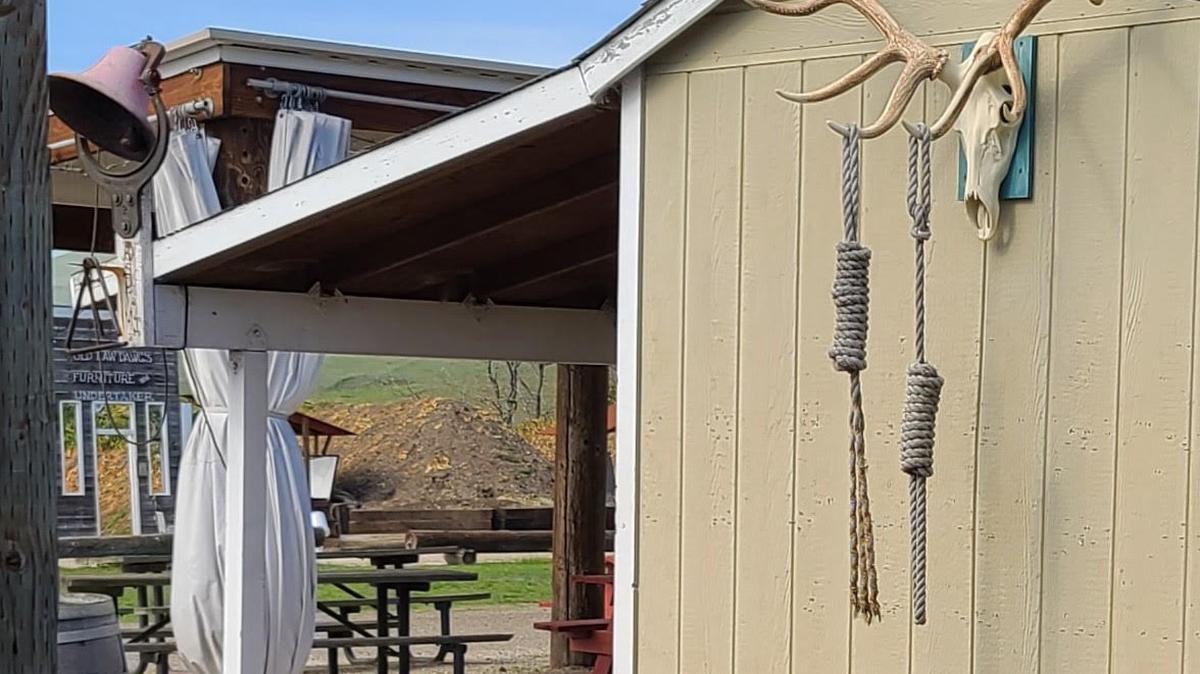
For at least a decade, two nooses hung outside a building on a shooting range off Highway 1 north of San Luis Obispo.
According to San Luis Obispo Sportsmen’s Association president Bill Plummer, whose group oversees the range, the nooses “are a part of cowboy history.”
But community members started raising concerns about the knotted loops of rope, which dangled from a large rack of antlers, at the beginning of May. Now the nooses are gone.
“They won’t be hung here anymore,” said Plummer, a Cal Poly emeritus professor of reproductive physiology. “It’s not worth the number of angry people who don’t understand (the noose’s) history.”
The Chorro Valley Regulators — a sub-chapter of the San Luis Obispo Sportsmen’s Association — operates the shooting range where the nooses were hung. The venue hosts Wild West-themed shooting events where attendees dress in cowboy regalia and shoot guns patented in the 1800s.
Competitions held by the Chorro Valley Regulators are overseen by the Single Action Shooting Society, which serves as the governing and sanctioning body for the sport of cowboy action shooting and Wild Bunch action shooting around the world.
The California Department of Fish and Wildlife owns the land where the Chorro Valley Regulators’ shooting range is located. The department’s Central Region has its own shooting range on the property and stores some of its boats at the Regulators’ shooting range — within eyesight of where the nooses once hung.
When asked about the nooses spotted at the property, Fish and Wildlife Warden Matt Gil said agency officers looked for them but they had already been taken down.
Gil also told The Tribune that he’d never noticed the nooses there before.
The Tribune was made aware of the nooses from an anonymous tip.
Noose’s history as execution method, racist symbol
Nooses were used to execute people for centuries.
From the 1800s to about 1930, thousands of people of color In the United States were brutally killed by hanging, often without trials for possible crimes or due process of law. The noose became a racist symbol used to threaten and intimidate Black Americans in particular.
“Execution by hanging was a violent process. People did not die quickly. It took them a long time to die,” said Jack Shuler, a professor at Denison University in Ohio who wrote the book “The Thirteenth Turn: A History of the Noose.” “And as with any system of capital punishment in the world, we know that the vast majority of people who are executed are people who are on the margins, who have less power.”
“Even if you see the noose solely as a system of justice, if you know anything about the justice system, you know that people who have more money and more power usually get off,” Shuler said.
Plummer argued that the nooses hung at the shooting range were a symbol of cowboy history.
“Most people under the age of 35 have cut off history. Those of us who are older remember other history” of the noose, Plummer said.
He elaborated by explaining that nooses were used in the Old West as a means of punishment for serious crimes.
“If you were convicted of murder, you were going to be hanged,” he said.
San Luis Obispo Sportsmen’s Association general manager Julia Soto said that nooses “have more than one history,” adding that, because the shooting range was period-specific to the cowboy era, the nooses were not racist.
Shuler wondered why anyone would want to honor the tradition of the noose because of its deeply problematic history.
“By hanging the noose, you bring up all of that violent history,” he said. “I think taking them down was a good thing. It is a sign that people recognize that we can do better, be better than that.”
This story was originally published May 24, 2021 at 5:00 AM.