
SLO council defends police actions in June 1 protest, considers oversight commission
San Luis Obispo City Council members discussed establishing a police oversight committee at a Tuesday meeting, addressing an after-action report that analyzed the police response to a June 1 protest that ended in the use of tear gas.
While council members supported police for maintaining public safety at the June 1 protest, Council members Jan Marx and Erica Stewart both expressed interest in forming a police oversight committee of appointed public representatives who could address concerns about police accountability.
Marx, who raised the idea of a committee in her City Council campaign leading up to the November election, said it could serve to address the specific needs and issues related to SLO community policing.
“No police department is immune from public scrutiny nor should it be,” Marx said.
Stewart, echoing other council members, said SLO’s department does a good job of keeping the public safe.
But a community oversight body could help in situations when problems arise.
“We do have good police officers, but sometimes police officers (commit bad actions),” Stewart said.
No specifics were mentioned around the type of work the committee would do, however, and further discussions would need to take place at a future City Council meeting.
.jpeg "123_1 (2).jpeg")
SLO council response to after-action report
At the Feb. 16 City Council meeting, interim Police Chief Jeff Smith shared the law enforcement perspective and areas for improvement as part of an after-action review of the June 1 protest, which included a 100-page report written with the input of police and community consultants.
Smith said that police feared Black Lives Matter protesters would take to the freeway for a second time that day as darkness loomed, risking public safety.
Tear gas was deployed on Santa Rosa Street as a nonlethal tool to disperse the crowd after repeated announcements from police for the crowd to leave, Smith said.
“At the conclusion of this protest, this was no longer a peaceful protest,” Smith said. “It had turned into attacking police officers (with water bottles and other objects thrown). ... I stand by my decision that day (as incident commander), as unfortunate as it was. I am happy there were no serious injuries and happy we were able to end what had turned into a very serious situation.”
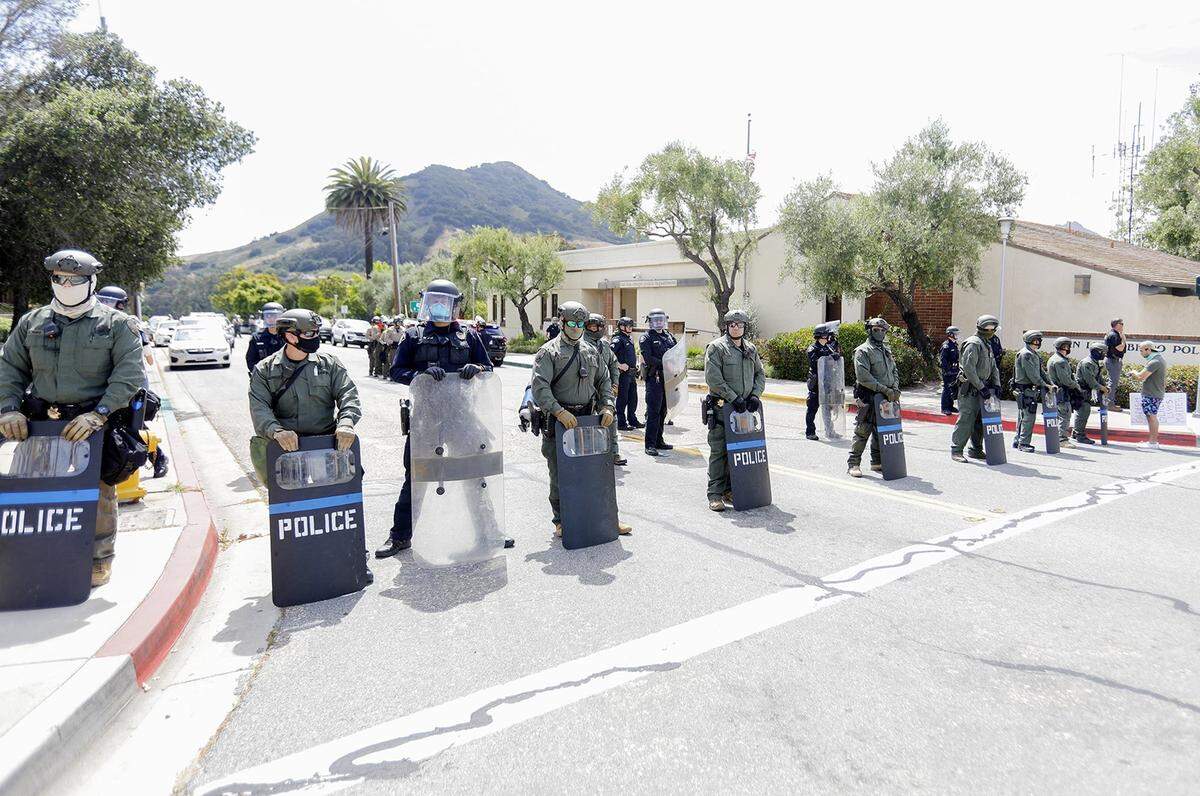
While some in the community have called for a city ban on use of tear gas, multiple council members said it was an appropriate step to protect public safety.
Council member Jan Marx said that when she was watching the Jan. 6 insurrection unfold in Washington, D.C., she wondered to herself why police weren’t using tear gas as a dispersing mechanism, later learning Washington, D.C. ,authorities were prohibited from doing so.
“If there’s a giant crowd of angry people, it doesn’t matter what their political beliefs are,” Marx said. “If they’re Proud Boys, trying to dominate the city and take over the freeway, would that change people’s opinion about use of tear gas?”
Keeping people off the freeway amid the June 1 racial justice protest was “the paramount goal,” Council member Carlyn Christianson said. “Police department actions could have prevented serious injury or death on the freeway.”
Stewart said that she wished tear gas had never been used, saying it was stressful and concerning to her, but that police did the best they could at that moment.
But Stewart also highlighted the need for clear rules of engagement in protest situations, laying out how police plan to respond in given situations.
Council members urge civility after heated meeting
City Council members said that public comment at a tense Feb. 16 meeting related to the after-action report spiraled out of control with personal attacks on city leaders. They hope to bring the community together around constructive conversations on policing.
Public comments from speakers, some June 1 protesters, included an expletive referring to the city manager and a derogatory comment about a police officer’s body language at the Zoom meeting. Christianson said that comments became “mean” and counterproductive.
While multiple council members reaffirmed the city’s commitment to diversity, equity and inclusion — a major city goal — they expressed their apologies for not stepping in with a firmer tone to redirect the conversation as part of the city’s civility code.
Mayor Heidi Harmon, who moderates City Council meetings as mayor, personally said she wished she had done a better job of reinforcing the city’s civility code after hearing attacks against individuals.
“Personal attacks are against everything I believe in,” Harmon said. “We’re all interconnected and we’re all human beings. I reject the binary idea that we’re on different sides. ... We all have a stake in this conversation. As we increase our awareness of the bigger picture problems, we must recognize positive values.”
.jpeg "123_1 (7).jpeg")
Harmon added: “Villainizing each other isn’t going to work.”
Harmon said Zoom meetings, designed to social distance amid the pandemic, can be more challenging to moderate.
Stewart added, “I’m personally sorry for not stepping forward. I know I could have stepped in sooner.”
Report ‘inadequate’ for tackling issues of racism
Consultant recommendations in the report included calls for SLO police to ensure multiple routing options for protesters; functional body camera equipment; adequate acoustic devices for speaking to crowds; and working relationships with protest leaders.
Smith said the June 1 protest didn’t have a clear leader, which made communications difficult.
The department since has made some changes, however, replacing body cameras that ran out of battery power that day with new devices that allow for rechargeable battery use.
The department also purchased Long Range Acoustic Device (LRAD) loudspeakers to make announcements clearly heard. Some protesters told the city they never heard the warnings to disperse.
Smith said the loudspeakers are safe for the public and not military grade, countering some of the comments from public speakers who cited cases elsewhere of LRAD devices damaging eardrums.
Some public speakers on Feb. 16 also called for reallocating funds to social service resources.
Christianson disagreed with that approach, saying the city shouldn’t “take away needed resources or defund the Police Department in public safety.”
Stewart defended the conversation, however, saying that the concept of defunding police is related to appropriately spending resources for public safety and social service needs so that workers can do their jobs effectively.
“The actual purpose of ‘defund the police’ is for police to do what they do and then fund social services to do that job,” Stewart said. “We’re not wiping out the police and getting rid of all the budget. ... There’s a reminder that that message is still important.”
Stewart cited the city’s recent decision to post a position for a homeless response manager as a step toward balancing police and social service needs.
Christianson said that roles blend at times, however, citing the need for police to respond to incidents involving the mentally ill and substance abuse situations.
Christianson encouraged the city to look to county and other outside resources with budgets for social services (SLO doesn’t receive federal funding for social services).
Council member Andy Pease said that while the report and recommendations were adequate to address the June 1 incident, the report was inadequate for the depth of the issue of systemic racism and social inequalities.
Council members reinforced the need for continued work on diversity and inclusion.
They cited SLO’s Diversity, Equity and Inclusion task force and police outreach to minority members of the community through its Police And Community Together (PACT) and PEACE (Policing Education And Community Engagement) programs as resources for building community trust.
“It was very difficult and I heard the pain and urgency of our speakers,” Pease said. “Some people of color don’t feel safe and valued. ... I take responsibility for that. I’m truly sorry for pain and loss of trust.”
This story was originally published February 23, 2021 at 9:05 PM.
%20Cropped.jpg)