SLO police examine tear gas use during BLM protest. Here’s what they would change
The San Luis Obispo City Council will review an internal report detailing the police response to a June 1, 2020, Black Lives Matter demonstration in which SLO police officers used tear gas to break up a crowd of “hostile” protesters who refused to disperse from a standoff on Santa Rosa Street
The Police Department’s “after-action report,” released Thursday in a city staff report ahead of the Feb. 16 council meeting, identified “lessons learned” and key areas of improvement to “lessen the likelihood” that future protests result in the use of chemical munitions.
Some of the recommendations, however, such as deploying more officers and using better police equipment in future situations, are unlikely to satisfy local racial and social justice groups.
The June 1, 2020, march was the second local event in protest of the police killing of George Floyd in Minneapolis and followed a peaceful rally and march the previous night.
The march of about 200 to 300 people lasted approximately four hours and was peaceful, though at one point demonstrators marched onto Highway 1, blocking traffic for about an hour before they returned to city streets.
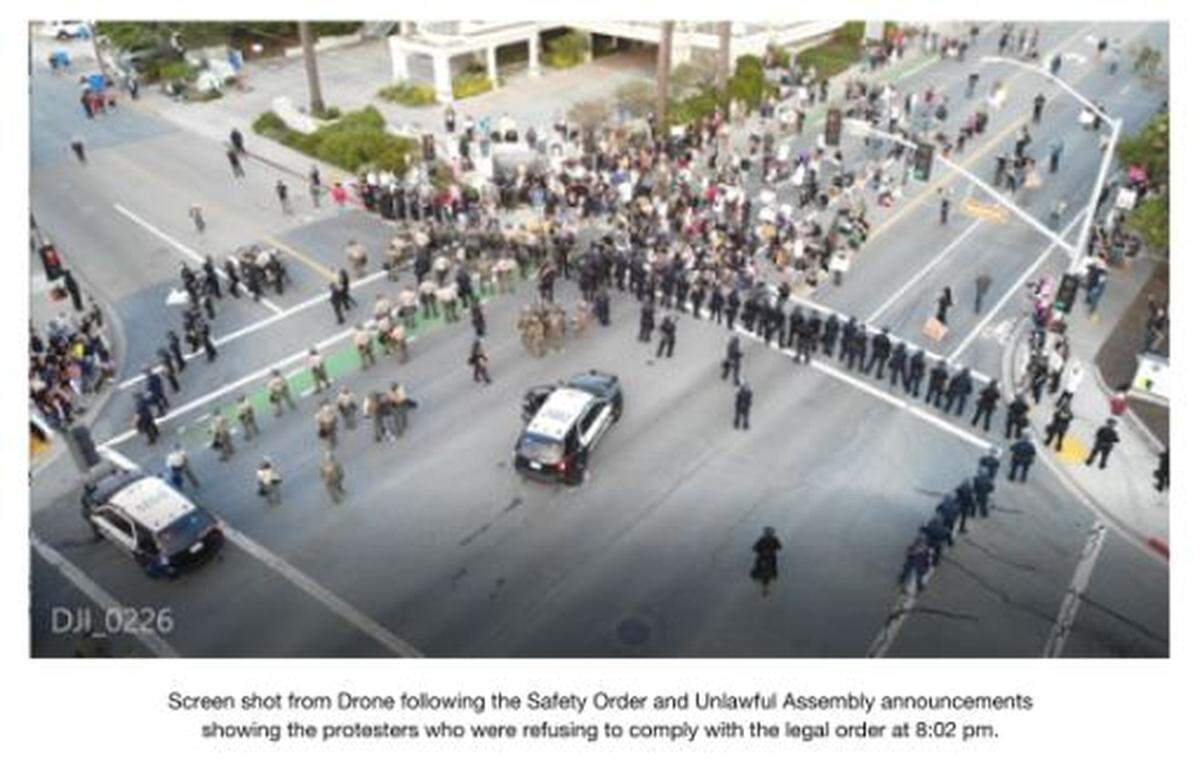
The march later resulted in a standoff on Santa Rosa Street as protesters appeared to be heading back toward the freeway, which officers were determined to prevent.
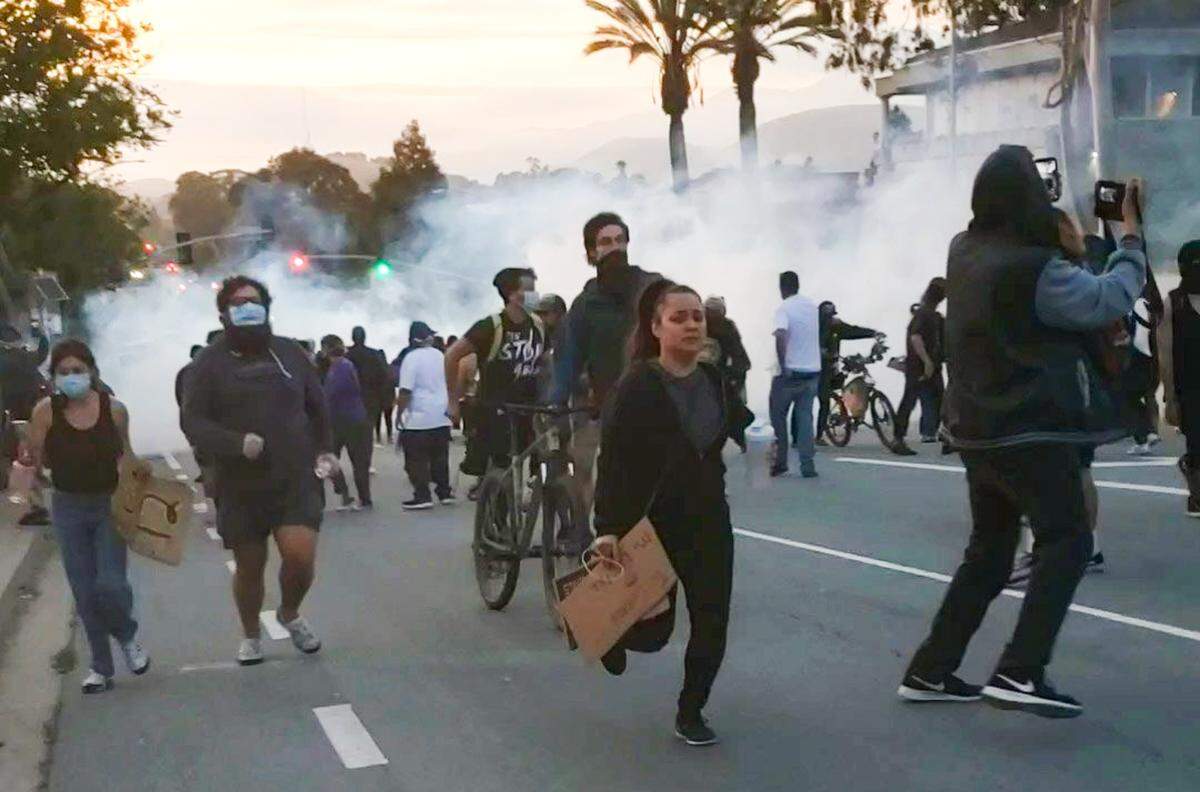
After a standoff near the police station on Walnut Street, SLOPD command staff gave the orders for officers to fire pepper balls, foam rounds, bean bag rounds, pepper spray, and tear gas canisters to break up the crowd.
No one was seriously injured.
Five protesters arrested during the event are facing misdemeanor charges for failure to disperse and obstructing officers; those cases are ongoing.
The report noted several “action items” that could prevent a similar situation in the future:
- The protesters had only one way to disperse from the standoff, which was to turn around and go back. The report notes that is “difficult for crowds.”
- City personnel had not yet developed any relationships with organizers or members of the group, “and thus, no way to communicate with them.”
- Officers did not have the proper equipment to “make a loud enough announcement” to the crowd.
- Community members expressed concern about the early appearance of officers in riot gear during a peaceful protest.
- Lieutenants should be in the field overseeing tactical operations.
- There was an insufficient number of officers to prevent protesters from marching on the freeway.
- There was insufficient civilian support staff to assist with traffic control.
- Other agencies assisting SLOPD — California Men’s Colony and CHP officers, as well as sheriff’s deputies — reported not receiving sufficient direction from SLOPD command staff.
- San Luis Obispo police lacked drone pilots and batteries and other equipment able to cover a lengthy event.
- The department’s officer body-worn camera batteries have a life of 7 to 8 hours with intermittent use, or three hours of constant use. The report says the city has just approved the purchase of cameras that have rechargeable batteries and that capacity issues “should be mitigated.”
In its response to the report’s findings, the Police Department says many of the issues “have been addressed and changes implemented” since the findings were made.
Though an internal report, the Police Department says the review was done in consultation with James Bueermann, who the city says is an expert in after-action reports of large-scale police events, and has consulted on reviews of notable incidents such as the civil unrest in Ferguson, Missouri; and the mass shooting in San Bernardino carried out by a husband and wife.
The Police Department paid Bueermann $7,500 for his consultation services, the staff report says.
Police say they warned the crowd before using tear gas
The city’s consultant also solicited the help of Cal Poly’s director of Diversity, Inclusion and Outreach, Kari Mansager, to conduct interviews with 11 protesters who were at the June 1 event for their perspectives.
A major consensus among those interviewed was that there was no leader of the march, and several told Mansager that there was no coordinated effort to march back onto the highway.
Instead, protesters told the administrator that they felt “trapped” after police blocked the intersection of Santa Rosa and Walnut streets, leaving the demonstrators with no option but to back up and march back from where they came from.
“Unless it’s planned, turning around feels like a defeat,” one protester told Mansager, according to the report. “Having no option but to turn around was a hard one without any leadership.”
“Blocking all of Santa Rosa and not giving anyone a forward-moving option is not viable for creating consensus. Protesters just kept saying they wanted to move forward,” another interviewee said. “Someone had to back down, and it was either going to be police or protesters. It didn’t feel like it was the role of protesters to back down from the people (police) who had been intimidating them all day.”
Another protester told Mansager that officers weren’t interacting with any of the protesters, and it was difficult to hear anything they did say due to the sound of the crowd and a helicopter flying overhead.
“The protesters’ bullhorn was more effective than the police’s. I couldn’t hear what the police were saying,” the person said. “It was far back, and nobody knew what the police were saying.”
Several people echoed that they did not hear any police warning to disperse. The report says that a sergeant on scene used a patrol car’s speaker to order the crowd to turn around and leave the area by walking south on Santa Rosa.
The report says the department has since purchased a long-range acoustic device loudspeaker that it will employ to make multiple announcements from different locations in any future incidents.
According to the city’s timeline of events, initial police announcements were made at 7:40 p.m. and officers again made the order after calling off the helicopter overhead, and some protesters began leaving.
About 10 minutes later, officers identified two protesters who were allegedly encouraging others to continue the standoff. They were arrested without incident.
After another 10 minutes, officers began to advance toward the crowd, which became agitated and began throwing items such as water bottles and fireworks at the police line. The report says at least one person was seen throwing rocks.
After shooting pepper bullets at the ground toward the crowd, at 8:14 p.m., SLOPD command staff authorized the use of Choloroachetophenone (tear gas) canisters, two of which were thrown in front of the protesters, who ultimately dispersed.
Officers took control of Santa Rosa Street at about 8:36 p.m., the report says.
One protester told Mansager that one of the tear gas canisters hit their foot and they have a scar from where it burned through their pant leg.
“I’m going to remember this moment for the rest of my life when I look at this scar,” the person said. “I want an accounting of all the weapons that were shot. What was it? What hit me on the leg and scarred me?”
‘Something changed in SLO that day’
The report also includes feedback from residents who were on the receiving end of the tear gas on what longstanding effects the police response to the incident has had on them.
“I was pretty weary of police before, now I’ve galvanized against them,” one protester told Mansager. “I don’t like police at all now.”
Another protester identified as Anne said she felt officers did their best in a complicated situation.
“But unfortunately, the best the police were trained to do was inherently violent, over-reactionary, and escalating and that’s why this went down the way it did,” Anne said.
One resident of downtown who said he wants to start a family in the city told her that “something changed in SLO that day.”
“We now know that the SLOPD is willing to use what could be lethal force to break up a bunch of kids that were justifiably angry,” he said. “They can’t undo or deny the fact that they tear-gassed us”
“To this day I will always be more wary of police officers,” another person told Mansager. “I thought SLO was going to be a place where these things wouldn’t happen.”
Community can weigh in Feb. 16
Prior to the Feb. 16 review by the City Council, the Police Department says it will discuss the report’s findings with community organization members of the city’s Police and Community Together (PACT) program, including the Diversity Coalition of SLO County, Transitions Mental Health, Women’s March SLO, GALA, the Anti-Defamation League, and others.
“We take seriously our commitment to partner with the entire community and especially with those who represent diverse perspectives. Input from PACT and round-table members — and everyone in our community — on the after-action review will give us invaluable insights as we move to heal from the events of June 1, 2020,” Jeff Smith, the city’s interim police chief, said in a news release Thursday.
Community members who want to participate in the City Council review of the report can do so by submitting comment or attending the meeting via Zoom conference. More information can be found at the city’s website.
This story was originally published February 4, 2021 at 2:28 PM.