
At heated meeting, SLO protesters blast use of tear gas as council reviews police report
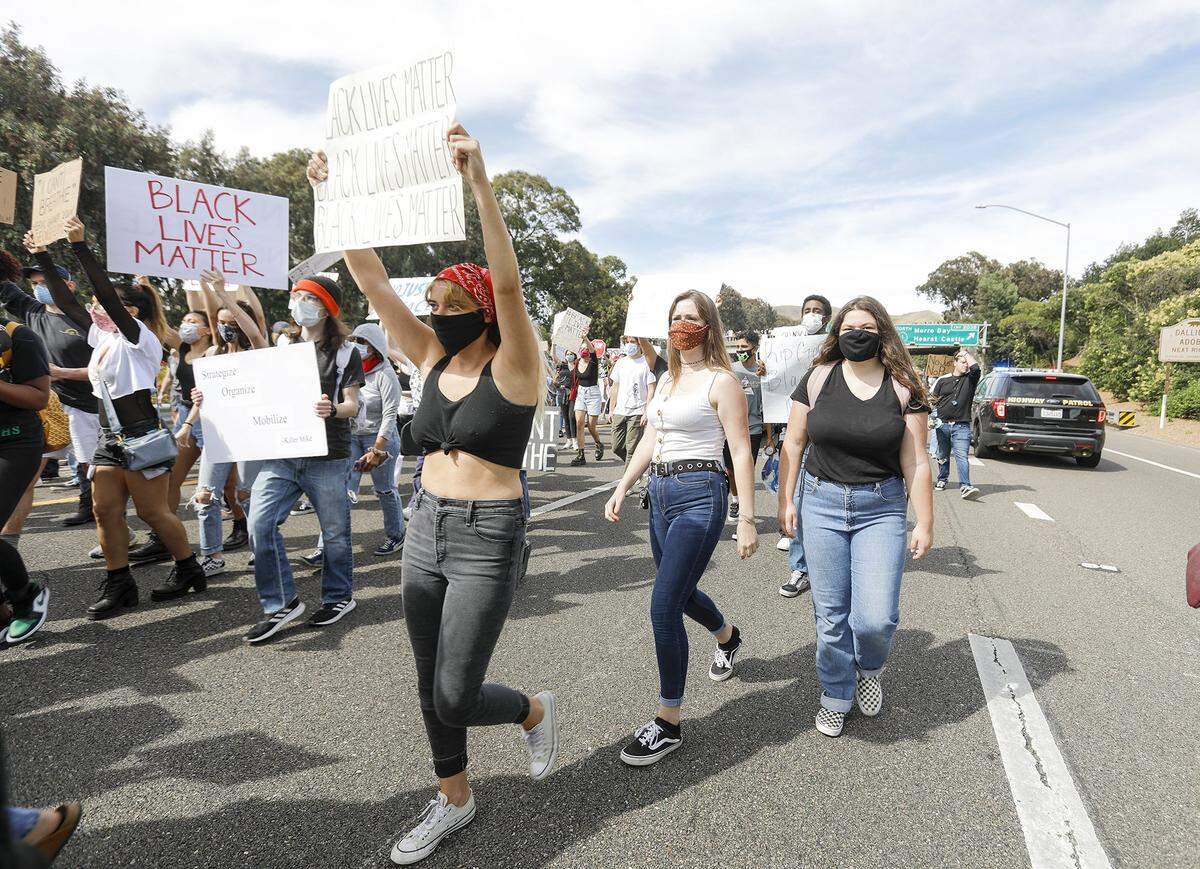
In what San Luis Obispo mayor Heidi Harmon called “one of the hardest (City Council meetings) I’ve been at so far,” a steady stream of racial justice advocates — some identifying as protesters — issued a sharp rebuke of the city’s police response to the protests on June 1, when authorities used tear gas to disperse the crowd.
Interim Police Chief Jeff Smith shared the law enforcement perspective and areas for improvement as part of an after-action review, which included a 100-page report written with the input of police and community consultants.
Smith described an agitated crowd without clear leadership that had created a safety risk that day by going onto Highway 101 and walking on city streets, putting pedestrians at risk of being hit by cars.
Earlier in the day, police were worried about social media posts of possible looting and an out-of-town presence at the demonstration, Smith said, which didn’t take place that day as feared.
Many in public comment described police as a militarized presence at a peaceful demonstration of First Amendment rights, days after George Floyd’s death at the hands of a police officer in Minneapolis set off protests nationwide.
Public speakers said law enforcement acted overly aggressively, and several called for the City Council to reduce funding for the Police Department by as much as 33% and reallocate the money to community needs like homeless services and non-violence programs.
Tuesday’s City Council meeting, held on Zoom and posted on YouTube, was continued to Feb. 23 at 5 p.m. after nearly two hours of public comments on the report. The meeting ended after 11:30 p.m.
June 1 protest details debated
The June 1 protest began around 2 p.m., occupied the highway about 4 p.m. and ended around 9 p.m. after police used tear gas and rubber bullets to clear out the crowd gathered near the police station on Santa Rosa Street.
The use of tear gas and rubber bullets against the crowd was a continued point of heated debate that boiled over at Tuesday’s meeting with some expletives used and city staff calling on the public to tone down personal attacks against SLO officials.
“I’m not here to be respectful,” said Black Lives Matter protest leader Tianna Arata, who was identified in the after-action report. “It’s utterly ridiculous that police have no accountability and they’re allowed to investigate themselves. ... (Former SLO Police Chief) Deanna Cantrell is not asked or forced to be in this meeting. She was the one who called the shots to have us tear gassed. This is a joke.”
.jpeg "123_1 (2).jpeg")
Arata used an expletive in reference to City Manager Derek Johnson, and others protesters used harsh language toward police in general, one calling them a name and another criticizing a SLO police official’s body language in the Zoom meeting, saying it appeared disrespectful.
City Attorney Christine Dietrick, Johnson and Harmon all called for civility and for speakers not to target city officials in personal attacks.
Dietrick said it appeared to her that some of the comments were “compounding collective trauma, not alleviating it,” in a reminder on council meeting civility.
SLO police breakdown of the protests
Cantrell, who left her position to become the Fairfield police chief in late August, was the highest-ranking law enforcement official leading the police response on June 1 and made the final call to use the tear gas. Cantrell was not in attendance at Tuesday’s meeting.
In total, 178 law enforcement officials had responded by the end of the incident, 50 from SLOPD and 128 from neighboring agencies such as California Men’s Colony, the Sheriff’s Office and the California Highway Patrol, the report noted.
Interim Chief Smith, an incident commander on June 1, revealed that near the end of the event, SLO police ordered officers to hold a line on Santa Rosa Street, preventing activists from advancing toward the highway and leading to a standoff between demonstrators and police. The crowd was stopped on Santa Rosa near the police station around 6:15 p.m.
Smith acknowledged internal discussions established that any breach of the line would be a threshold for the use of tear gas against the crowd.
Smith said activists went around police, however, and police also issued several warnings for the crowd to disperse before they deployed tear gas at 8:14 p.m.
“They hadn’t reached the line, but they were approaching,” Smith said. “We’d established a plan to make sure they didn’t get on the freeway again.”
Smith added: “Individuals were going around buildings. A number of people were occupying the northeast corner of Santa Rosa and Walnut. ... People were putting officers in a safety risk situation.”
Ways SLO police is changing
Smith acknowledged some ways they were ill-prepared to handle the event, with an inadequate plan to re-route protesters and loudspeakers that were inaudible to some in the crowd.
In later protests, police offered multiple ways for protesters to re-route and established better relationships with organizers, but the June 1 event didn’t have clear leadership and organization, Smith said.
The department since has made changes, replacing body cams that ran out of battery power that day with new devices that allow for rechargeable battery use. The department also purchased Long Range Acoustic Device (LRAD) loudspeakers to make announcements clearly heard.
Smith defended officers’ use of tear gas.
Smith said that police didn’t want protesters to go on the freeway as they had earlier, and a bike officer overheard a protester saying that was being planned in the early evening. That was perceived as a safety risk as darkness fell.
“We were asking they turn around downtown but not proceed northbound,” Smith said. “There was a couple of points where some tried to convince the crowd to turn around, but many in the crowd felt otherwise.”
Protesters also had thrown water bottles and other objects at police as the officers moved the line forward to clear the road, citing safety concerns for pedestrians in roadways as well, Smith said.
Tear gas was an alternative to physical force, Smith said.
Protesters say police were wrong
In addition to Arata, SLO Diversity, Equity and Inclusion (DEI) Task Force Chair and Cal Poly engineering graduate student Amman Asfaw; Joshua Powell (arrested for his alleged role in a July 21 protest), SLO County Democratic Party Central Committee Chair Rita Casaverde; and former SLO Police Chief Jim Gardiner were among more than 20 speakers at the Zoom City Council meeting. Gardiner spoke in defense of police.
Casaverde lambasted the department for identifying the need for batteries for body cameras and other equipment in its after-action report.
She said the department should have been more self-critical of its use of tear gas, police bias and discrimination, while understanding the demonstrators’ emotions were raw from the death of George Floyd.
“Let’s see if we can replace this (interim Chief Smith),” Casaverde said. “We need new leadership who gets the issue and doesn’t gaslight the community.”
.jpeg "123_1 (6).jpeg")
One protester identified as “Haley” said the tear gas forced demonstrators to take off their masks, coughing and sneezing and putting people at risk of the spread of COVID-19.
Barry Price, of Bend the Arc Jewish Action, called for better de-escalation skills, saying police appear to be blaming the marchers and excusing their own actions, noting police and marchers have different versions of events and adding that the city needs to re-examine its police standards.
“Our policies need to reflect our community’s values and the voices who are speaking out about these matters,” Price said.
Protests call for city police divestment
Several commenters were supporters of Abolitionist Action Central Coast SLO, a group demanding structural change and divestment of police funding.
They said the after-action report missed the mark and seemed to be a call for more police resources — such as the new loudspeakers they said could shatter eardrums and be used as a weapon against protesters — rather than a reflection on better public safety behaviors.
“Don’t make reforms and spend money toward racial bias training,” said speaker Mattie Vogler. “We need divestment from police forces and money put back into the community to prevent violence.”
Asfaw, also facing charges for his alleged role in the July 21 demonstration that led to Arata’s arrest, said he felt physically weak as he spoke. Asfaw said he hoped police would hold themselves accountable, but the report showed “justifications and excuses.”
“I tried to see, as the chair of the (diversity task force) if the city could commit to, at least, not increasing funding in the next five or 10 years, but that didn’t seem to get much traction,” Asfaw said. “To be honest, if things don’t get fixed, we’ll leave and I’ll go to Africa and we’ll build that up and America’s future will be unknown.”
Arata was the only protester named in the after-action report, for allegedly challenging a counter-protester to a fight, which dissipated.
Arata accused SLO officials of trying to ruin her life and putting her in the middle of a national debate on race.
Michelle Arata, a SLO High School graduate and Tianna’s mother, said she will “never encourage Tianna to communicate with police ever again” after her daughter’s experience, saying she was labeled a rioter, terrorist and instigator.
Michelle Arata said “McDonald’s employees have better de-escalation skills” than SLO police.
But Gardiner, who served as the city’s police chief from 1987 to 2002, defended the department, saying SLOPD has a long history of advocating for disenfranchised members of the community, citing his personal support for the construction of the 40 Prado homeless center, among other issues.
Gardiner said SLO officers took a knee with protesters on June 1 in an effort to connect with them, and police weren’t uncaring of their message.
“The department has a history of reaching out and supporting,” Gardiner said. “They are not perfect, but open to making change. They’re a damn good department.”
City Council members ask questions
Councilmember Erica Stewart asked questions around how well the crowd could hear and if officers could have issued warnings by moving into the crowd to make everyone aware of the unlawful assembly announcements they made on June 1.
“Officers were facing hostility, and walking up the line incurs challenge,” Smith said. “... Maybe there could have been officers in front and in back of the crowd to make sure everyone is aware.”
Harmon pressed Smith on the use of “riot gear” at the event, but Smith said it was limited to helmets and shields, not full tactical gear that would have included protection around the arms and legs as well.
Earlier in the meeting, Smith said, “We realized that presence felt threatening to the crowd,” and in later events officers kept a more distant presence with less gear. “... This was not a peaceful protest.”
Harmon also posed questions around alternative options that didn’t require use of tear gas by police.
With public comment concluded, the City Council will weigh in on the review, offering thoughts and further direction at the meeting’s continuation on Tuesday.
“There are systemic problems that are way beyond the individuals in these systems,” Harmon said. “This is one of the hardest (meetings) I’ve been at so far. These issues are so crucial and so important.”
This story was originally published February 17, 2021 at 1:43 PM.
%20Cropped.jpg)