SLO County police agencies say Black Lives Matter protests cost them at least $825,000
Law enforcement agencies in San Luis Obispo County say personnel costs to cover the bulk of local Black Lives Matter protests and provide mutual aid to other departments came to more than $825,000.
Most local departments say their estimates are rough and the actual amount is likely to be much higher.
The police departments of Arroyo Grande, Atascadero, Grover Beach, Morro Bay, Paso Robles, Pismo Beach and San Luis Obispo, as well as the county Sheriff’s Office and California Department of Corrections and Rehabilitation, provided amounts to The Tribune, but many did not have records to provide.
The protests covered in the totals include a series of demonstrations in San Luis Obispo from May 31 to June 18, several mutual aid assignments to Los Angeles during the same period, and a rally and march in San Luis Obispo on July 21.
Smaller, more recent events in San Luis Obispo which required far less officers are not included in the total figure.
San Luis Obispo has had the most local protests and rallies — 27 to date since May 31 — and the city’s manager on Tuesday warned council members that the city’s Police Department is close to exhausting its overtime budget.
Staff will likely come back to the council late next month to ask for a budget adjustment from emergency reserves.
The Tribune has requested similar amounts from the California Highway Patrol but had not received requested records as of Wednesday afternoon.
Costs of Black Lives Matter protests
The San Luis Obispo County Sheriff’s Office said that, at the end of the series of protests June 14, it had accrued the most of any local agency in costs related to sending its deputies to local events — $393,283.
Provided records show that amount includes mostly overtime, although the agency reported spending $1,400 on food, a little more than $5,000 on travel expenses related to the Los Angeles protest it assisted in, and about $7,319 in a “special dept. expense,” which a department spokeswoman said is essentially “unexpected” expenses.
Between June 1 and June 14, the agency deployed deputies to nine events, with as many as 89 deputies and as few as four at each one. The Sheriff’s Office also sent 44 deputies to Los Angeles.
Those costs for the Sheriff’s Office represent less than 0.8% of the department’s roughly $52 million budget for fiscal year 2020-2021.
The San Luis Obispo Police Department says June protests had cost them $253,238, which included approximately 2,358 hours of overtime — worth roughly $176,850 — and 374 management hours.
The July 21 protest that saw demonstrators march on Highway 101 required about $13,068 in personnel costs, the city said.
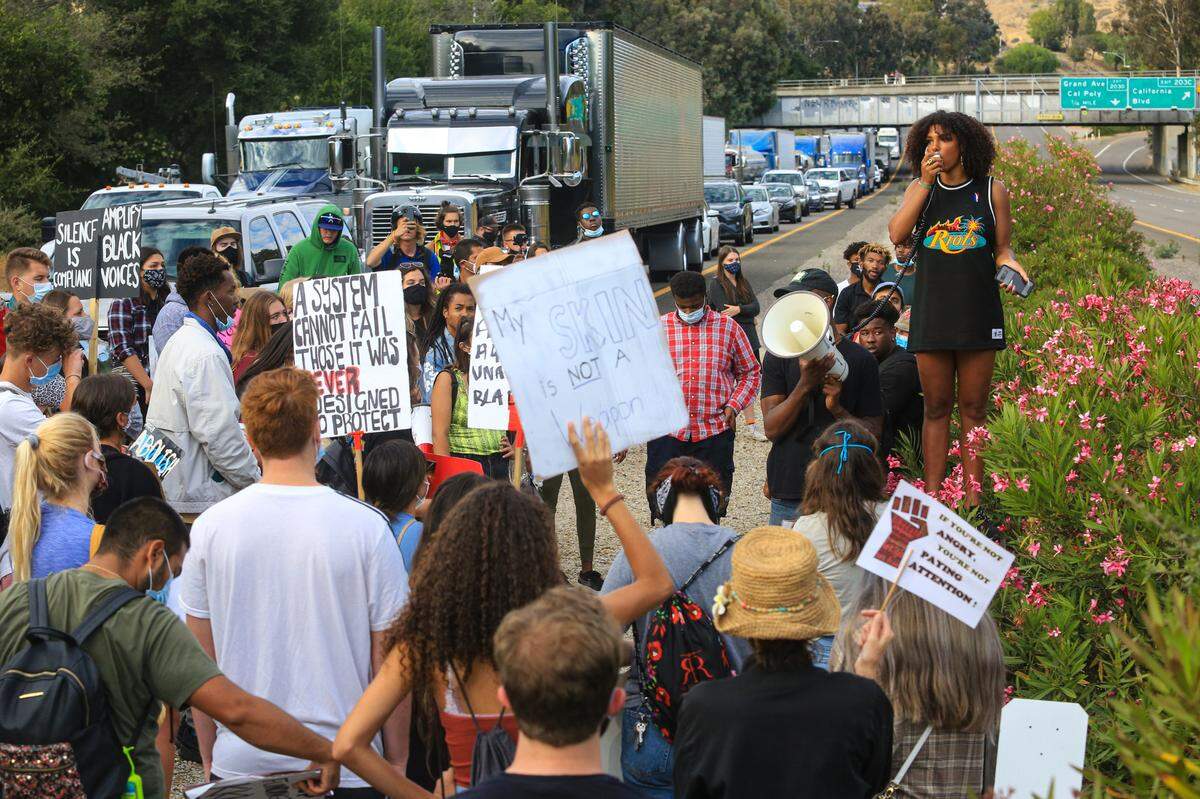
Through the July 21 protest, San Luis Obispo police spent a rough total of $266,306 in personnel costs, according to city staff.
Local police also received aid from California Men’s Colony’s Crisis Response Team, with roughly 16 officers from the state prison attending each protest May 31 through June 5 in San Luis Obispo and 15 officers assisting during an Arroyo Grande protest on June 6.
A California Department of Corrections and Rehabilitation spokeswoman said the agency calculates their personnel costs at $46,574.
Atascadero police Chief Jerel Haley said his department likely spent at least $30,000 to provide about 190 hours of overtime support in San Luis Obispo, Paso Robles, and Los Angeles but did not have a precise figure.
The Pismo Beach Police Department spent about $26,546, Chief Jake Miller said, for protests in San Luis Obispo, Paso Robles, Grover Beach and Los Angeles.
The Paso Robles Police Department accrued at least $26,136, according to Chief Ty Lewis, who said that amount includes an expense of about $86 for travel to Los Angeles.
Grover Beach police Chief John Peters said his costs came to about $17,500 to cover a protest in his city as well as in San Luis Obispo and Morro Bay.
Morro Bay police Chief Jody Cox said his personnel costs came to about $9,650. Of that, roughly $5,500 was for staffing, $2,300 was spent on equipment and $1,200 went to fuel for travel, he said.
The Arroyo Grande Police Department only reported accruing about $8,785 for overtime costs for events May 29 through June 11.
‘We have our hands full’ and may dip into reserves, SLO manager says
The city of San Luis Obispo says local protests have taken their toll financially.
City manager Derek Johnson told the San Luis Obispo City Council Tuesday night that demonstrations have added to strain amid the COVID-19 pandemic, area wildfires, and recent energy risks associated with a record-breaking heatwave.
“I think it’s clear that your staff is being challenged at every single front,” he told the council. “We have our hands full.”
Johnson said that, as of Tuesday, the city knew of four more upcoming protests and a news conference scheduled by the end of the month.
He said the San Luis Obispo Police Department is “on the pathway towards exhausting (its) overtime budget,” and anticipates city staff will likely return to the council in mid-September or early October and ask for a budget adjustment — funds for which would come from emergency reserves.
Asked by Councilwoman Erica Stewart about the potential for recovering any of those costs, Johnson said that any recouping would come from permitting fees, which would only cover a fraction of the total cost to the city.
The permitted Women’s March in San Luis Obispo early this year, for example, cost the city between $30,000 and $40,000; the city recovered about over $12,000 of that amount, in addition to roughly $8,000 Women’s March SLO paid for things such as traffic control and signage, according to the organizers.
Johnson said of the 27 protests in the city so far, only one event — a vigil held at Mitchell Park on Sunday evening — was permitted.
The city has been in better contact with known event organizers to encourage them to apply for permits and allow the city to plan and take safety precautions.
“We’re hoping that becomes more of a trend because we believe there’s a benefit; a benefit to the community, a benefit to organizers,” he said.
Johnson added that while the city has tried to balance residents’ First Amendment rights and its own rules for events, he has talked to San Luis Obispo police Chief Deanna Cantrell about requiring permits for all events and taking “affirmative action” on the protests that are not permitted. That could include citing individuals that are “in the streets without a permit,” he said.
Those talks are ongoing, he said.
This story was originally published August 19, 2020 at 3:01 PM.
CORRECTION: An earlier version of this story included an incorrect total for costs related to covering San Luis Obispo County protests and permitting fees for the 2020 Women’s March..