That led to tense confrontations between drivers and protesters, disruption of traffic and two arrests at the end of the night.
In a wide-ranging interview Tuesday on the protest and the July 21 police response, Cantrell said law enforcement was trying to navigate a “very delicate balancing act” of allowing protesters to exercise their rights to demonstrate while also looking out for the safety of the public.
Blocking roadways is illegal, Cantrell said, and entering Highway 101 presents an especially dangerous situation.
“Protesters being in the streets makes the situation volatile,” Cantrell told The Tribune. “My perspective of the protesters getting on the freeway is that it’s super, super dangerous, and illegal. … It’s an absolute danger not just to the protesters but to vehicles and to police.”
The July 21 demonstration — one of more than 20 protests in SLO County over the past two months — occurred on the same day that a video came to light of a July 6 Tea Party gathering in the North County.
That’s where SLO County Sheriff Ian Parkinson said “there is no endgame” to the protests and “no purpose, other than destruction.” He later told The Tribune that he’s “never seen any indication that systemic racism exists in this county.”
A group of about 300 protesters took to the freeway and marched on city streets, including areas where people were dining outdoors as part of the city’s Open SLO program, chanting “F--- your comfort” and “No justice, no peace, no racist police” and “Out of the shops, into the streets.”
SLO chief’s point of view
Touching on several key points of widespread community debate, Cantrell said that:
▪ Protesters should never get on the freeway or try to block cars, which creates a public safety hazard and could lead to arrests or someone being run over.
▪ The CHP is responsible for blocking freeway on-ramps and off-ramps in SLO protest situations and it investigates incidents on the freeway.
▪ Police have spent somewhere in the range of $500,000 to respond to the many demonstrations in SLO, and SLOPD can’t afford to call out extra forces from other agencies each time a protest is scheduled.
▪ She agrees with activists that systemic racism “does exist in SLO County” said she understands what the protesters are trying to accomplish.
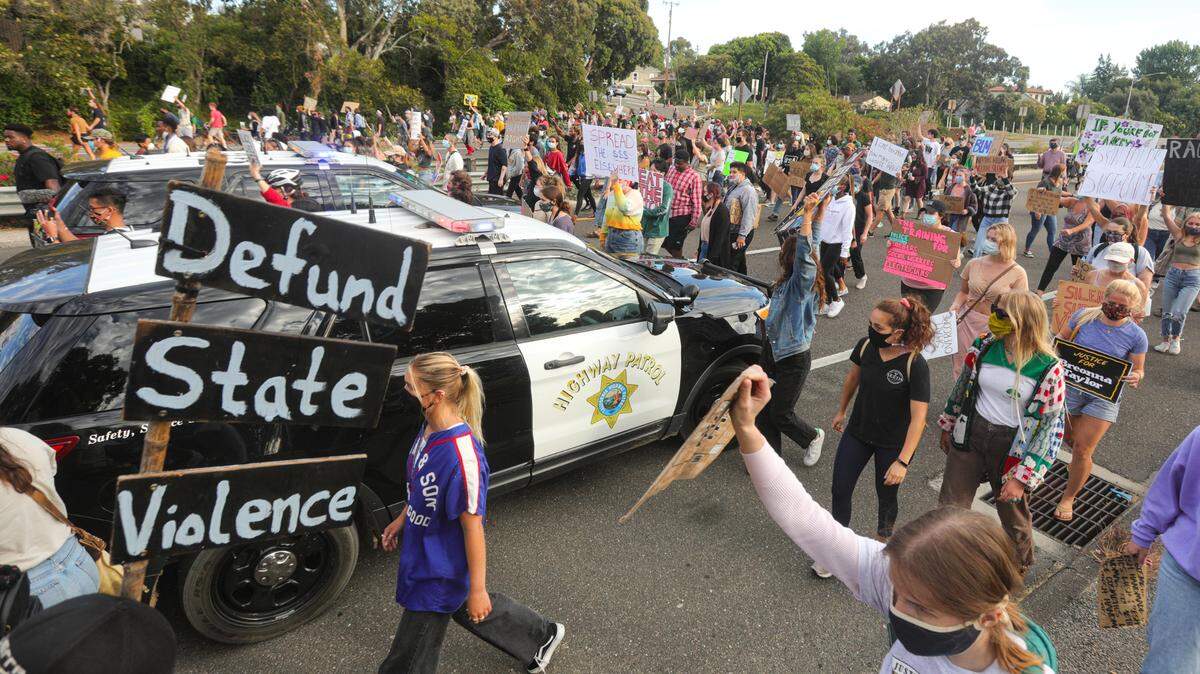
No Justice No Peace protest began at Mitchell Park and moved to marching the streets of San Luis Obispo. Marchers move past Highway Patrol cars blocking traffic on Highway 101. David Middlecamp dmiddlecamp@thetribunenews.com
▪ 20-year-old Tianna Arata was identified by SLOPD as the “leader and aggressor” who broke laws and guided others into the streets, including being at the head of the pack that marched onto Highway 101.
▪ Criminal charges from the July 21 protest still haven’t been formally submitted to the district attorney by SLOPD, pending further police review of evidence (the DA’s Office will then have to assess the recommended charges before filing a case in court).
▪ SLO police conferred with the District Attorney’s Office during the course of the July 21 demonstration, but it wasn’t Cantrell specifically who communicated with the office.
▪ Her officers will continue to “do their job by giving people respect. … They do their job the same way they’ve always done (it) before all of this.”
Several protesters, however, in social media comments and other public statements have said they did nothing wrong while exercising free speech rights and contend that police overreacted.
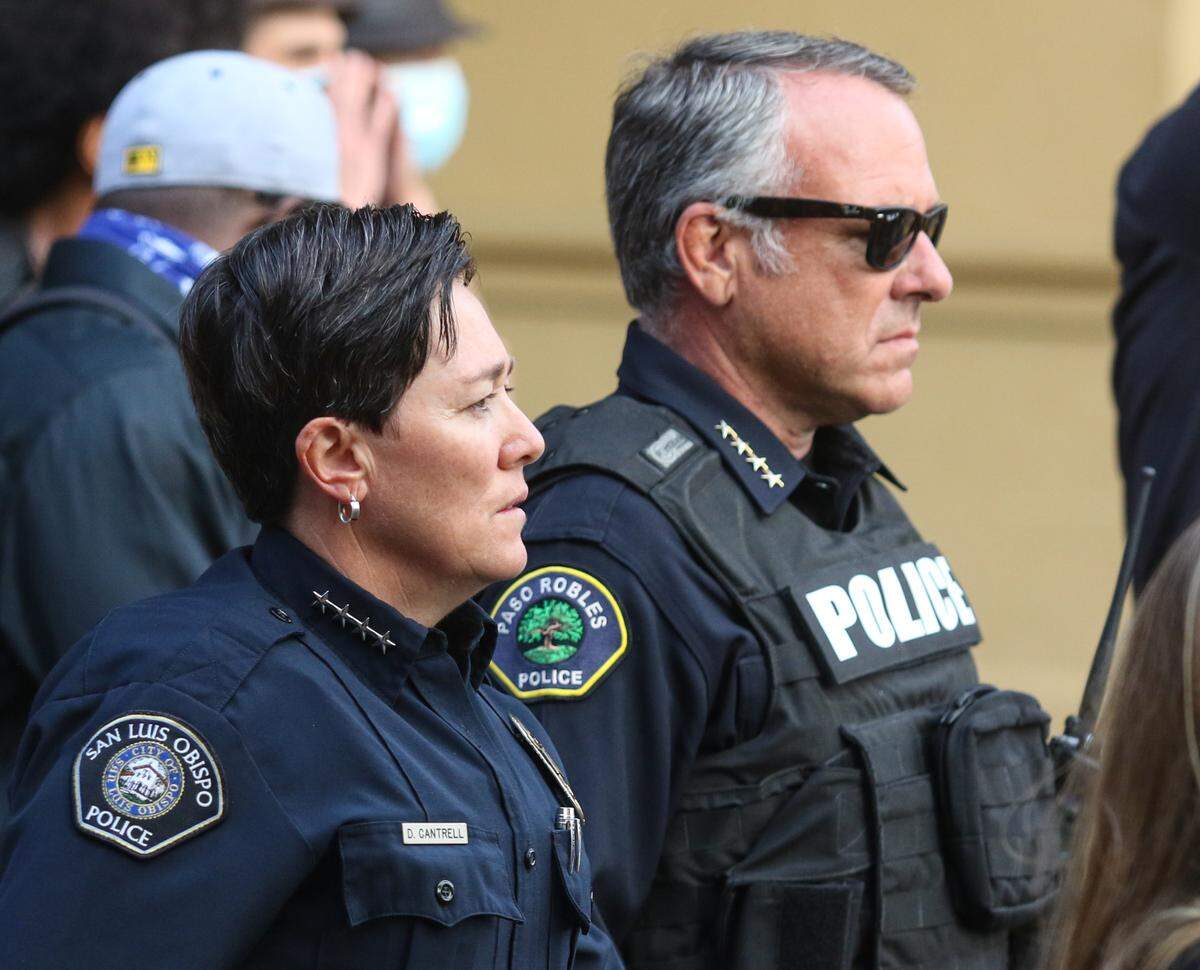
Police chiefs Deanna Cantrell of San Luis Obispo and Ty Lewis of Paso Robles marched with the group in San Luis Obispo in June. David Middlecamp dmiddlecamp@thetribunenews.com
Tianna Arata arrest
Toward the end of the night, amid calls for police to stop, Arata was arrested on suspicion of five criminal charges — participation in a riot, unlawful assembly, conspiracy, unlawful imprisonment and resisting arrest.
Asked about why Arata was pinpointed as the primary instigator among a group estimated at more than 300 people who entered the freeway and roadways, Cantrell identified her as the clear “leader and aggressor.”
Police issued a press release saying protesters smashed a car window with a 4-year-old inside and said that Arata struck another vehicle with a flagpole. In both instances, protesters have said cars drove into demonstrators.
City officials told The Tribune that Arata led groups that ran up to cars with the intent to block them in the road.
But Arata’s attorney, Patrick Fisher, views the situation differently.
Melissa Elizalde, left and Tianna Arata lead a chant at Mitchell Park. No Justice No Peace protest began at Mitchell Park and moved to marching the streets of San Luis Obispo. David Middlecamp dmiddlecamp@thetribunenews.com
“The Black Lives Matter movement came about because of a lack of patience,” Fisher said. “This movement calls out a lack of police patience, and the result of this protest is a perfect illustration of why (the) Black Lives Matter movement exists.”
Fisher added: “My client put herself out there to make the world a better place. Let’s keep in perspective that was the whole motivation of the protests, and to have the result of that be felony charges (against Arata) is a total head-scratcher.”
Fisher called the police response a “a strategic political approach against a perceived organizer.”
“She was in charge of what?” Fisher said. “What do they believe she did to constitute being in charge of this? How does she control a group? Was there a riot? I didn’t see a riot.”
In reference to that charge, Cantrell cited the penal code definition of a riot as “any use of force or violence, disturbing the public peace, or any threat to use force or violence, if accompanied by immediate power of execution, by two or more persons acting together, and without authority of law.”
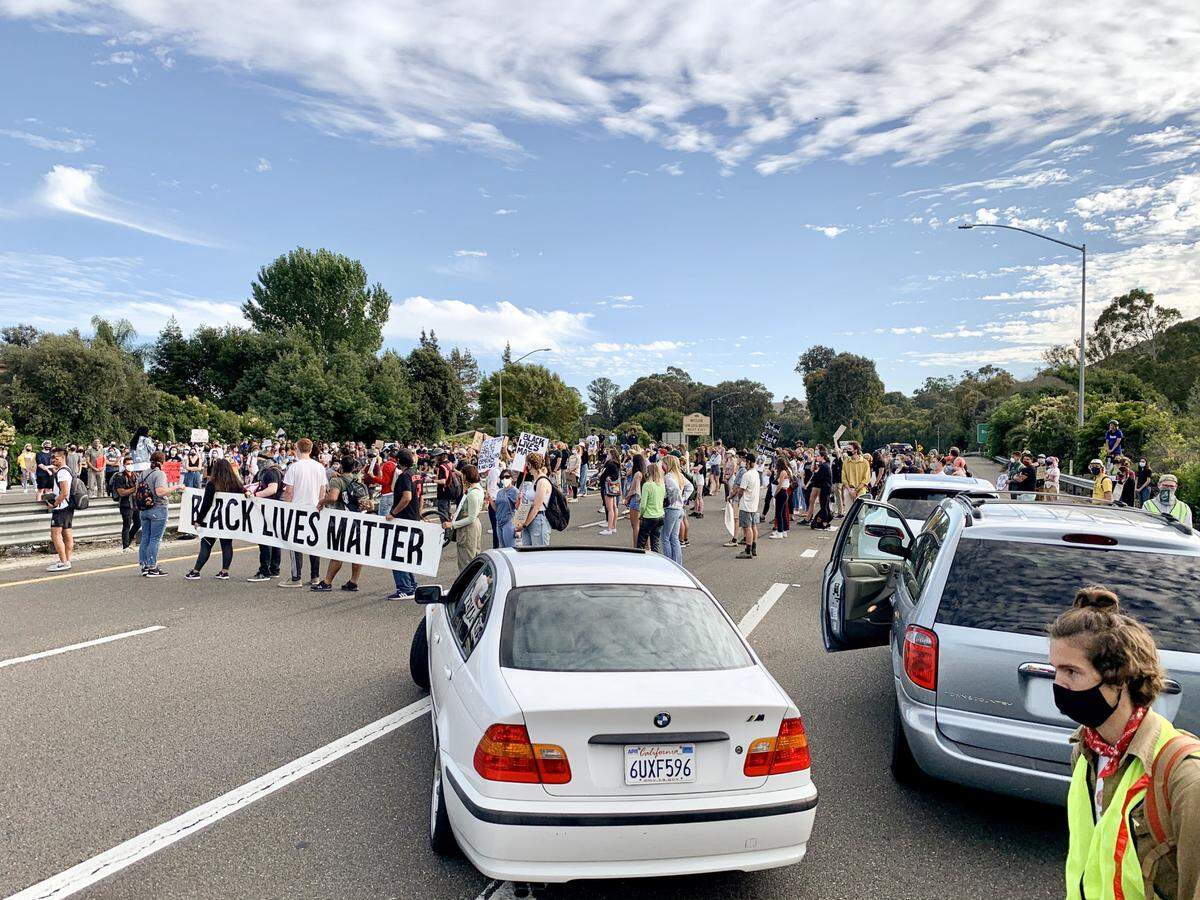
No Justice No Peace protest began at Mitchell Park, later blocking traffic on Highway 101 on July 21, 2020. David Middlecamp dmiddlecamp@thetribunenews.com
Texts and conversations on safety
Cantrell said SLO police previously had repeatedly communicated with protesters, including Arata, in texts and conversations about safety — saying they reached an understanding the marches wouldn’t take to the freeway or involve acts of violence or vandalism.
Arata texted Cantrell before the July 21 protest, saying the event will remain “peaceful,” the police chief said. Asked if the informal communications had anything to do with Arata’s arrest, Cantrell said “no.”
The police chief said she didn’t think the arrest charges of Arata were too heavy-handed, as some have contended, saying she stands by the decision.
“We based our charges against her on probable cause,” Cantrell said. “We’re still reviewing the evidence before we (formally) submit our charges to the DA’s.”
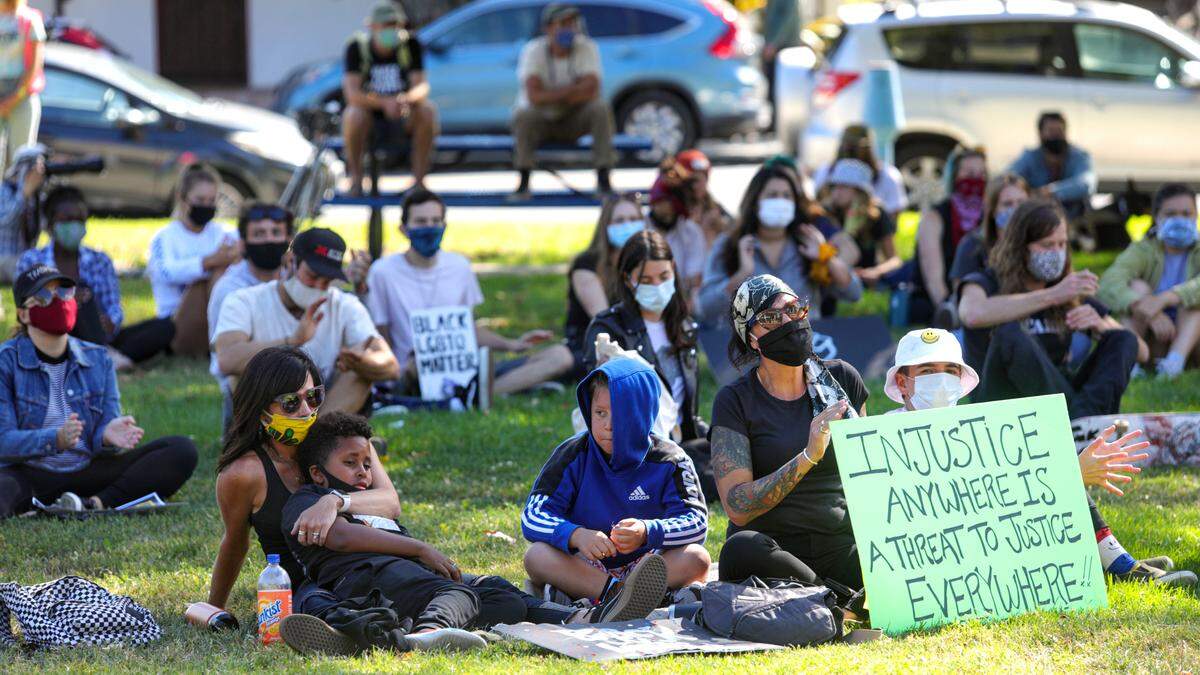
Protesters gather at Mitchell Park for a No Justice No Peace rally and march July 21, 2020. David Middlecamp dmiddlecamp@thetribunenews.com
Cantrell said the department has generally allowed some leeway on allowing protesters to use city streets.
But Cantrell said drivers have a right to use the roadway and sometimes are in fear of protesters or may be facing an emergency.
However, there’s a difference, Cantrell said, between a slow-moving vehicle that safely moves forward to advance on a roadway in attempt to get away from protesters and someone ramming into a crowd with a vehicle — which could result in charges against the driver.
In a livestreamed video, Arata said “F--- Deanna” while talking to a fellow protester who informed her about a smashed car window on the freeway with the child inside, after hearing the chief texted that “trust goes both ways,” according to the clip.
Cantrell said that after Arata led the protesters off the freeway, she texted her: “We’re better than this.”
Protesters, however, say cars drove into them.
“What I saw (in the drone video downtown) is people getting scooped up onto the hood as the car moves forward,” Fisher said of a confrontation between a driver and protesters at the intersection of Chorro and Pacific streets.
Enforcing the law
The July 21 protest was not the first time demonstrators moved from city streets to Highway 101.
On June 1, law enforcement officials in riot gear used teargas to disperse SLO protesters who refused to leave Santa Rosa Street after the crowd blocked Highway 101 earlier that day. Police were criticized by some in the community for that decision.
Cantrell said in subsequent protests, police took a less visible approach along city streets after hearing from protesters that law enforcement was “overmothering” and “overpolicing them.”
“We’re capable of keeping people off the freeway, but at the expense of what? Tear gas, pepper balls, rubber bullets?” Cantrell said. “It’s a very delicate balancing act.”
Cantrell said she and other SLO officers had established good communications with demonstrators over the course of the past few weeks, including Arata, in an attempt to work with them.
“I like Tianna,” Cantrell said. “I think she has a lot of good energy and potential. Her energy needs to be guided in the right direction.”
Protest organizer Tianna Arata speaks to marchers after they closed traffic on Highway 101 in San Luis Obispo during Tuesday’s No Justice No Peace demonstration. David Middlecamp dmiddlecamp@thetribunenews.com
Arata’s attorney responds
As part of a general response to the chief’s comments, Arata’s attorney said that he has reviewed videos captured at the July 21 protest and met with his client.
“I’m doing a lot of guess work as to what law enforcement was thinking and how they came up with these charges,” Fisher said. “They were very creative as to how they (made their allegations).”
Fisher said police “tried to get into the psychology of a driver of the vehicle shown in a drone video, moving into protesters blocking the roadway, saying the person had fear, before apparently talking to that person.”
Fisher said he believes police acted on personal feelings to arrest his client. In the interview, Cantrell said she based her decisions on the laws and probable cause to arrest.
“Maybe something was taken personally by the police chief,” Fisher said. “… I’m disappointed to see our local law enforcement respond this way.”
Fisher said his client was protesting to try to improve lives and help bring racial equity, urging less public tolerance of police brutality nationwide.
“We’re talking about a 20-year-old woman who has had her own life experiences and was putting herself out there to make the world a better place,” Fisher said.
Fisher said the police don’t get to determine charges and the DA’s Office will have to assess the case based on what charges prosecutors think they can prove beyond a reasonable doubt.
“Based on what I’ve seen so far, I don’t see her being held criminally liable,” Fisher said. “Fortunately, the DA’s Office has a different standard.”
District Attorney Dan Dow issued a statement Friday night urging patience as his office waits for investigation results before considering whether to formally bring charges against Arata and Bautista.
“I know that many in our community are very interested in this situation,” Dow wrote. “At this time, I would like to respectfully ask all who are concerned to please be patient and allow us to complete our duty in a fair, thoughtful, and thorough manner. Our obligation is to be objective and to not make charging decisions on the basis of public opinion.”
Mayor’s comments
Without directly addressing Arata’s arrest, SLO Mayor Heidi Harmon issued a group email letter Tuesday, saying that she agrees that going on to the freeway is dangerous.
But, she added, “My concern and curiosity about the reasons why (protesters) are willing to risk to get (their) message out are far more deeply rooted.”
“Yes, going on the freeway is dangerous, and it creates danger for others, and this needs to be taken seriously,” Harmon wrote in addressing the protesters. “But it’s important to recognize that it’s also dangerous to be Black in America. You are calling us to justice in ways that are going to be loud and unpredictable. Let your righteous rage be the transformational path for justice, as it has been for so many before you.”
Harmon also urged people who are concerned with the protests to listen.
“I hope we all recognize that we can be uncomfortable, or even can disagree with styles of protest, and still be deeply committed to creating a better world for our children,” she wrote. “If you find yourself in a situation that feels unfamiliar and unnerving, here’s your first best step: listen. If we listen, we will find that we gain understanding, insight, and most importantly, true connection to our fellow human beings.”
Harmon also noted: “After last Tuesday’s protest, the main call has been not for justice but for punishment: punishment for the protest organizers, for police, for the county sheriff. Let’s be more interested in transformation than punishment. Transformation for the organizers, the police, the sheriff, for all of us.”
She concluded that she believes the city can be leaders in social justice.
This story was originally published July 29, 2020 at 2:40 PM.


%20Cropped.jpg)