
SLO cultural committee chair clashes with city over development: ‘I’m being fired for doing my job’
Update to this story >> >> SLO committee chair fired for being ‘rude and disrespectful.’ He’s running for City Council
Original story:
The chair of the San Luis Obispo Cultural Heritage Committee expects to be fired by the City Council at Tuesday’s meeting, saying he believes the council is quashing his voice of dissent and overriding his policy interpretations of legal historical standards.
A council member who serves as a council liaison to the Cultural Heritage Committee, said the review of James Papp’s role will address his conduct and how he treats members of the public.
That includes Papp’s recent use of language such as “bizarre,” “shocking,” “dangerous” and “nuts” to describe a historical evaluation submitted to the committee.
Councilmember Andy Pease told The Tribune that Papp is “extremely knowledgeable and a great resource for this community,” but said that he has crossed the line at times in addressing members of the public.
“We align on many issues of historic preservation, and even when we start on different pages, I appreciate his perspective,” Pease said. “However, I don’t feel he should serve on the CHC any longer because I believe his manner of questioning and deliberation limits the participation of others.”
Pease said multiple informal conversations have taken place between the council liaisons and Papp about adversarial interactions during Cultural Heritage Committee meetings, but he has fallen short of incorporating a more inclusive, respective environment.
Papp for his part is charging the council with “attempted political influence over the city’s legally established process of objective and expert review of development.”
“I stand by my language because it was based on very clear laws around historic buildings,” Papp said. “I’m being fired for doing my job.”
Debate surrounds downtown SLO property
Papp, a local architectural historian, was appointed as Cultural Heritage Committee chair in March 2019 for a term expiring on April 1, 2023.
The CHC oversees a broad range of educational and technical programming aimed at “preserving historical and cultural resources.”
Papp opposed the council’s decision to move forward with a 50-foot-tall, mixed-use project near historic homes that he and others argued would alter the character of downtown. And he’s openly criticized the council in opinion columns in The Tribune.
Papp said the council’s critique of his role as the CHC’s chair hinges on the committee’s review in April and May of an application to delist commercial buildings from the city’s Inventory of Historic Resources.
The property includes three commercial spaces located between 782 and 790 Higuera St., in the heart of downtown. That stretch of the building, originally constructed in the 1800s, was purchased by the Davis family, a Central Valley farming family, in 2018 as part of a group of adjoining buildings on the corner of Higuera and Chorro streets.
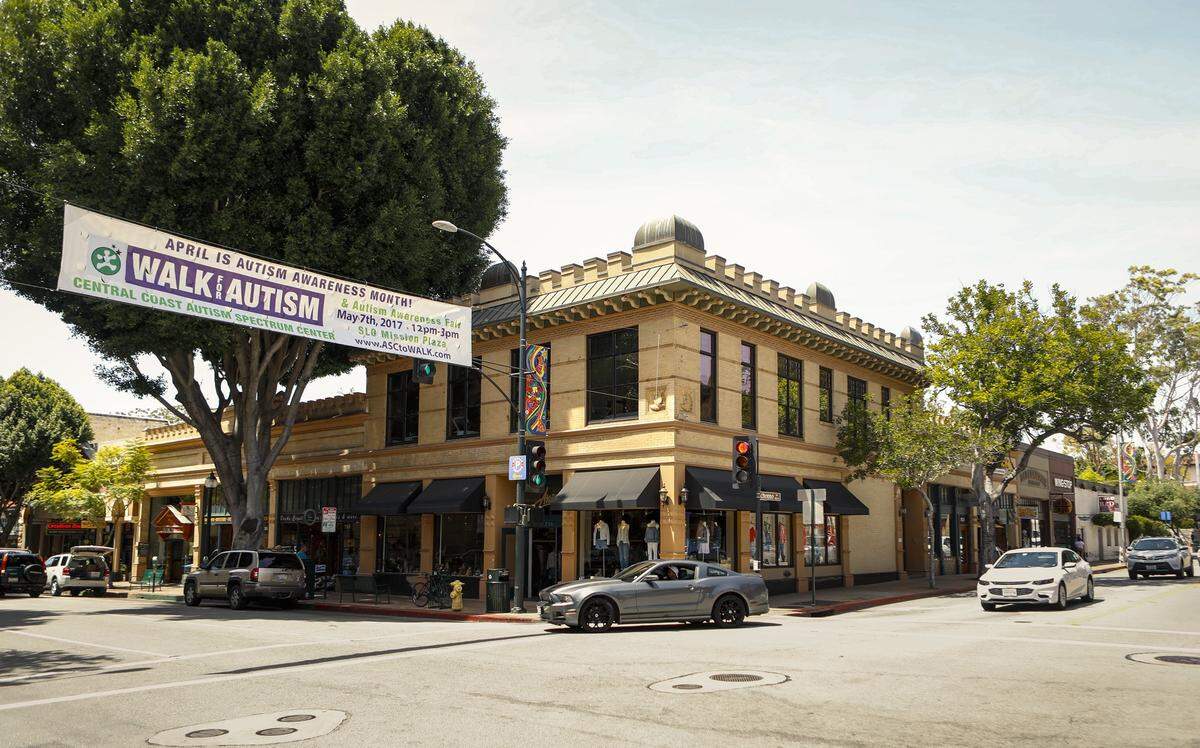
The CHC ruled against the applicant, listed as Randy Russom of RRM Design Group, who argued the building had changed over time to the point where the historic significance didn’t warrant a listing, Papp said.
Retired Caltrans architectural historian Bob Pavlik, a former CHC chair, did a historic resource evaluation. But Papp cited gaps in Pavlik’s analysis.
In his own research, Papp said he found architectural components of the property that remained in alignment with historic standards.
“When they took off the stucco and studs the façade had survived,” he said, “and they restored this and reconstructed the cornice and parapet, all to Secretary of the Interior Standards for Restoration, the highest standard in the country ...”
Papp added that “one or two anonymous sources within RRM had expressed concern” about the applicant’s historic interpretation.
Papp said that he used language such as “bizarre,” “dangerous,” and “nuts” to describe the applicant’s interpretation the building lacked historical significance.
The review met “15 standards of significance and seven aspects of integrity the city’s historic preservation ordinance contains, and the committee voted to recommend against taking it off the master list,” he said.
City Council stresses ‘clear communication’
Pease said that she and Carlyn Christianson, who also serves as council liaisons to the CHC, aren’t critical of the content of the discussion.
She said the Higuera Street property is a “red herring” to a broader conversation about process.
Pease said Papp has repeatedly used language that attacks rather than includes, which doesn’t reflect the approach of the City Council. CHC members serve at the pleasure of the council, which has the authority to appoint or terminate them.
“Public meetings should be a place where all those who wish to participate in constructive discourse feel welcome and respected,” Pease said. “At a time when so many of us are frustrated with the divisiveness of national politics, local government must be approachable and inclusive. As council members and advisory body members, we will continue to create space for independent thought and collaborative discourse, including healthy, constructive disagreement.”
Language in the council’s policy states “if friction develops, individuals should make every attempt to clarify differences and make certain that clear communication is taking place. The public meeting should not be used to express anger or disagreement.”
But Papp said debate and discussion helps drive the conversation to reach a reasonable determination.
The language about “anger and disagreement” is “meant to refer to not airing personal grievances during public meetings,” Pease said. “I acknowledge it is a poor word choice and should be reviewed and updated in the future. Our community enjoys broad public participation and we are a better city for it.“
This story was originally published July 6, 2020 at 3:24 PM.
%20Cropped.jpg)