
Vina Robles has a new owner. How will it affect winery’s tasting room, amphitheater and more?
Vina Robles Winery is under new ownership — and they’re already making some noticeable changes to the prominent Paso Robles winery.
Over the weekend, Vina Robles closed its tasting room at 3700 Mill Road, ushering in a new era for the longstanding winery as it transitions to the CMB Family of Wines, owned by California winemaker Courtney Benham. CMB produces wines under the Martin Ray, Angeline, Synthesis and Courtney Benham labels.
Claire Ceklovsky, vice president of marketing, consumer sales and experience for Benham’s Martin Ray Winery, confirmed the business closed its tasting room in the Vina Robles hospitality center in preparation to open a new as-yet-unconfirmed location in Paso Robles in the coming months.
“This new location is part of our vision to create a refreshed hospitality space and experience that celebrates Vina Robles’ legacy while introducing new opportunities for exploration and connection,” Ceklovsky said.
Benham officially bought the Vina Robles brand in September, though the purchase only included the company’s trademark, wine inventory, barrels and intellectual property, according to an announcement in Wine Business.
It did not include the winery property itself — highly visible along Highway 46 East — nor the 14,000-square-foot hospitality center, the attached Vina Robles Amphitheatre or the roughly 1,500 acres of local vineyards.
Ceklovsky said Benham had long been a fan of the Paso Robles wine region, so when the opportunity to purchase the brand arose, he jumped. Sans property, that is.
“Operationally, he never felt like he could maintain a winery of that size, with that much land with an amphitheater attached to it,” she said. “It’s, as you can imagine, a massive, massive undertaking. ... He really felt like he could stick with the brand and still hold true to everything that really was founded on.”
Death of founder, COVID-19 impacted popular Paso Robles winery
The purchase caps off several years of major changes for the prominent Paso Robles winery.
Swiss entrepreneur Hans Nef founded Vina Robles alongside longtime friend, Hans — R. Michel, in the late 1990s with the intention of creating a brand “that would honor his European roots while embracing the unique growing region,” according to a Vina Robles press kit.
But in 2019, that dream was cut short after Nef died in a swimming accident in the Cabo Verde islands.
The next year, the coronavirus pandemic hit, bringing with it a number of impacts to the San Luis Obispo County wine industry as tasting rooms were shut down. Vina Robles had the additional hit of temporarily losing the ability to host concerts at its outdoor theater venue as well, and being forced to cancel its lineup for the first part of the 2020 season.
“The pandemic definitely hit us hard,” the winery’s then-marketing director Chaterine Jaeger told The Tribune in May 2020.
The winery has since rebounded from its COVID-19 lull, with production now up to about 55,000 cases of wine annually, according to Ceklovksy. That compared to the 40,000 cases it was producing in September 2020, according to the Vina Robles press kit.
Ceklovsky added that under the new ownership, they plan to maintain the current volume of production “until the business dictates a different direction.”
“We believe in organic growth,” she said. “It is the general model for all of our brands.”
Why close the Vina Robles tasting room?
Ceklovsky said Benham did not plan to shutter the current tasting room when he first acquired Vina Robles.
“We actually didn’t necessarily know that we weren’t going to stay within the hospitality center,” she said Monday. “But we came upon an opportunity for a new space just in the last two weeks that seems perfect.”
The tasting room was located in the Vina Robles Hospitality Center, which opened among 30 acres of vines and “sweeping views of the surrounding wine country” in 2007. There visitors could sip the winery’s estate wines, enjoy wine and cheese pairings or grab lunch at the attached bistro restaurant.
Ceklovsky said she could not release specifically where the new tasting room will be located but described it as “in the heart of Paso Robles” and “not that far from the winery.”
“We’ll be centrally located in Paso Robles and cannot wait to announce our new location,” she added.
As it prepares for the move, the company offered jobs to “all employees interested in the opportunity in continuing with Vina Robles,” Ceklovsky said. It has since hired seven of those workers as of Monday.
“We’re priming ourselves to be ready to open the new location, so we’re thrilled to have so much institutional knowledge — and it makes the transition great for our local consumers and club members,” she said.
The new tasting room should be open no later than February, according to Ceklovsky.
Will Vina Robles wines continue to be made in Paso Robles?
Though the winery is planning to open a new Paso Robles tasting room, one thing it may not be doing locally much longer is production — though even that is up in the air.
According to Ceklovsky, the CMB company signed a contract to have all the 2024 vintage made at the Paso Robles winery site.
“The wines are still being housed and made at Vina Robles currently in the current facility,” she said.
But next year’s vintage? That’s anyone’s guess.
“We don’t necessarily have a definitive plan for what production is going to look like in 2025,” she said. “Definitely the plan is to maintain the contracts we can through the property — but because it could contractually change, we just don’t know.”
Ownership won’t impact Vina Robles Amphitheatre, wine club memberships
Ceklovsky said in general, Vina Robles customers shouldn’t expect too many other major changes.
“The only part that’s really changing is they’re not going to be tasting and coming to the same space for their hospitality experience,” she said. “They’ll be coming to a new tasting room.”
Ceklovsky said she expects the company will continue to be able to use a portion of the hospitality center like a VIP section for its wine club members, and those members will continue to receive certain perks like VIP tickets and early access to the Vina Robles Amphitheatre.
“That was a huge perk for the local club members,” she said. “It’s really nice that that’s not changing at all. ... We definitely wanted to maintain those components of the business as much as we could.”
The outdoor concert venue will also continue to primarily sell Vina Robles wines, though it will also potentially start offering some of CMB’s other brands as well, Ceklovsky said.
Meanwhile, the theater continues to operate as its own entity, VR Group CEO Kurt Ammann told The Tribune.
VR Group was the parent company that sold the wine brand, and that continues to own the Vina Robles properties and the Vina Robles Amphitheatre.
Ammann said the group is “very excited” about the upcoming concert season, which so far includes singer Leon Bridges on June 4 and rock legend Rod Stewart on June 15.
Other acts for the upcoming season are expected to be announced soon, he said.
What is happening with Vina Robles property, vineyards?
With the Vina Robles wine brand moving off-site, the Highway 46 property is slated for some of its own changes.
Ammann said VR Group plans to transition the site to offer “custom crush” where outside entities can take advantage of the former Vina Robles production facilities — and most importantly their sustainability features — to make wines.
“The better way to put it is probably we are contracting with folks to make wines on their behalf,” he said. “So if you have 300 tons of cabernet, we can process, ferment, barrel, bottle and package it all here.”
Ammann said this offers those outside businesses the opportunity to use “probably the most technologically advanced wine facility in California,” noting the property’s many sustainability features like rainwater recapture and solar power.
Notably last year, Ammann said the facility captured about 5 million gallons of rainwater that could then be re-injected back into the groundwater basin along with treated water that was used in the winemaking process.
“That’s a big deal up here,” he said, noting the Paso Robles Groundwater Basin’s critical overdraft status.
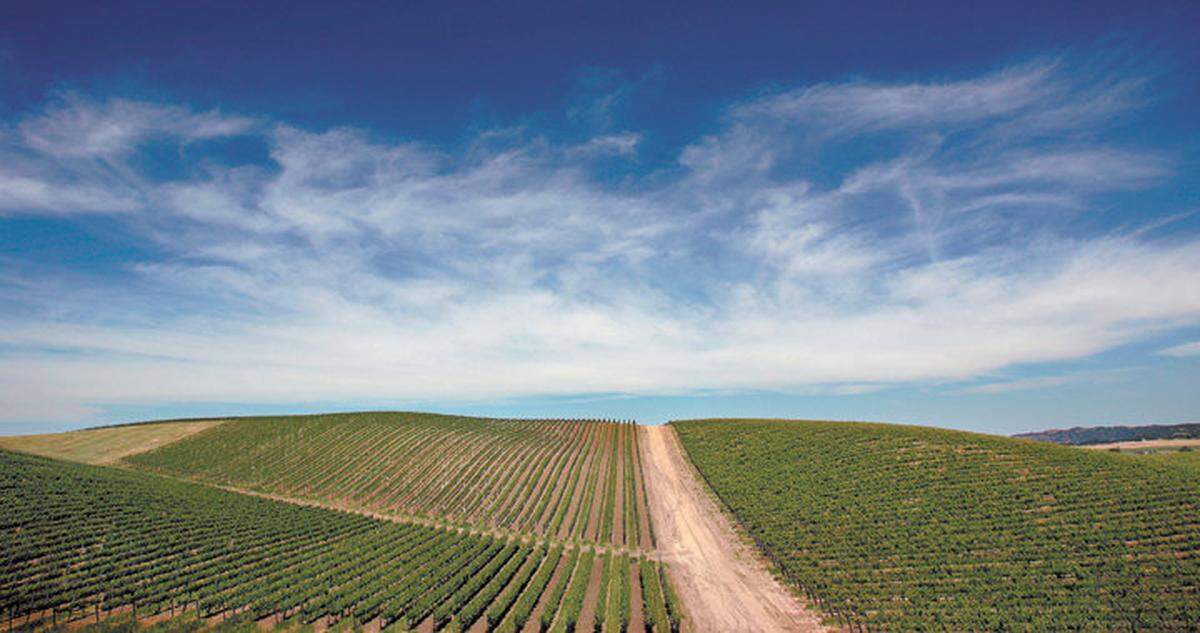
The grapes from the 1,500 acres of vineyards still owned by VR Group will also be available for outside entities.
Ammann said previously, only about 15% of the grapes grown locally were used for Vina Robles wines, with the vast majority instead going to other brands.
Moving forward, he said the grapes will continue to be available via contract.
The company’s farming outfit, Viticulture Management Inc., is also still owned by VR Group, Ammann said. It contracts with a handful of other Paso Robles wineries to provide vineyard management services.
%20Cropped.jpg)