
Space travel and bug nutrition: The intriguing life of SLO County's Wrestler of the Year
As an eighth-grader, Trevor Melsheimer had no idea wrestling existed outside of the cage matches and chair throwing he saw on TV.
Then he heard about a wrestling tryout at school — no face paint required. Melsheimer didn't really have a favorite sport, but he liked wrestling around with his dad and brother, so he decided to give it a shot.
“The first wrestling practice was super fun. The second practice, I was thinking, 'Oh my god, what did I get myself into?’” Melsheimer said.
Over the next four years, that struggle turned into a love for the sport and this past winter a standout season in his senior year at Arroyo Grande High School. Melsheimer finished ranked in the Top 50 in the state and Top 15 among wrestlers from 500 schools at the CIF Southern Section Masters tournament in the 147-pound weight class.
But to discover the real Trevor Melsheimer, you need to leave the wrestling mat and think about bugs, the Boys Scouts and a galaxy far, far away.
A space odyssey
Last fall, Melsheimer was in his car listening to NPR when he had a light-bulb moment.
The guest on the show that day was former NASA astronaut-turned-celebrity Scott Kelly. He said something during his interview that hit Melsheimer like a comet.
“He said, ‘The generation that is going to Mars has already been born,’” Melsheimer remembers. “I was like, ‘Wow, that could be me.'”
Growing up, Melsheimer was that kid looking up at the stars on a clear Central Coast night. He would think about the possibility that humans weren’t alone in the universe, and his imagination ignited. Now, at 17, that dream is more realistic.
“Combining that interest in space with my interest in science, a giant adventure and doing a community service, it kind of just seemed like the perfect mix,” Melsheimer said.
Since last fall, Melsheimer said everything in his life has been about making his dream a reality, but that doesn't mean it will be an easy path.
According to NASA, astronaut candidates need STEM (science, technology, engineering and mathematics) degrees — many astronauts have a master's degree or even a Ph.D. in their field — at least three years of professional experience or 1,000 pilot-in-command time on jet aircraft, plus the ability to pass an astronaut physical along with a height of between 62 and 75 inches.
Even having all those things doesn’t guarantee a spot. In 2017, NASA selected 12 astronauts from a record 18,300 applications. There are currently just 44 active astronauts available to conduct flight missions.
You might expect those closest to Melsheimer to talk some sense into him based on how difficult it is to break in, but the response has been the opposite from his parents and coach.
“Astronaut, huh?” Arroyo Grande wrestling head coach Kent Hubert remembers thinking we he first heard of Melsheimer's aspirations. “A lot of guys say that, but Trevor is one of the guys who you look at and you say, ‘Yeah, he probably will.’”
Hubert has watched Melsheimer develop into one of the best wrestlers in the county using not much more than a relentless work ethic in the past four seasons. It paid off in his final season with a 43-11 record and PAC 7 title.
“He was waking up three or four days a week at 5:30 to go running while wearing a high-altitude training mask,” Hubert said. “This is my 20th year coaching, and I have had state champs, guys who have achieved more, but I don’t know if any of them out-hustled or outworked Trevor.”
That work ethic has also shown up in academics. In the fall, Melsheimer will study chemistry at prestigious Boston University after graduating with a 4.6 GPA, good enough for Top 15 in his class.
Boy Scout connection
Outside of academics and a curiosity of the unknown, Melsheimer does have something going for him that NASA seems to covet — a Boy Scout background.
“Of the 312 pilots and scientists selected as astronauts since 1959, 180 were Scouts or have been active in Scouting,” reads a fact sheet on the Boys Scouts of America website. “Of the 12 men to physically walk on the moon’s surface, 11 were involved in Scouting.”
The 312 astronauts selected includes 40 Eagle Scouts, a group Melsheimer joined earlier in March. He has been involved with the Boy Scouts since he was 5 years old and finally attained all 21 merit badges, achieving the group’s highest rank. He celebrated at a ceremony put on by his parents.
For his final project, Melsheimer constructed a patio area at a local church that gives preschoolers and teachers a place to relax.
Melsheimer, however, is not slowing down. His latest passion — teaching the the community about eating bugs as a form of sustainable food — keeps him plenty busy.
A bug’s life
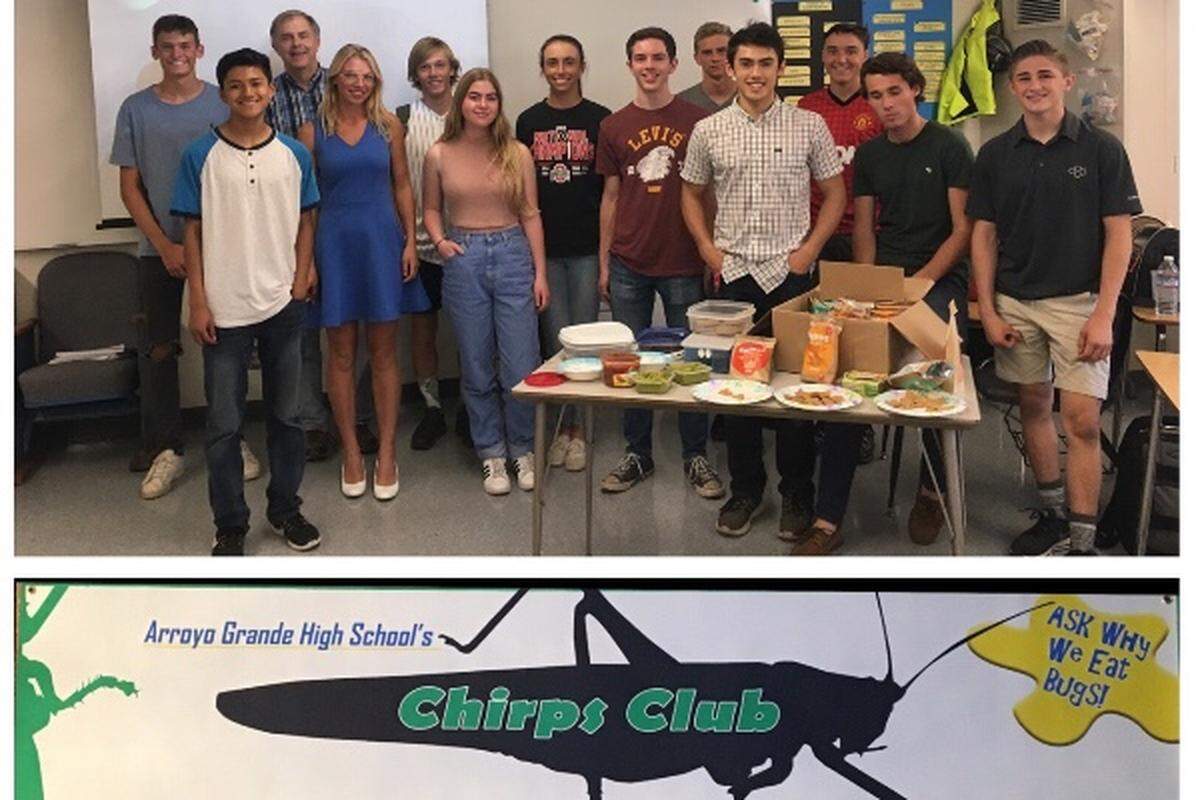
A research project his junior year based on a report from the UN first turned Melsheimer onto the idea of eating bugs. Pretty soon, he went to his friends with an idea — “Let’s start a bug club.”
He reached out to a few companies for access to products, and before he knew it, the club had 12 members. But don’t expect to see crawling cockroaches or chocolate-covered grasshoppers at the weekly Chirps Club meeting; instead, there are just normal-looking — and tasting — foods like corn chips and chocolate chip cookies. The only difference is these chips and cookies are made out of cricket powder.
“It’s not a novelty club,” Melsheimer said. “It’s a lot more about getting people used to the idea of eating bugs, not as a novelty, but more as a sustainable resource.”
Melsheimer sees entomophagy — the human use of insects as food — as a realistic food solution in a world where water and space are becoming more and more scarce.
“Compared to beef, pork and chicken, it uses a lot less feed and water,” Melsheimer said. “You use one liter of water for a pound of crickets. For a pound of beef it’s almost 1,600 liters of water.”
Other benefits, according to Melsheimer, include the ability to use vertical farming, a lack of ethical dilemmas and the fact that 99 percent of protein-rich crickets are edible.
The two main problems in making bug consumption popular with mainstream Western society so far are cost (three 3-ounce bags of chips costs around $17) and the fact that most people are still grossed out by the idea. So Melsheimer visits elementary schools and farmers markets to bring the idea already embraced by most of the world to the local community.
“We do show and tells there to get the little kids hooked on it. I mean, it’s cookies and chips,” Melsheimer said. “When I go to college, I hope to have more connections, and hopefully I can get involved more. I see this as a middle ground. Right now, I am pushing the idea.”
Melsheimer plans to visit Southeast Asia to try more bug options and bring some ideas back to the United States.
It will be just another stop in what is already the fascinating life of Trevor Melsheimer.
This story was originally published March 23, 2018 at 9:49 AM with the headline "Space travel and bug nutrition: The intriguing life of SLO County's Wrestler of the Year."