Let’s cut Hunter Breese some slack. He did nothing (legally) wrong | Opinion
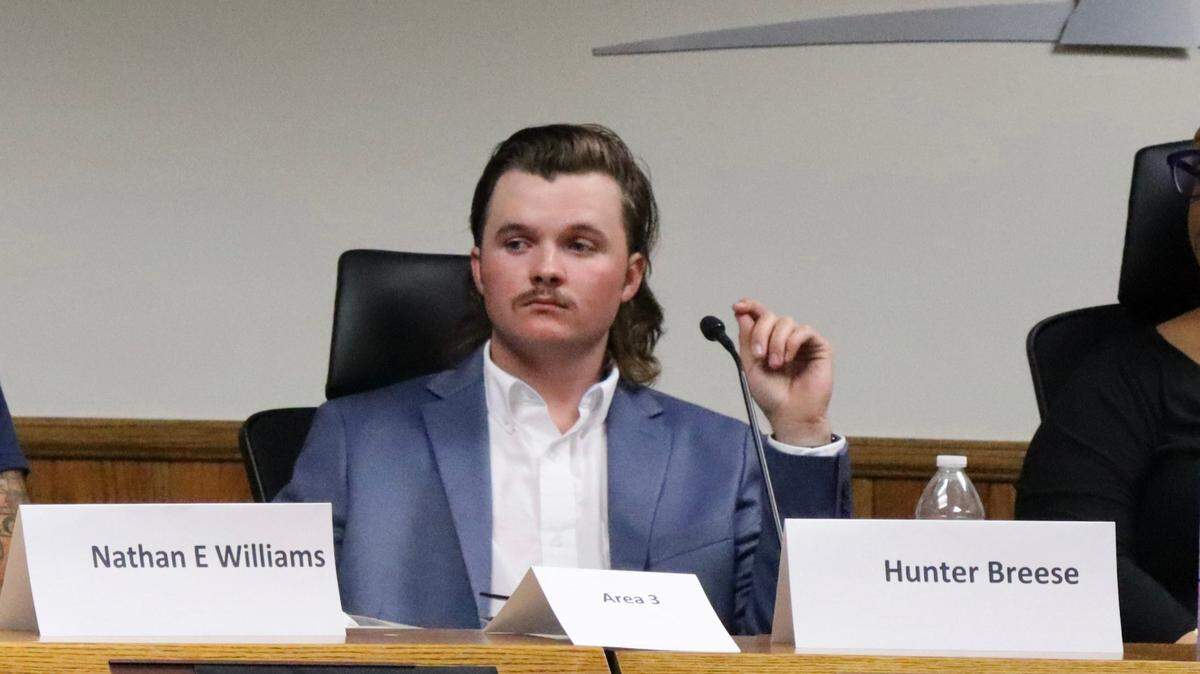
Hunter Breese — the 19-year-old Paso Robles school board candidate accused of falsifying his home address — is innocent.
That’s my humble opinion, anyway.
I have no doubt that he made sure he followed the letter — if not the spirit — of the law when he filed election papers to run for the District 3 seat on the Paso Robles Unified School District Board of Trustees.
Sure, it smells fishy. Breese moved into a house on Red Cloud Road owned by Sharon Johnson, who happens to be the fiancee of Kenney Enney, who happens to sit on the Paso Robles school board.
Enney would love for Breese to join him on the board. That way, conservatives could regain the majority — provided Enney and Laurene D. McCoy win reelection.
Breese aroused suspicions because he wasn’t seen much around the Red Cloud property. But rest assured, he does have a signed lease to prove that he is indeed living in Trustee Area 3.
True, by his own admission, he is not living there full time — but he said he will be once Johnson moves out in May.
“Once they (Enney and Johnson) are married in May, and she moves out, I’m going to be moving in full time,” he said on a KPRL interview with Cal Coast News reporter Karen Velie.
Breese, who is under investigation by the District Attorney’s Office, also explained why neighbors haven’t seen him around the Red Cloud Road house much.
“How much time did you really spend at your house when you were 19 years old?” he asked rhetorically.
“I’m out. I’m doing tons of things. I’m running an election right now. I’m not home all the time. I’m running around, doing other things.”
What is residency, anyway?
Given that the law is a bit vague in defining residence, we should give Breese the benefit of the doubt.
The California Elections Code tells us that, in the context of voting, “residence” actually means “domicile.”
“The domicile of a person is that place in which his or her habitation is fixed, wherein the person has the intention of remaining, and to which, whenever he or she is absent, the person has the intention of returning.”
There’s nothing mentioned about how much time one must spend in the “domicile,” so there you have it. It appears that even if he’s not always at the Red Cloud home now, Breese has every intention of returning there.
Breese is not alone
Oddly, in this election year San Luis Obispo County has seen a spate of accusations about candidates not actually living at the addresses they list on their candidacy papers.
Michelle Marie Morrow of Grover Beach faces a slew of felony charges for allegedly claiming to live in District 3 when she ran for county supervisor in the March primary, when she actually lived in District 4. (Morrow, a write-in candidate, received 866 votes to incumbent Dawn Ortiz Legg’s 12,272.)
The District Attorney’s Office has charged her with one count of voter registration fraud; one count of filing false election papers; one county of perjury; and one count of fraudulent voting.
The DA’s Office also is in the process of investigating Gaea Powell, who is running for mayor of Arroyo Grande.
She openly admits that she in not living in the city, but rents a room in a condominium within the city limits.
She also says the city informed her that she did not have to live in the city while she campaigned for mayor, which the city clerk confirmed with a Tribune reporter.
Interestingly, the city’s election code does require candidates for council to live in the district at the time nomination papers are issued, but lists no such requirement for mayoral candidates.
Yet the city’s handbook for prospective officeholders does state that candidates for mayor and council must be “a registered voter of the city of Arroyo Grande and otherwise qualified to vote for that office at the time that nomination papers are issued to the person.”
That raises a couple of questions: If Powell isn’t living in Arroyo Grande, how can she be qualified to vote there? And why in the world would the city neglect to specify candidates for mayor are subject to the same residency requirements as candidates for council?

It may be legal, but is it ethical?
I remain convinced that Breese broke no law, though I’m less certain about Powell.
Regardless of legality, though, it all seems, at best, inauthentic, and at worst, politically sleazy to uproot yourself, and possibly your family, for the sole purpose of running in a local election.
Ideally, candidates for office have spent some significant period of time among their constituents. They would have some institutional knowledge of the area. They would shop at local stores, attend local churches, maybe have their children enrolled in local schools.
They would not have to be told about the challenges facing their community — they would know them first hand.
That’s not easy to do when you’ve recently changed address, especially if you’re living there only part-time — or not at all.
Some agencies do require candidates to live in a jurisdiction for a minimal period before filing candidacy papers — the cities of San Luis Obispo and Paso Robles require 30 days of residency — but many don’t have any waiting period.
Theoretically, candidates with the money — or the connections — to up and move on a political whim could establish residency one day and file papers for office the next.
As a result, we have modern-day carpetbaggers who may have little or no connection to the people they will be represent and scant knowledge of the issues affecting them.
They are simply in it to win it, whether its just for themselves or their political colleagues.
Again, it’s all perfectly legal. But as voters, we don’t have to fall for it.