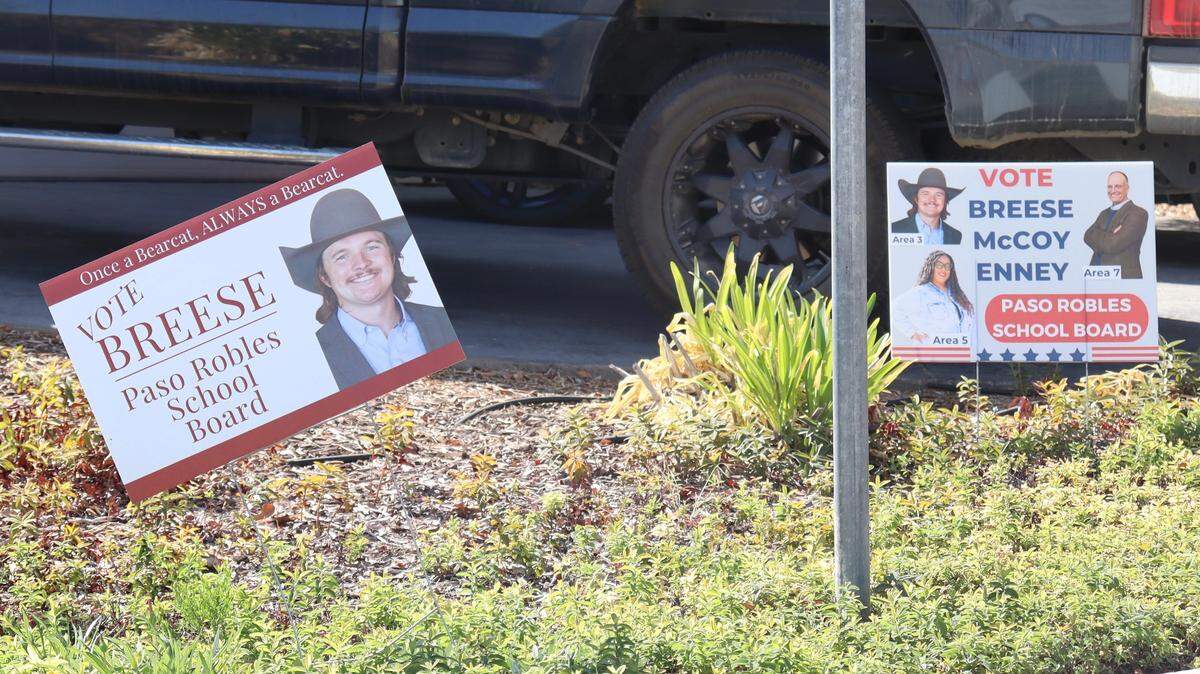
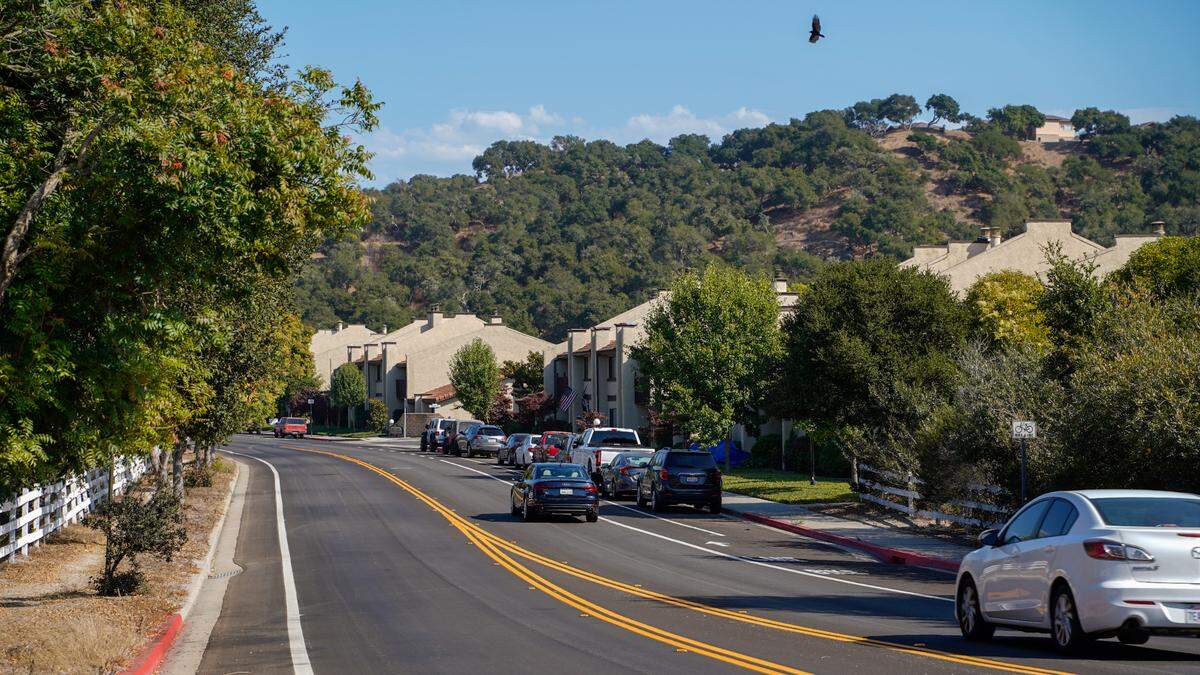
Paso Robles school board candidate Hunter Breese is registered to run under an address on Red Cloud Road in Trustee Area 3, shown here, but his family’s home is on White Tail Place in Trustee Area 5. Campaign posters sit outside of both residences.
Chloe Shrager
cshrager@thetribunenews.com
The San Luis Obispo County District Attorney’s Office is currently investigating two cases of possible election fraud and recently charged a previous candidate with voter fraud and perjury in a third case.
The three concurrent cases of potential election misconduct by local candidates beg the questions: Why is the county suddenly seeing so many allegations of election-related fraud and what is done to prevent it?
The two latest investigations question whether Arroyo Grande City Council mayoral candidate Gaea Powell and Paso Robles school board candidate Hunter M. Breese made false declarations of candidacy by listing addresses different from where they actually live on their candidate filing documents — which is a felony crime under penalty of perjury.
The new investigations come in the wake of the DA’s Office charging Michelle Morrow — a former candidate for the San Luis Obispo County Board of Supervisors who allegedly registered under a false address — on four felony counts of voter registration fraud, filing a false declaration of candidacy, fraudulent voting and perjury by declaration.
Morrow appeared in court for the first time on Thursday, but no details of the case were revealed and the circumstances that led to her being charged are still unclear.
The Tribune looked into the laws and processes that govern how SLO County verifies its candidates as a part of its Reality Check series.
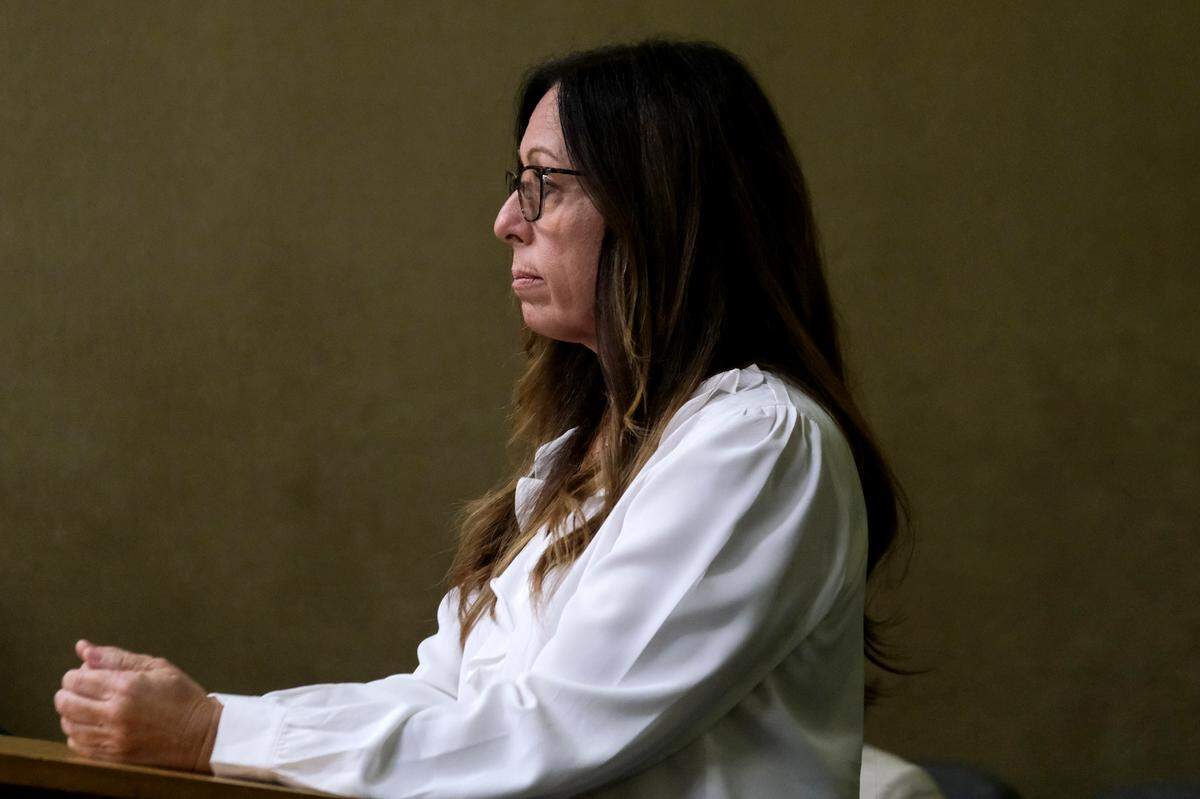
Michelle Morrow attends a court hearing in San Luis Obispo Superior Court on Oct. 10, 2024. She is charged with a voter registration violation, voter fraud, perjury by declaration and false filing of candidacy — all felonies. Chloe Jones cjones@thetribunenews.com
County Clerk-Recorder’s Office plays minimal role in verifying candidates
In California, most candidates running for public office are required to live in the district they wish to represent, a rule that extends to most elections in SLO County.
But there’s a notable gap in the verification system.
Candidates are not required to prove their residency, and the county isn’t required to check if they are lying, Clerk-Recorder Elaina Cano told The Tribune.
Cano is SLO County’s top election official — her office manages voter registration for the whole county, as well as ballot collection and counting on behalf of cityies that opt for the county to run their elections for them. Most cities in SLO County usually choose this option for ease of centralizing elections under the county’s oversight — all of the city council and mayoral races in the current election cycle are being run by the county.
The Clerk-Recorder’s Office handles the candidate filings for county, school district, community services district and a few other non-city races. City council candidates file with their own city clerk’s offices, even if that city later opts to have the county run their elections.
But beyond a basic cross-reference, verifying a candidate’s residence eligibility to run does not fall under the clerk-recorder’s responsibilities.
“When a candidate files their paperwork to be a candidate, they provide us with their address, which we look up in the voter registration system to determine if they are eligible to run for that specific office,” Cano told The Tribune in an email.
The San Luis Obispo Board of Supervisors Santa Barbara County election division manager Elaina Cano as interim clerk-recorder on Tuesday, Oct. 12, 2021. Laura Dickinson ldickinson@thetribunenews.com
Candidates are not required to show any proof of residency — such as a rental agreement, lease or deed — as they are signing their candidacy documents under penalty of perjury, Cano said. Making a declaration under penalty of perjury carries the same consequences as a sworn statement under oath.
“We don’t investigate. We don’t ask. We don’t ask for proof,” Cano said in a previous conversation with The Tribune. “They’re doing that under penalty of perjury,” which could expose them to criminal charges if they’re found to be willfully lying.
Cano said the only scenario in which the Clerk-Recorder’s Office would need to verify a candidate’s qualification is if the seat itself has qualifications to meet in order to run, such as the district attorney — which requires a law degree to practice in California — or sheriff — which requires law enforcement experience and a peace officer certification.
The county’s only general qualifications for candidates are that they are registered voters at the time they file nomination papers — which are the official forms they submit to run for office — and that they are not felons.
However, most district offices’ whose elections are run by the county — like harbor, health care, community college and school districts — require more specific qualifications for candidates’ residency. They each use slightly different language in the rule book but all mean the same thing: Candidates must be registered voters living inside the district they wish to serve.
Cities can also have their own requirements, which are the responsibility of the individual city clerk’s offices to vet, not the county Clerk-Recorder’s Office.
As for the county, the Clerk-Recorder’s Office does not have any duty beyond confirming that the address at which a candidate is registered to vote is the same as the one under which they are registering to run for office, and that the address is within the district or area of the office they are running for.
“As the elections official for San Luis Obispo County, my primary responsibility is to ensure the integrity, transparency and accuracy of the electoral process,” Cano said in the email.
Investigating cases of potential election fraud committed under the penalty of perjury is up to legal authorities — and the Clerk-Recorder’s Office is “not the law enforcement,” Cano said.
“Our focus is on conducting the election,” public information officer for the Clerk-Recorder’s Office Erin Clausen told The Tribune in an email. “The clerk-recorder doesn’t have a role to play in determining whether these investigations result in charges, nor does she have any opinion she’d share publicly.”
In regard to the two open investigations of Powell and Breese, The Tribune received anonymous tips about each of the candidates and were able to confirm through the Clerk-Recorder’s Office that the DA’s Office is conducting investigations. The DA’s Office declined to comment on the investigations.
“I am not involved in the conduct of the investigation,” Cano said in an email. “However, if there is information that they have requested, then I can provide it to them.”
When asked, Cano previously told The Tribune that the DA’s Office requested Breese and Powell’s candidate registration filings, which she gave to them to aid their investigation.
Cano confirmed the investigations to The Tribune when asked but “has nothing further to add,” Clausen said. “The DA’s Office will be the ones to announce if/when they take any action as a result.”
The Clerk-Recorder’s Office said the same thing when Morrow was charged. Clausen said it applies to this situation, too.
“There is nothing my office takes more seriously than upholding the law and conducting local elections that adhere to California Elections Code,” Cano said on Sept. 12 about Morrow. “The subject of election security has become a hot topic in recent months and years, both nationally and here at home. I appreciate the passion community members have for transparency in the elections process, and I also appreciate that, when warranted, local law enforcement gets involved.”
Her statement continued: “SLO County has a proven track record of safe, secure and accurate elections. In any instance in which an individual or individuals attempt to corrupt the process, my office will work with law enforcement to thoroughly investigate and ensure that justice is served. Maintaining the integrity of our elections is our top priority, and we will continue to safeguard the voting process for all county residents, ensuring that every valid vote is counted and that any fraudulent activity is addressed swiftly and appropriately.”
How does the election code work, and what is falling through the cracks?
The Tribune recently reported on the two cases of potential election fraud currently under investigation by the DA’s Office.
Little is known about Breese, the 19-year-old Paso Robles school board candidate, who did not respond to The Tribune’s efforts to contact him or his family.
Breese is registered to run at a home on Red Cloud Road in school board Trustee Area 3 of Paso Robles, where he is seeking office. He re-registered to vote at that address in July. He is alleged to live outside of Trustee Area 3, but it is unclear where. His family’s home is on White Tail Place in rural Paso Robles, in Trustee Area 5.
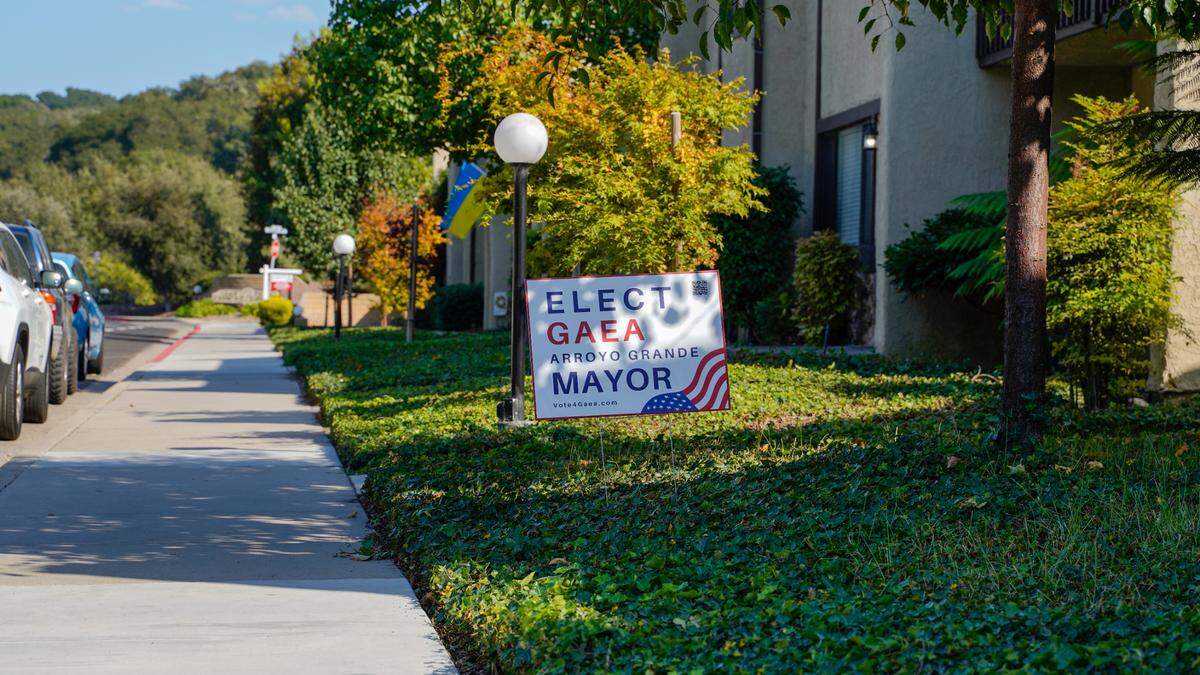
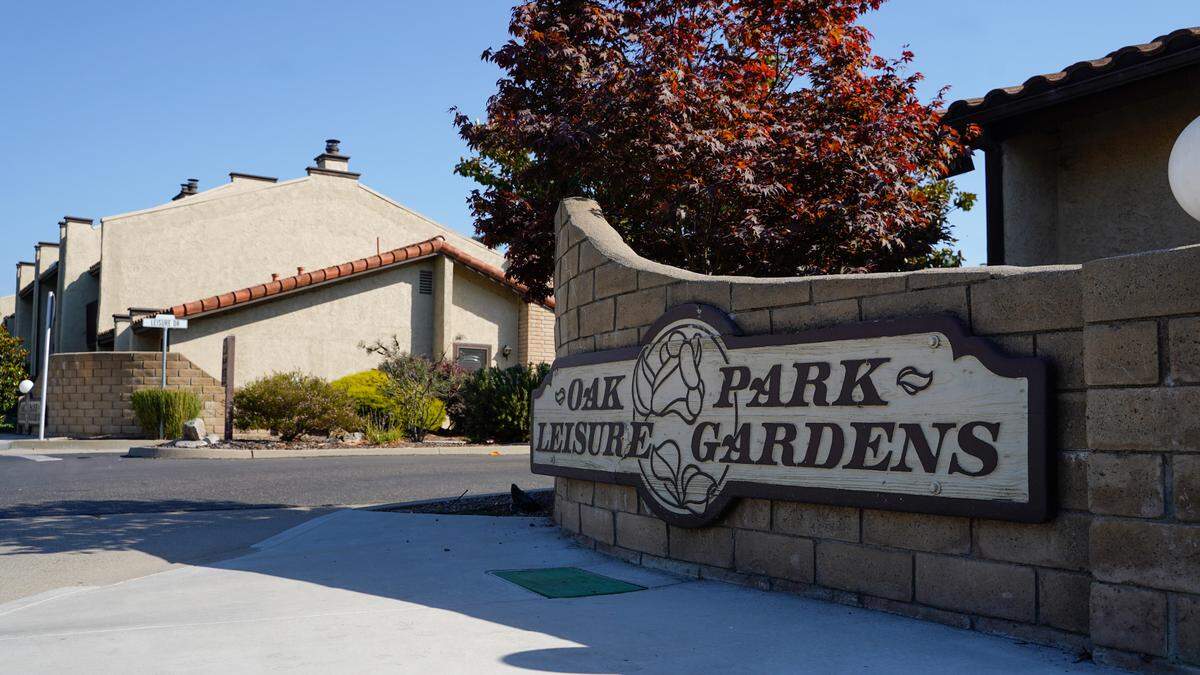
A campaign sign is planted in the lawn in front of the Oak Park Leisure Gardens condominium on James Way, where Gaea Powell is registered to run as a candidate for Arroyo Grande mayor. She has a second residence on Heritage Lane, outside of the city limits. Joan Lynch jlynch@thetribunenews.com
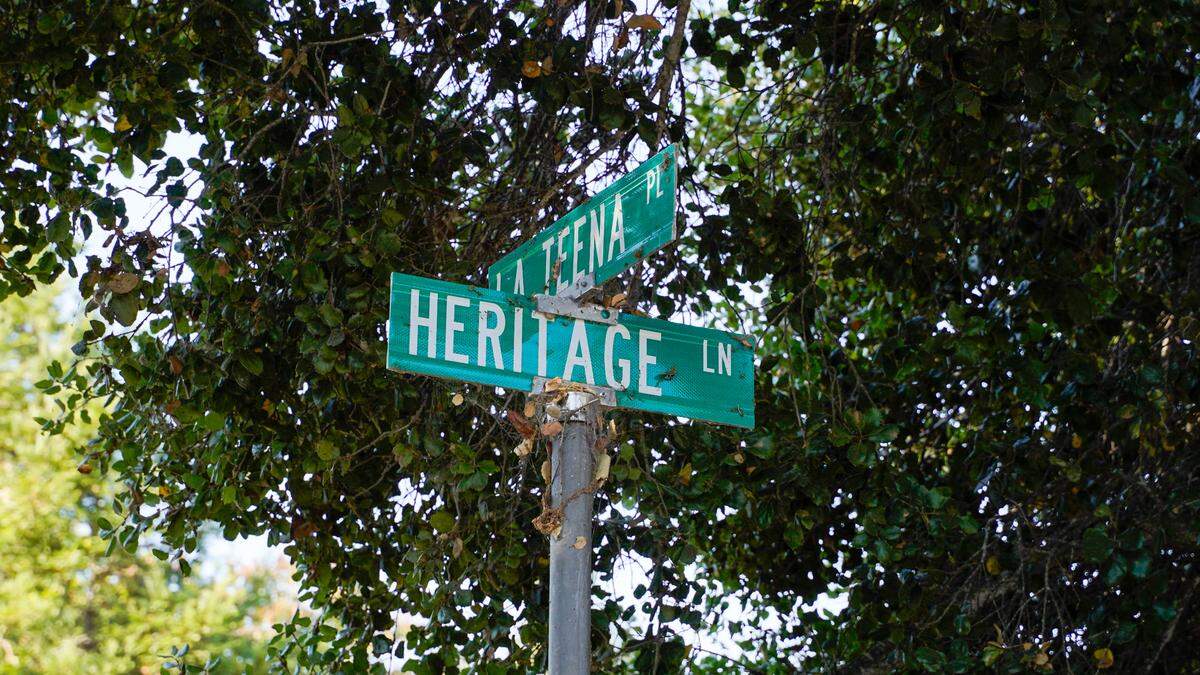
As for Powell, a candidate for mayor in Arroyo Grande, she admitted to The Tribune that she lives outside city limits on Heritage Lane at a residence different from the James Way address she registered under. Powell said she rents a room at a condominium on James Way but does not spend time there.
This could be an indication of fraud — filing a false declaration of candidacy — but Powell got confirmation from the city before running that she does not have to actually live at her residence inside the city limits in order to launch her campaign and run for office.
Arroyo Grande City Clerk Jessica Matson told The Tribune the same thing she told Powell about the requirements to file for candidacy: “The city’s municipal code does not have residency restrictions related to time spent at one residence within the city limits versus at another residence outside city limits.”
Powell believes she is in the clear — and she might very well be, depending on what DA’s Office decides — but the city’s rules seem to be in direct contradiction with those of the county and state, which say that candidates are required to live in the district or area where they seek to hold office, both at the time that they launch and during their campaign.
Gaea Powell is registered to run in the Arroyo Grande mayoral race from an address in the Oak Park Leisure Gardens condominium complex on James Way, which is inside the city limits. She has a second residence on Heritage Lane, which is outside of the city limits. Joan Lynch jlynch@thetribunenews.com
It states: “A person is not eligible to be elected or appointed to a public office unless that person is a registered voter and otherwise qualified to vote for that office at the time that nomination papers are issued to the person or at the time of the person’s appointment.”
Cano said this essentially means candidates need to live inside the area they are running to hold office in when filing for candidacy and during their campaign.
“This code indicates that a candidate must be a registered voter in the district or jurisdiction they seek to represent, which effectively sets a basic residency requirement for candidacy,” Cano said.
California Government Code Section 34882 reiterates the rule in similar language: “A person is not eligible to hold office as a member of a municipal legislative body unless he or she is otherwise qualified, resides in the district and both resided in the geographical area making up the district from which he or she is elected and was a registered voter of the city at the time nomination papers are issued to the candidate.”
So why did the city tell Powell she is allowed to live outside the city while running for mayor?
Gaea Powell is registered to run in the Arroyo Grande mayoral race from an address in the Oak Park Leisure Gardens condominium complex on James Way, which is inside the city limits. She has a second residence on Heritage Lane, which is outside of the city limits. Joan Lynch jlynch@thetribunenews.com
Within the state elections code, there are separate codes that govern municipal elections differently than county elections. The county conducts municipal elections at the request of a city’s elections official but does not supersede or override their rules, Cano said.
For example, Arroyo Grande’s municipal elections code specifies for the election of council members that “any candidate for city council must reside in, and be a registered voter in, the district in which he or she seeks election at the time nomination papers are issued,” similar to the state elections and government codes.
But, curiously, it does not have the same rule for mayoral elections.
The only rule about mayoral elections in Arroyo Grande’s municipal code details the nature of the election for an at-large seat and the term length of office.
California Government Code Section 34904 also addresses the residency requirement for city council members but does not state whether it applies during candidacy or to mayoral elections: “A person is not eligible to hold office as a member of the city council unless he or she is at the time of assuming office an elector of the city and was a registered voter of the city at the time nomination papers are issued to the candidate or at the time of the candidate’s appointment.”
Arroyo Grande mayoral candidate Gaea Powell is registered to run in the Arroyo Grande mayoral race at the Oak Park Leisure Gardens condominium complex on James Way, inside the city limits. Joan Lynch jlynch@thetribunenews.com
How does the District Attorney’s Office investigate claims?
Ultimately, the DA’s Office will be the final rule on whether Powell or Breese may have engaged in any fraudulent activity, and whether charges should be filed, as occurred with Morrow.
The office declined to comment specifically on the investigations but did tell The Tribune broadly about how it investigates claims.
The DA’s Office receives information on potential crimes from one of two sources: the police or members of the community who contact the office directly, Assistant District Attorney Eric Dobroth said.
The DA’s Office will work with law enforcement on most investigations, but there are some cases where the office will handle entirely in-house.
“Cases that come into our office that we typically will grab original jurisdiction of will be real estate fraud — we do a lot of that — (and) public integrity,” Dobroth said. “Within public integrity type cases, generally, are cases where either an employee or an appointee or an elected official does something that is suspect. And so elections concerns fall within that.”
Dobroth pointed to the allegations against Morrow as an example.
“That’s one of maybe a handful of case types that we’ll take originally and investigate ourselves, instead of pushing it back to our local law enforcement,” Dobroth said.
As far as what an investigation entails, the DA’s Office primarily looks at the intent to commit a crime, Dobroth said.
This is true of any investigation, but especially fraud cases, he said.
“There’s issues that are typical of all crimes related to mental state, but in particularly in fraud type crimes,” he said. “You’ve got to have the particular enumerated mental state,” meaning the purposeful intent to commit fraud.
There are usually “obvious routes of investigation” that the DA’s Office will take, which can include interviewing the suspect and issuing warrants to search their electronic devices, residences and/or other personal belongings, he said.
As for when the outcome of an investigation might come to light, Dobroth said there are some cases in which it is not beneficial to immediately disclose information to the public.
“Information about an investigation can be detrimental to the suspect, violate their due process rights in that investigation and also in other aspects of their life,” Dobroth said.
In the lens of election fraud investigations, the Department of Justice’s 60-day rule suggests that federal prosecutors should avoid making public announcements about politically sensitive investigations or taking overt investigative steps that could influence results within 60 days of an election.
The intent behind the rule is to prevent the Justice Department from interfering in elections or swaying how people vote. It’s been in the national media a lot recently in regard to Donald Trump’s criminal ongoing proceedings during the presidential election.
Because the 60-day rule is a guideline rather than a written policy, its use cases are not well-defined, but it is common practice at the federal level where the stakes are highest.
Dobroth did not say whether the county DA’s Office adheres to the 60-day rule or not, adding only that “we investigate cases as efficiently as we can once they come to our attention.”
This story was originally published October 11, 2024 at 5:00 AM.
Chloe Shrager is the courts and crimes reporter for The Tribune. She grew up in Palo Alto, California, and graduated from Stanford with a B.A. in Political Science. When not writing, she enjoys surfing, backpacking, skiing and hanging out with her cat, Billy Goat.