
SLO County’s traffic is getting worse. Is a new sales tax the key to easing congestion? | Opinion
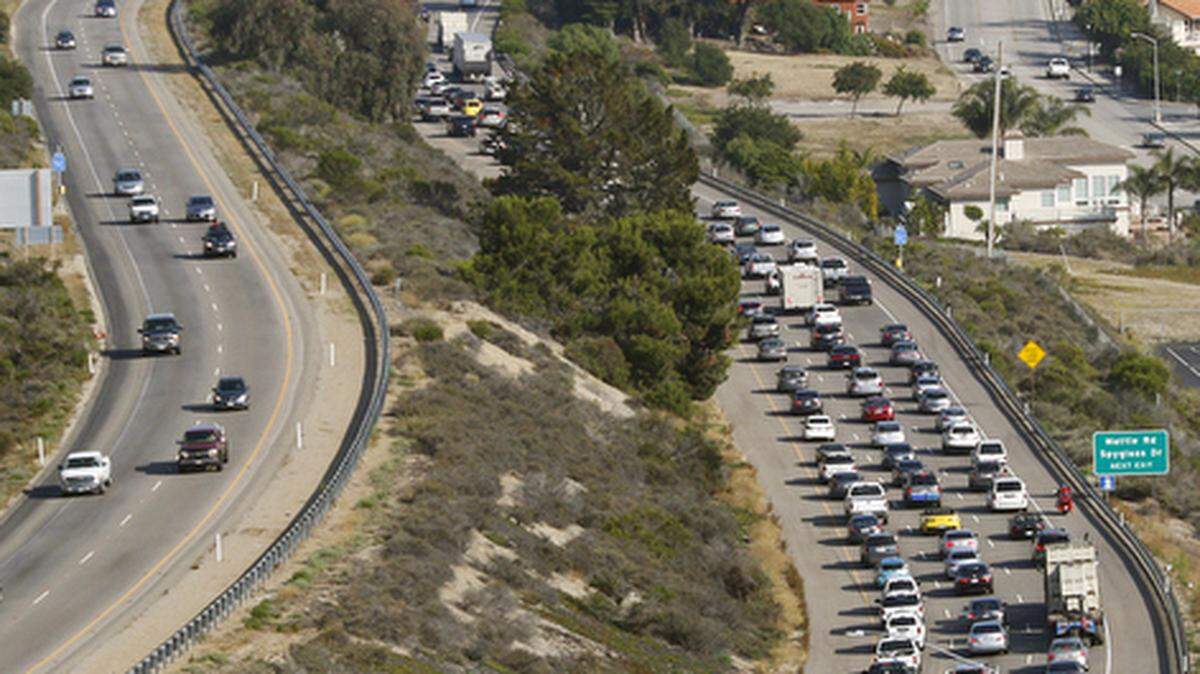
Voters in San Luis Obispo County may get another chance to pass a half-cent sales tax increase to fund highway improvements and other transportation projects.
It’s about time.
A tax has been discussed for years — it came close to passing once — but the proposal has languished, due in part to the reluctance of some public officials to even put it on the ballot again.
The idea has been revived, however, and while there are several hoops to jump through, it could come before the voters next year.
It may not be the best time to ask voters for money — not if gasoline prices keep rising, interest rates remain high and inflation is still not under control — but if we depend solely on state and federal funds to make long-needed improvements, we’re going to be wasting a lot more time sitting in traffic.
An eight-year wait
In 2016, 66% of San Luis Obispo County voters supported Measure J, a half-cent sales tax that would have raised $25 million per year for transportation.
That was a remarkable result, yet the measure failed. It required 66.67% to pass. It got 66.3%.
With that kind of support, it might have passed two years later — except voters never got the opportunity to decide.
To make it onto the ballot, the county Board of Supervisors, along with other local jurisdictions, needed to approve putting it to a popular vote.
Unfortunately, that was a stumbling block, given the makeup of the board at the time.
Supervisor Debbie Arnold and former Supervisor Lynn Compton voted against putting it on the ballot in 2016 because they did not want to burden taxpayers.
John Peschong was not on the board then — he took office in 2017 — but he made it clear that he did not support putting the tax on the ballot.
He thought the state should pony up more money for roads instead. Good idea — but it didn’t work out so well.
Self-help counties
Had the tax passed in 2016 — or, say, 2018 — some of the work we’ve been waiting decades for might be done or at least underway.
Look at the infamous Shell Beach Straits — the congested stretch between Avila Beach and Pismo that can add anywhere from 5 to 15 minutes to a commute. After waiting decades for funding, it took until this year to receive a $65 million state grant. Completion is now scheduled for 2027, if the project stays on track.
Look at how long we’ve been waiting for a Prado Road overpass.
While you’re at it, look just past the county line at Santa Maria, where Highway 101 has been expanded into three lanes in both directions, thanks to a transportation sales tax Santa Barbara County passed years ago.
Santa Barbara is one of 25 self-help counties in California that have passed just such a tax, which makes it eligible for state and federal matching funds for large, regional projects.
A similar tax in SLO County would generate an estimated $35 million per year and would also fund local projects, such as road widening, intersection improvements and bike lanes.
Let the voters decide on tax
The San Luis Obispo Council of Governments — SLOCOG — is exploring the feasibility of putting the tax on the ballot.
It’s conducting an online survey (www.localroadsfirst.com/local-voices-needed) to find out what improvements people want to see, and will follow up with a telephone poll in October to gauge voters’ appetite for a new tax.
“If (the survey results are) strongly supportive, then we might encourage our board to move forward to the next step,” SLOCOG planning director James Worthley told The Tribune. “If it’s fairly lukewarm — if 50% of the voters want it and 50% don’t, then we probably won’t go forward at all.”
If SLOCOG decides to go for it, a majority of the seven cities, the Board of Supervisors and the SLOCOG board would need to approve placing it on the ballot.
If it gets that far — and we hope that it does — we strongly urge elected officials to give the ballot measure their blessing so that voters can decide, rather than paternalistically assuming that a tax would be too big a burden on their constituents.
Voters are adults. It should be up to them to choose whether they want to spend a little more now to support projects that will make all our lives easier, and safer, down the road.