
Why Hwy. 101 traffic is so bad in Shell Beach — and how it could be fixed
We can already hear the mocking laughter of jaded Angelenos.
“You call this traffic?” they ask incredulously, when anyone so much as suggests that Central Coast highways have become congested.
But yes, we do have traffic jams here in laid-back San Luis Obispo County.
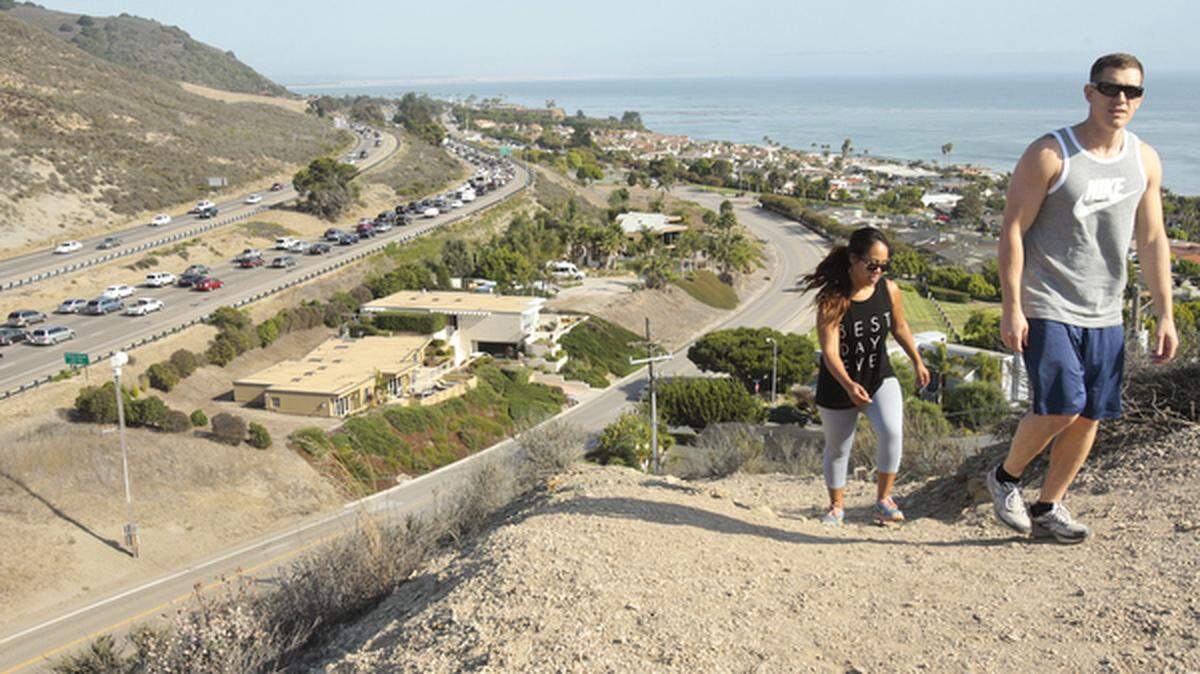
Exhibit No. 1: The Shell Beach Straits — that oft-clogged, southbound stretch of Highway 101 between Avila Beach and Pismo Beach. Travel it around 5:30 p.m. on a Friday (or any weekday, for that matter) and you’re bound to encounter bumper-to-bumper traffic — so much so that highway planners are taking a preliminary look at the intriguingly weird concept of creating a separate lane that would be used only during rush hours.
That’s one of several fixes being studied, in a joint effort by Caltrans and the San Luis Obispo Council of Governments, or SLOCOG, which is the agency that decides how to use the county’s share of regional transportation funds.
Trouble is, those funds are in seriously short supply, so there’s no telling when actual work on the Shell Beach bottleneck could begin. However, alternatives are being evaluated so that a project will be ready to go when and if funds become available.
That will be a relief to locals, who have been dealing with this headache for years.
Officialdom also has ranked the stretch of highway as one of the worst in the county. Ron DeCarli, SLOCOG’s executive director, said it gets D’s and F’s in highway rankings, and according to a Highway 101 Mobility Study for San Luis Obispo County, the Shell Beach Straits is the No. 1 “hot spot” in the county.
“Even folks that live in the North County recognized that,” said Caltrans senior planner Larry Newland, who attended public meetings where the study was discussed.
It’s so bad that drivers often try alternate routes, such as Highway 227 and the Shell Beach frontage road, but that’s contributing to congestion on those arteries. As a result, alternate routes are not necessarily much faster.
So why, exactly, is traffic so bad along the 5-mile-long Shell Beach Straits, when just a mile or two to the south or north it’s generally fine?
Theories abound.
One time-honored idea: Motorists traveling south on Highway 101 have been so starved for a sight of the Pacific (there is no ocean view along Highway 101 between here and the Bay Area) that when they catch the first glimpse of sea just south of Avila Beach, drivers slow down to gaze in wonder.
But regular commuters tend to blame the backed-up traffic on the auxiliary lane that starts at Avila Beach. It was intended to be a truck-climbing lane, so slow-moving vehicles wouldn’t impede the faster-moving cars making the uphill climb just south of Avila Beach. However, the far right lane isn’t used just by trucks. Impatient drivers move over there, too, to avoid slowing traffic. But because the lane ends a short distance later, they soon have to merge back into traffic — often to the chagrin of other motorists.
Even when the auxiliary lane ends and traffic gets (somewhat) back to normal, it’s not clear sailing. Traffic often slows again, and doesn’t really clear up until past Pismo Beach. Planners suggest there may be too many on- and off-ramps in the area, which makes for lots of weaving in and out of lanes.
A variety of alternatives for relieving congestion are being explored, as described in a SLOCOG staff report presented in June:
- Reconfiguring the ramp at Mattie Road. That would involve closing the existing Dinosaur Caves Park southbound on-ramp and creating a new southbound on-ramp at the Mattie Road undercrossing. It would also include adding an auxiliary lane from the new on-ramp to Dolliver Street.
- Extending the auxiliary, truck-climbing lane that starts at Avila Beach either to the Shell Beach Road exit or beyond. That way, motorists traveling to Shell Beach or Pismo Beach — or those who simply want to get off the freeway for a few minutes to gawk at the ocean — could stay in the auxiliary lane all the way to the exit, instead of having to merge back into traffic.
- Adding a “managed lane” that would be open only during rush hour. While there are no such lanes in California, other states use them, as well as some European nations.
The concept of the managed lane is simple enough: Allow the shoulder of the highway to be used as a traffic lane at the busiest times of the day.
In practice, though, it’s not that easy: The shoulder has to be wide enough to accommodate traffic, which is an issue along the Shell Beach Straits. And the subsurface roadbed has to be able to stand up to increased traffic.
Those issues are being studied now; Caltrans is looking at both sides of the southbound highway to see which might better accommodate a managed lane. On the east side, “the Pismo Rock is a pretty serious impediment,” said Newland. And on the west side, there’s the frontage road to worry about.
Another issue: How do you keep drivers from using the lane during nonrush hour?
Enforcement could be the key there, just as it is with carpool lanes. Ticket enough people using the managed lane illegally, and with the cost of fines being what they are, word should get out.
Newland pointed out that while the idea of a managed lane may seem strange, there was a time when roundabouts were regarded with even more skepticism. Twenty years ago, “you would get laughed out of the room” for suggesting a roundabout, he recalled, adding that now they’re commonplace.
Whatever solution is ultimately selected for the Shell Beach Straits, it could be years — if not decades — before it’s actually built, given the planning, environmental review and funding hurdles to overcome.
Until then, we can only offer commuters this obvious bit of advice: Try to leave work early (or late) enough to avoid the evening rush hour, which is generally between 5 and 6 p.m. But don’t hold us to that — we’ve seen traffic get bad as early as 4:45 p.m.
And when you can’t avoid it, be patient. As any Angeleno will tell you, there are worse places to be stuck in traffic.
Is it ‘Straights’ or ‘Straits’?
CHP officers and dispatchers use the term “Shell Beach Straights (or Straits)” to refer to the stretch of Highway 101 between Avila Beach and Price Canyon Road in Pismo Beach. Transportation planners and news media, particularly radio, also have adopted the term. But since it’s used primarily in spoken communication, it’s hard to know whether it’s “straight” or “strait.” We queried a couple of authorities — the CHP and SLOCOG — about the proper spelling, but they didn’t have definitive answers.
In a way, both spellings make sense.
The highway is “straight” in that area.
On the other hand, that particular stretch also is a “strait” in the sense that it’s a restricted, narrow passage, especially in the section where the auxiliary lane ends, forcing traffic to merge. “Straits” also has a nice nautical ring.
So for this story, at least, we’re using literary license and going with Shell Beach Straits.But who knows? Someday, when improvements make the traffic situation less dire, we may reconsider and call it a “straight.”
This story was originally published August 5, 2015 at 10:44 AM.