
SLO County’s far right is assaulting democracy. They don’t deserve to be called conservatives
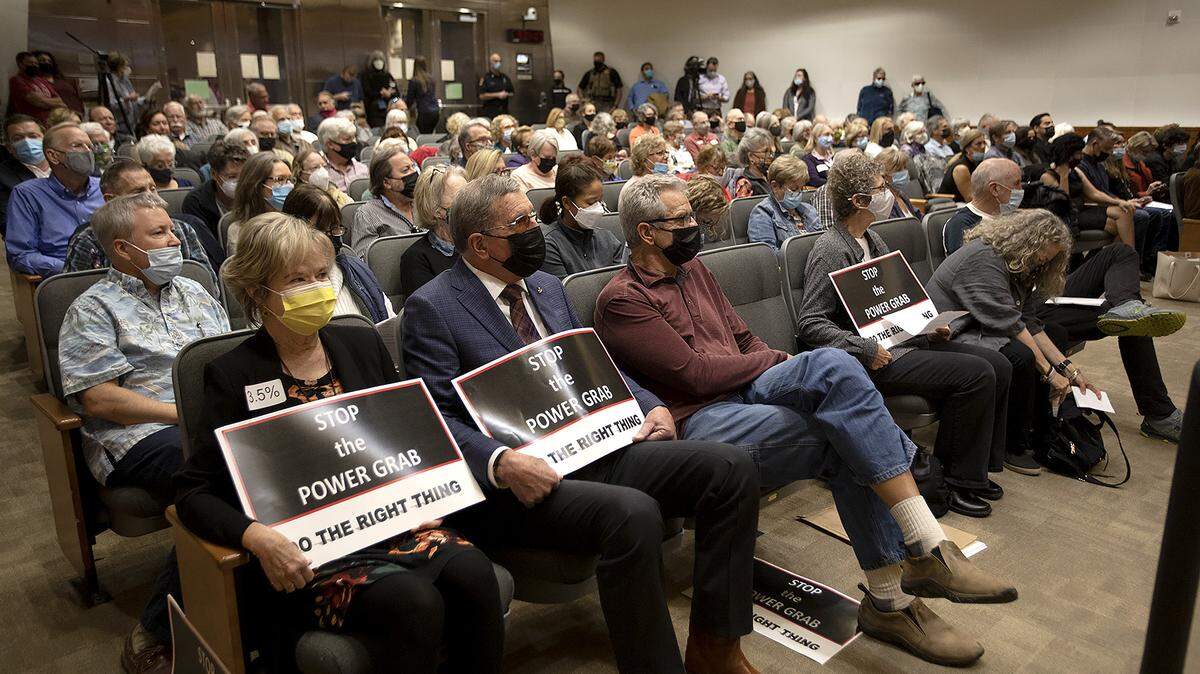
Today, the far-right majority on the county Board of Supervisors will almost certainly adopt a new district map — one engineered to ensure Republicans hold on to their majority, even as the number of GOP voters shrinks countywide.
As a Tribune analysis of voter registration has shown, under the new map, Republicans will hold an even stronger majority in three of the five districts, a feat accomplished only by replacing the current map with one that bears almost no resemblance to its many predecessors.
It’s a power grab, adopted under cover of a litany of nonsensical excuses and outright lies to justify efforts to dominate the county board over the coming decade.
It’s a form of thievery in plain sight, practiced by ruthless politicians intent on winning at any cost.
And it’s cowardly. Are these supervisors so afraid they can’t win that they feel they have to rig the system?
Yet we don’t call them crooks or cowards or connivers.
Throughout the redistricting process, we’ve been using the term “conservatives” to refer to political leaders and their followers who are undermining democracy by cramming this conspiracy of political favoritism down our throats, no matter how many people speak out against it.
And it’s not just happening here; it’s taking place in many cities, counties and states throughout the nation — tactics include gerrymandering, passing voter suppression laws, and placing new restrictions on the authority of election officials to make it easier to overturn results.
Too often, we in the media are providing what one publication described as the “veneer of respectability” to these extremists by labeling them conservatives, normalizing behavior when we should be sounding the alarm.
Supports a false narrative
A thoughtful Tribune reader has suggested we reconsider that wording.
“Labeling current Republicans as ‘conservatives’ supports a false narrative,” she wrote. “While it feels uncomfortable for me as I make the switch, I think when I refer to our board majority I am going to replace ‘conservative’ with ‘populist.’”
She makes a good point.
Terms like conservative, moderate and liberal are imprecise — yet they are convenient shorthand, especially for journalists trying to cram as much information as possible into a headline or a story summary.
But using the term “conservative” to describe people trying their damnedest to kill our democracy is like calling the Jan. 6 insurrectionists “patriots.”
It’s a description that does a huge disservice to legitimate conservatives who aren’t looking to rip apart our nation and who are deserving of respect.
Yet the term “populist” also has issues.
For one thing, it sounds too much like “popular,” making it appear wholesome and positive. And unless you were a political science major, the meaning may be somewhat hazy.
An article in The Atlantic described a 1967 meeting of academics who attempted to define the term. Their conclusion: “There can, at present, be no doubt about the importance of populism. But no one is clear what it is.”
And this, from another Atlantic essay: “They may not win 100 percent of the vote, but they lay claim to 100 percent of the support of good, hardworking folks who have been exploited by the establishment.”
Here’s a less erudite take on the the word, from an op-ed in USA Today: “Populism’ isn’t conservative. It’s crazy.”
For the record, Merriam-Webster defines a populist as “a member of a political party claiming to represent the common people.”
It’s safe to say politicians of all stripes claim to represent the common people, which only adds to the confusion.
‘Anti’ and ‘ultra’ aren’t so good either
There is the option of attaching an adjective like “radical” or “ultra” or “uber” to the root word — be it conservative or liberal — but that has problems too.
As John Feffer writes in a “Fair Observer” piece: “When The Washington Post tries to rectify the problem by labeling far-right activist Ali Alexander an “ultraconservative,” it only makes matters worse. An ultraconservative should be even more determined to uphold the status quo rather than ... trying to undermine it.”
Sigh.
That leads us to another term: antidemocratic. Pundits are writing about antidemocratic attitudes, an antidemocratic movement and antidemocratic candidates, with Donald Trump No. 1 on that list.
We have no problem calling the SLO County redistricting decision antidemocratic — or dictatorial or oppressive or authoritarian or any other synonym you want to add — but we’re not so sure “antidemocrat” works as a noun. That could be mistaken for someone who doesn’t like Democrats, rather than someone who is assaulting democracy.
And finally, as tempting as the terms may be, “Trumpers,” “Trumpists” and “Trumpsters” don’t work — at least not in straight news reporting. While there’s a high probability that the vast majority of folks clamoring for the gerrymandered map voted for Trump, “never assume” is one of the first precepts of journalism.
We could go with whimsical — with apologies to Jimmy Buffett fans, we could call the Parrot Heads, since they keep repeating the same nonsense — except this is no joke.
As much as we could all use some levity, the destruction of democracy is deadly serious.
To the reader who raised the concern about terminology, we have no definitive answer — but we will keep looking.
And if any other readers have suggestions, by all means, pass them on.
This story was originally published December 14, 2021 at 5:30 AM.