
Paso ethnic studies class should be mandatory for all — including the tone-deaf school board
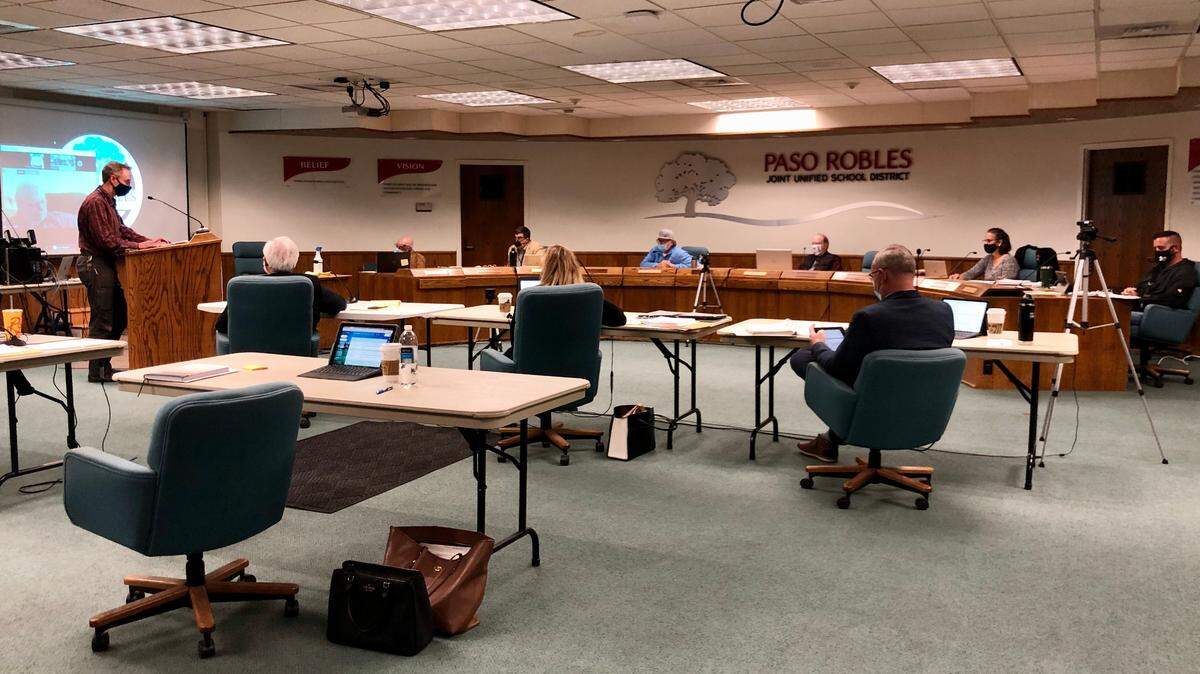
The Paso Robles school board reluctantly approved a high school ethnic studies course this week — but made it clear that the course should not “bash” America for past misdeeds.
The plan is to offer the course as an elective starting this fall.
Given the importance of the subject, it really should be mandatory — and Paso Robles school board members should be the first ones required to take it, because the lack of sensitivity on display at Tuesday night’s meeting was stunning.
It was perhaps best exemplified by Board President Chris Arend rudely shouting down a speaker who was attempting to translate a public comment into Spanish, for the benefit of non-English speakers in the audience.
“No, no, Susana. You’re out of order,” Arend huffed.
Fortunately, the other board members overruled him, and the speaker was allowed to finish.
In reality, Arend was the one out of order — and not for the first time on this issue. Last year, he wrote a 6,600-word treatise about how systemic racism was a “myth.”
But he wasn’t alone.
During Tuesday’s discussion, trustee Lance Gannon — the only board member who voted against adding the course — worried students who take an ethnic studies class are “going to look at white students differently.”
“They are going to say, ‘Well, I’m learning that you’re part of that white privilege,’” Gannon said.
He prefaced his remarks by saying he’s of Puerto Rican descent and “believes in diversity.”
“I’m not a white privilege and I don’t like that word,” he said.
Throughout the discussion, trustees were on the defensive; they were so concerned about not “bashing America” and “providing context” that they sucked all the joy out of what was a win not just for students, but also for the entire community.
Why it matters
Learning the true-to-life history of the United States — not the whitewashed history that too many of us received at school — is a key to understanding how we got to where we are today.
We’ve seen too many local examples of what happens when we grow up oblivious to the challenges that have faced people of other races, religions and ethnicities:
A Cal Poly student smears his face with black paint, then says he didn’t know it was offensive to Black people.
Swastikas are spray-painted outside a Jewish fraternity.
A noose is used as a Halloween “decoration.”
A driver upset about being delayed by Black Lives Matter protesters says he should have brought his Glock.
Ethnic studies courses cover real-world issues that must be brought into the open and discussed, because they’re tearing this nation apart.
That’s why this course should be mandatory for all Paso Robles students.
Yet instead of trusting the teaching staff, Paso Robles board members are trying to micromanage the course to reflect their own political leanings.
They’re concerned that students who take the class will “pass judgment” on Christopher Columbus and George Washington.
They’re concerned the textbook proposed for the class will convince students that the United States is not “the beacon of hope and freedom for the world,” but rather, “a racist and often evil country,” to quote the words of Trustee Dorian Baker.
And most of all, they’re concerned the course lacks “balance” — without defining exactly what that means. (“We’ll figure out what balance means,” Arend said at one point.)
That’s an awful lot of concern over an elective course that won’t even go forward if it doesn’t get at least 20 students, although that shouldn’t be a problem.
Exemplary teacher
For one thing, Geoffrey Land will be teaching the course. He’s excellent — he has a deep understanding of history and culture, he’s even-handed and he’s a strong advocate for his students.
“This is not about bashing America,” he told trustees. “This is not about finding the dirty laundry. ... It’s about our constant effort to create a more perfect union.”
Deputy Superintendent Jen Gaviola provided more reassurance for those clutching pearls over the prospect of diverse perspectives actually being elevated in attention: “I know it’s scary sometimes to hear the story of others and feel like it might take away from our story.”
But that doesn’t have to be the case, and Gaviola explained it well
“Stories of oppression don’t condemn me as a white person,” Gaviola continued. “They actually enlighten me and make be better as a human being and a leader.”
In the end, the board approved the course — with the caveat that it be revised to reflect more “balance.”
But let’s get real here.
It’s the Paso Robles school board — which is predominantly white and male — that needs more balance.
These board members seem so intent on carrying out their own personal agendas that they’re dictating what can and can’t be taught in the classroom.
Trustee Baker, a retired teacher, made her agenda clear when she ran for office last fall on a slate with three other candidates, including Trustee Chris Bausch.
“We have a particular interest in addressing the areas of American history and sex ed,” she wrote in a letter to the Paso Robles Daily News. “We need to select curricula that teaches the true American story of freedom, liberty and excellence.”
Is it any wonder she shared a quote to her Facebook page that described California’s ethnic studies curriculum as “poison”?
Or that trustee Gannon implied that white students have to be protected from an ethnic studies curriculum that delves too deeply into historical “mistakes”?
Or that Board President Arend offered to come into the classroom and teach a unit on the “intellectual fallacy” of critical race theory, an academic theory that holds that law and legal institutions are inherently racist?
We have to ask, do Paso Robles families want school board members with political agendas dictating what’s taught in the classroom?
Or do they want those decisions made by teachers and administrators acting in the best interests of all students?
If it’s the latter, we strongly urge them to get involved, and the sooner the better.
Here’s a good place to start: Watch the March 23 discussion of the ethnic studies course on YouTube.
It’s a valuable crash course in how this tone-deaf school board operates — as well as a learning experience that should carry over to the 2022 election.
This story was originally published March 25, 2021 at 10:35 AM.