
Can’t afford your own ATV? You could be shut out of Oceano Dunes off-road playground
READ MORE
Revisioning the Oceano Dunes
The SLO Tribune Editorial Board examines competing proposals for the Oceano Dunes state park, from a total ban on off-highway vehicles to a major expansion of camping and recreation areas.
Expand All
Editor’s note: This is the second in a three-part series of editorials on major changes proposed at the Oceano Dunes, which includes the state’s most visited off-road recreation area.
The Oceano Dunes off-road park isn’t exactly a poor man’s paradise, judging by the high-ticket RVs and trucks lined up at the entrances on busy weekends.
Still, on a weekday you can rent an ATV there for as little as $16 an hour. Prices go up on the weekends.
At least, you used to be able to do that in pre-COVID days.
After a lengthy shutdown, the park reopened recently to off-roaders, but with a big difference: Only visitors who own their off-road vehicles are allowed in.
That doesn’t sit well with businesses that rent ATVs.
“Rental companies have been locked out (excluded) from participating,” BJ’s ATV Rentals, one of a handful of rental shops catering to off-roaders in South County, posted on its website.
That could become a permanent move, according to a paragraph tucked into the voluminous draft Public Works Plan that will be considered by the state Coastal Commission on Thursday.
State Parks is proposing to stop contracting with concessionaires who rent ATVs, which means only people who can afford their own expensive toys will be able to access the State Vehicular Recreation Area.
That sounds awfully elitist for a plan that strives to “foster accessibility for all user groups,” “encourage user diversity and inclusivity” and “enhance low-cost recreational opportunities.”
But there’s a bigger issue
The proposed change in the rental policy has been overshadowed by a much larger issue: Coastal Commission staff is recommending all OHVs be phased out in five years.
The staff report maintains that allowing off-roading to continue in the environmentally sensitive dunes environment is a violation of California coastal law.
And now State Parks may have handed the Coastal Commission another argument for shutting the whole thing down by proposing to limit access to those who can afford to “pay to play.”
If you’re going to set aside a large swath of state land for off-road recreation, no way should it suddenly be restricted to those wealthy enough to invest in ATVs and a truck and trailer to haul them. That can easily cost $100,000 or more.
You may as well turn this public land into a private playground.
Why do it?
State Parks says phasing out rentals will limit the number of inexperienced OHV riders.
But there are other ways to deal with that: Offer guided tours for beginners. Designate an area for beginners only. Mark trails by degree of difficulty, so beginning riders know which areas to avoid.
Those are among the suggestions from the OHV Commission, an advisory body that has urged State Parks to rethink its plan to shut down concessionaires.
“It’s important we keep our concessionaires in the dance,” Commissioner Tom Lemmon said at a recent meeting. “The lifeblood of the community is these additional jobs that are created here.”
How much is at stake?
Collectively, the four ATV rental shops in South County generate an estimated $11 million per year, according to reporting by Tribune writer Mackenzie Shuman.
But it’s not just rental companies that would be affected by an “owners only” requirement.
Visitors who rent ATVs for a few hours as a one-day activity are likely to eat at local restaurants, shop at local stores, maybe visit local wineries or breweries, and possibly stay overnight at a South County hotel.
More dedicated off-roaders, on the other hand, are likely to camp on the beach and bring along their provisions.
While ATV rental shops have spoken out about the proposed change in the rental policy, the South County business community as a whole has been more focused on the possibility of a total ban.
Several South County businesses have bright orange and blue “vehicle access for all” signs in their windows. The Pismo Beach Chamber was among the sponsors of a Sunday “peaceful protest” of the proposed ban on off-roading — a rare event for a staid organization like a chamber of commerce.
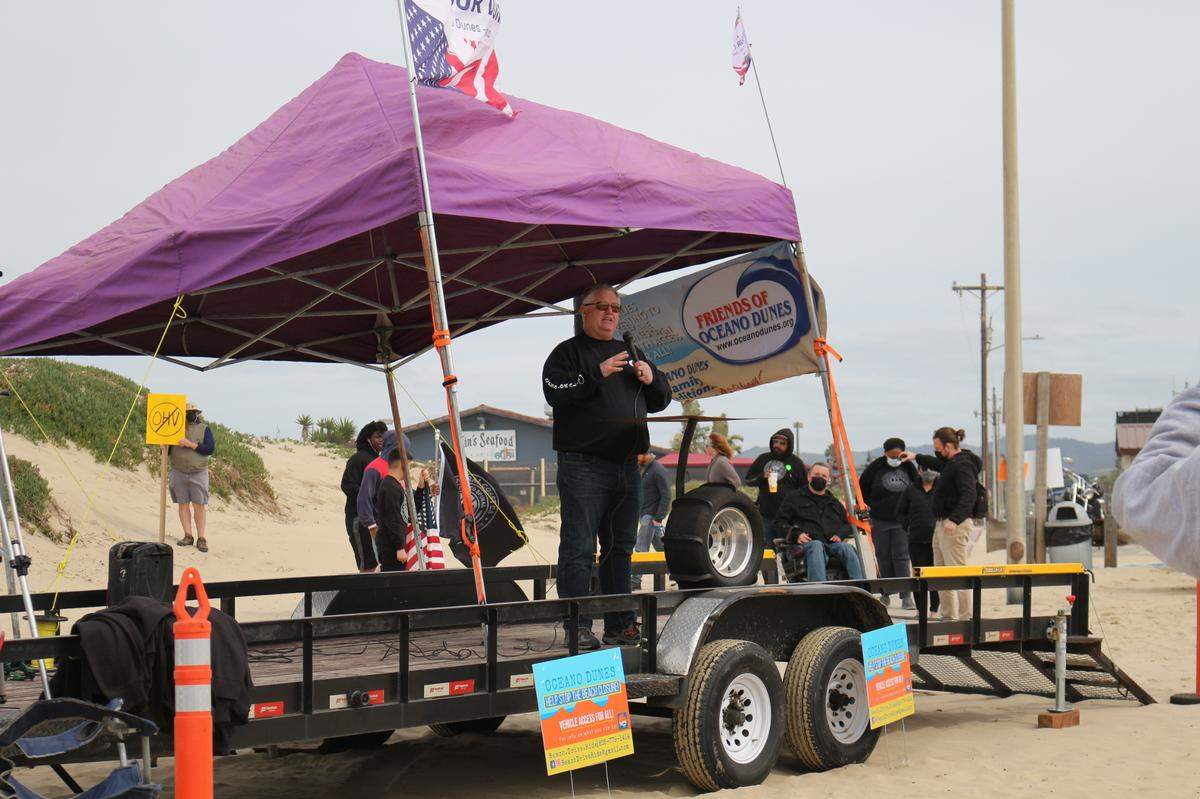
It’s a familiar refrain.
For decades, there has been strong support in the South County for keeping the Dunes open to off-roaders.
To borrow a phrase from OHV Commissioner Lemmon, many have looked upon the Dunes as the “economic lifeblood” of the area.
But that support has been eroding.
It took a big hit when dangerously high levels of particulate pollution on the Nipomo Mesa were linked to off-roading at the Dunes.
On top of that, many local residents became more vocal — and more organized — in demanding a vehicle-free beach, and lately, they’ve been pushing back on the long-held assumption that the South County economy would be crippled if the SVRA were to shut down.
Supporters of the proposed ban on OHVs say off-road activities would almost certainly be replaced by other forms of recreation.
They point to Pismo — which has a thriving tourist economy even though it does not allow vehicles on the beach — as an example of what could happen in Grover and Oceano if vehicles were banned on their beaches as well.
Representatives of the tourist industry counter that the Oceano Dunes SVRA is such a huge attraction that its loss would hurt the entire region, including Pismo.
So who’s right?
Unfortunately, there is no comprehensive, credible economic survey that sheds light on just how much the SVRA does — or doesn’t — contribute to the local economy.
A 2017 report by SMG Consulting, an analysis commissioned by State Parks, concluded the park generates $243 million annually for the local economy
But that report has been largely discredited. Among other criticisms, an economist hired by the Coastal Commission found a possible mathematical error that may have greatly inflated the revenue figure.
Visit SloCal, a nonprofit countywide marketing and management organization, is working with South County cities and chambers of commerce to hire a consultant to do an independent, thorough economic analysis to determine how much each component of the park contributes to the local economy, but it’s not expected to be ready for release until mid-summer.
For that reason — and because the Coastal Commission is down a member from the Central Coast, since Pismo Beach Councilman Erik Howell lost his seat — many South County leaders have asked the commission to delay Thursday’s hearing.
It would make sense to have a reliable economic study before making any big decisions about the future of the Dunes.
But let’s put this in perspective.
This decision should not ride on how much cash the SVRA brings to South County.
Public health and environmental protection have to take precedence over off-road recreation and the amount of money it generates.
It will be up to the Coastal Commission to decide whether State Parks can continue to operate the SVRA without jeopardizing the well-being of nearby residents or the fragile dunes environment.
It the commission does decide to allow off-roading to continue — whether for five years or 50 — it should ensure the Vehicular Recreation Area is accessible whether you own or rent an ATV, albeit with additional safeguards to protect inexperienced riders.
The Coastal Commission’s mission, after all, is to “maximize public recreational opportunities” — not to restrict them to those with the means to afford it.
Wednesday: A showdown at the state Coastal Commission?
This story was originally published March 16, 2021 at 5:30 AM.