
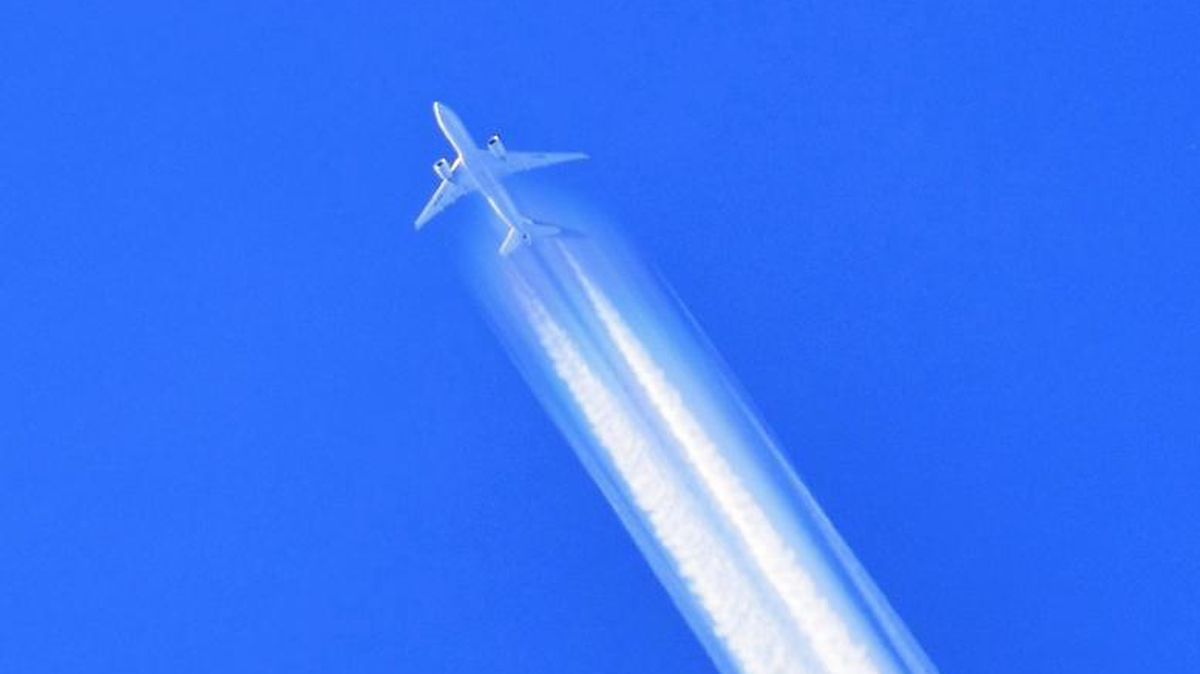
Why were high-altitude jets over SLO County so loud on this one day in April?
David Kudija from Paso Robles asked:
“Mr. Lindsey, was there some different atmospheric condition on April 14? We are under Flight Path 4 with airliners traveling to the Orient, and although we see them often, we only hear them faintly. Tonight, however, they are at least five to 10 times louder than normal. They sound almost like thunder outside. Is there some atmospheric condition tonight that might explain this?”
To answer this question, the first piece of information I thought of was the atmospheric profiles or soundings from Vandenberg Space Force Base.
Every day, the 30th Weather Squadron from the base in western Santa Barbara County launches a weather balloon with a tiny transmitter called a radiosonde attached. As the weather balloon climbs through the atmosphere, its transmitter broadcasts to the receiving station temperature, dew point temperature, pressure, and GPS coordinates for the winds.
The atmospheric data from these radiosondes are compiled on a Skew-T chart, a vertical graph of the atmosphere from the Earth’s surface to nearly 55,000 feet of altitude. The red line is the air temperature, and the green line is the dew point temperature in degrees Celsius.
You can look at these graphs from Vandenberg and other locations throughout North America that launch daily weather balloons through the University Corporation for Atmospheric Research (UCAR) at weather.rap.ucar.edu/upper.
The atmospheric data from April 14 shows a nearly isothermal condition from the Earth’s surface all the way up to 600 millibars, or about 15,000 feet. In other words, very little temperature change, which is unusual. After the 600-millibar mark, there was a gradual decrease in air temperatures up to the stratosphere at nearly 38,000 feet that day.
Most commercial jet airliners fly at an altitude between 28,000 and 41,000 feet — about 6 miles up in the sky — where temperatures are frigid and the upper-level winds are strong.
These airliners often fly at different altitudes to take advantage or decrease the impacts of the jet stream to optimize their groundspeed across the Earth.
On April 14, the airliners may have been flying at a slightly lower altitude to increase groundspeed on their journey to Asia, which probably put them in the troposphere, the lowest region of the atmosphere that extends from the Earth’s surface to a height of about 35,000 feet and fluctuates daily in elevation throughout the year.
One of the reasons airplanes fly in the stratosphere is because this is where the least amount of turbulence is found.
On that day, a significant amount of aircraft noise, more than normal, was probably directed toward the 600-millibar mark due to an atmospheric sound channel in the vertical plane.
You see, sound waves will always bend away from areas of higher velocity. Think of a bulldozer; if one set of its tracks is rotating faster, the dozer will turn toward the direction of the slower moving tracks.
In the isothermal condition from 600 millibars to the ground, the sound from the airliner was directed straight down toward David in Paso Robles.
Sound channels can also develop on the horizontal plane.
Those in coastal communities often hear the waves crashing along our coastline. There are times when the waves are high, but the sound is barely noticeable; other times, the swell is low, but the sound along our coast is quite loud.
Let me explain.
Many years ago, I took my son to the beach, and he picked up an empty shell of a Lewis moon snail, brought it to his ear, and said he could hear the ocean. The shell captures the ambient noise of the environment. The sound resonates inside the shell and produces a wave-like sound no matter how far away from the ocean.
Just as the shell walls pick up and direct sound to our ears, so can the atmosphere.
The atmospheric temperature inversion layers come and go as the Santa Lucia winds (northeast/offshore) and the northwest winds (onshore) fight for supremacy. You can see it by the ebb and flow of low coastal clouds along the beaches.
Cool, dense air at the Earth’s surface produces a temperature inversion layer that creates a sound channel, ranging from a few feet above the ocean’s surface to hundreds of feet high.
Some of the sounds of the waves reflect or jump from the inversion layer to the ground. In other words, the sound of crashing waves is picked up in the surface channel and propagates to our coastal communities with minor loss of intensity.
At other times, the winds blow fast enough to mix up the temperature inversion layer, allowing sound to travel in all directions with a much more significant loss of intensity, making it sound much quieter. I guess you could say the sound of the waves was lost in the wind.
Learn about PG&E’s wildfire prevention efforts
PG&E is hosting an interactive webinar for all customers on April 20 at 5:30 p.m. to discuss our wildfire prevention efforts across our service territory. Join one of our vice presidents and team members to ask questions and share your feedback. Visit www.pge.com for information.