
What happens to Valentine’s Day balloons that get away? Some end up littering Death Valley
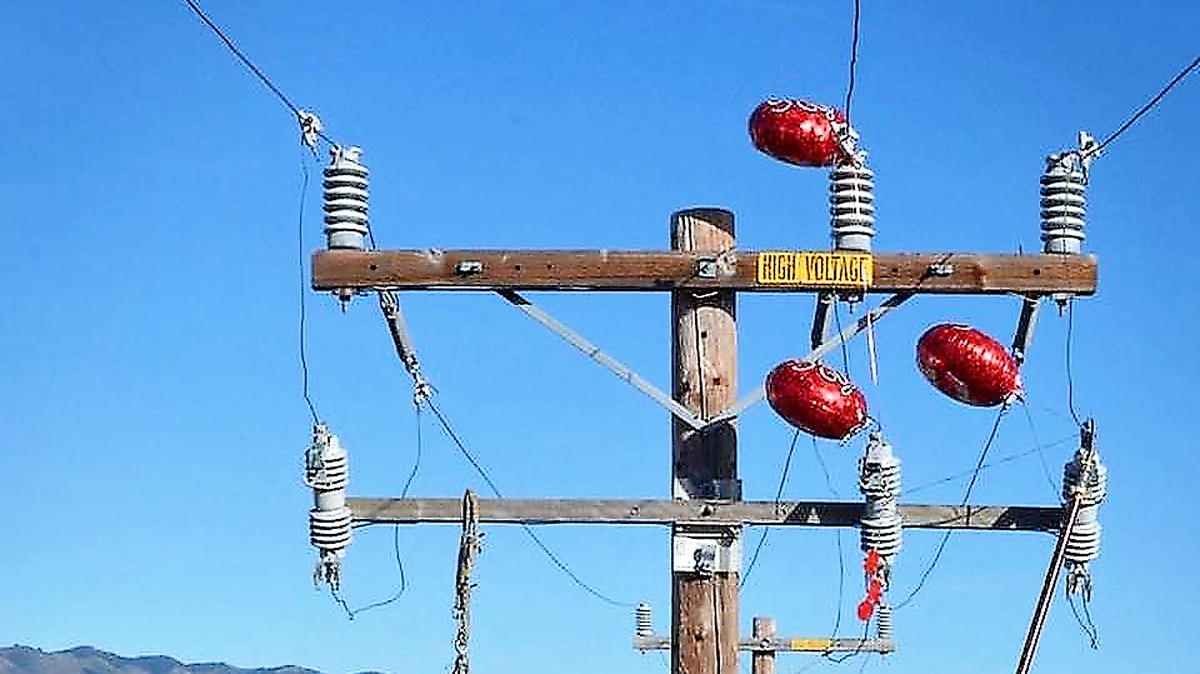
After days of warm and calm conditions, a major change in the weather pattern is expected on Valentine’s Day.
Gale-force northwesterly winds are forecast Monday into Tuesday and could cause power outages — but for reasons you may not suspect.
Valentine’s Day often means flowers and chocolates, but also helium-filled balloons to show your valentine just how much you care. Unweighted balloons — particularly metallic ones — can cause many problems if they escape control, especially in windy conditions, and drift into power lines.
Metallic balloons, like most other metals, are efficient conductors of electricity. When they contact electric power lines, they have the same effect as a metal wrench coming into contact with both the negative and positive terminals of a car battery.
The metallic balloon can cause power lines to short out, triggering the conductor to break, and resulting in energized lines falling to the ground.
In 2021, unweighted and untied metallic balloons that drifted into PG&E power lines caused more than 600 outages — a 27 percent increase from the previous year and the highest number of balloon-related outages that PG&E has seen in a decade.
Remember to make sure your balloons are securely tied with a weight to keep them from floating away.
Untethered balloons can hurt environment, litter national parks
Not only can metallic balloons cause power outages — they can also damage the environment.
When Mylar balloons climb to between 3,000 and 7,000 feet, they either explode or leak, causing them to lose their lift and fall on land or into the ocean.
Unfortunately, oceanic creatures such as sea turtles can mistake the balloons for food. When eaten, the balloons clog the creatures’ intestinal tracts, causing them to starve.
When they blow over the land, they can end up anywhere, including in pristine wilderness areas and national parks and forests.
Jay Snow, a park ranger, retrieves Mylar balloons from Death Valley National Park.
At 282 feet below sea level, it is the lowest point in the United States. It is also the hottest; the valley can reach 130 degrees with overnight lows in the 107 degrees range! The park is a land of fierce beauty with magnificent land forms surrounded by snow-capped mountains.
“You hike for miles through this vast wilderness area and discover a canyon, a canyon that only a few people have probably walked before, but like clockwork, you come across one of these metallic balloons,” Snow said.
His fellow rangers have found so many of the colorful chrome-like spheres with “Happy Valentine’s Day” or “Happy Birthday” written in joyful letters along the top that they have wallpapered the inside of their cabin with them.
How do Mylar balloons find their way to Death Valley?
For most of the year, the winds blow from the Pacific Ocean over Los Angeles toward the east at elevations typically below 6,000 feet. Those onshore winds carry Mylar balloons that have broken free from the greater Los Angeles area and find themselves on a journey toward Death Valley.
Easterly winds are predominant in late fall and winter and transport them from the Las Vegas area.
In both scenarios, the winds carrying the balloons hit the windward slopes of mountains surrounding most of Death Valley, quickly rise to their bursting point and fall to the valley floor.
What about other type of balloons?
Two types of balloons — Mylar and latex — are in use today.
Mylar balloons are made with Mylar nylon, a material not classified as biodegradable. They often are coated with a metallic finish that conducts electricity.
On the other hand, latex balloons are elastic and composed of biodegradable natural rubber.
Latex weather balloons — the kind launched from Vandenberg Space Force Base — are filled with helium and are about four feet in diameter at sea level. As they rise through the atmosphere, they expand in diameter.
By the time they reach about 100,000 feet, they expand to about 40 feet in diameter.
Air temperatures at that altitude can drop to 50 degrees below zero or lower and freeze the latex. At that high altitude, a frozen balloon undergoes “brittle fracturing” and ruptures into tiny shreds of rubber that fall to Earth.
Unlike latex helium balloons, metallic balloons can stay inflated and floating for two to three weeks — posing a hazard to power lines and equipment even days after being released outside.
To significantly reduce the number of balloon-caused outages and to help ensure that everyone can safely enjoy Valentine’s Day, PG&E reminds customers to follow these essential safety tips for metallic balloons:
- Use caution and avoid celebrating with metallic balloons near overhead electric lines.
- Make sure helium-filled metallic balloons are securely tied to a heavy enough weight to prevent them from floating away. Never remove the weight.
- When possible, keep metallic balloons indoors. Never permit metallic balloons to be released outside for everyone’s safety.
- Do not bundle metallic balloons together.
- Never attempt to retrieve any type of balloon, kite, drone or toy that becomes caught in a power line. Trying to retrieve it yourself is extremely dangerous. Leave it alone, and immediately call PG&E at 1-800-743-5000 to report the problem.
- Celebrate special occasions safely by ensuring that metallic balloons are secured with a heavyweight and never releasing them outdoors.
This story was originally published February 14, 2022 at 5:00 AM with the headline "What happens to Valentine’s Day balloons that get away? Some end up littering Death Valley."