
Soon-to-be-launched NASA telescope could tell us about weather on other planets
Today, I want to look past our local weather toward the heavens. Our galaxy is enormous, on a scale that our souls can understand but our brains cannot.
To fully fathom the size of it, consider the summer of 1977 when twin 1,600-pound spacecraft — Voyager 1 and 2 — launched from the Kennedy Space Center at Cape Canaveral, Florida.
Scientist and engineers from NASA’s Jet Propulsion Laboratory (JPL) in Pasadena and other labs, and engineering companies from throughout the country designed those spacecrafts to take advantage of a 175-year event — when the arrangement of the outer planets allowed those long-distance travelers to slingshot from one planet to the next, picking up speed with each flyby of a planet.
Today, after flying for 44 years and moving away from us at roughly 38,000 miles per hour, Voyagers 1 and 2 have left the heliosphere; however, neither spacecraft has yet left the solar system. The Oort Cloud is considered the outer edge of our solar system and may take thousands of years to fly beyond it.
Voyager 1 is about 14 billion miles away from Earth and holds the record for the most distant human-made object. Radio signals from Voyager 1 take about 21 light-hours to reach the Earth. Those modulated radio waves carry a treasure trove of data from visible, infrared and ultraviolet light sensors, along with information from a magnetometer at the end of a 43-foot-long boom.
Other instruments include plasma detectors and cosmic ray and charged-particle sensors that scientists from JPL and the California Institute of Technology study closely. One day, in only 40,000 years, Voyager 1 will fly by a star in the constellation Camelopardalis.
In about 300,000 years, Voyager 2 will pass within 25 trillion miles of Sirius — the brightest star in the heavens, also known as the Dog Star — because it is the primary star in the constellation Canis Major, the big dog in the southern part of the sky.
After that, the Voyager spacecraft are destined to wander the vast expanse of the Milky Way for a long-long time.
When Steve Matousek of JPL updated the calculations for those star flybys back in 1989, he thought ahead 300,000 years and realized that he would get to accomplish the dream of star travel in a small way.
“I often wonder what Sirius will actually look like from Voyager 2’s perspective when it flies by,” Matousek said. “You see, Sirius is about twice as massive as the sun and is a binary star system, consisting of a white star and a faint white dwarf companion.”
Those frightfully immense numbers only scratch the surface of how big our galaxy really is, not to mention the indigestible distances between the billions of galaxies in the universe.
Another human-meticulously manufactured object will help us to look billions of years back in time — in fact, up to 13.7 billion years ago.
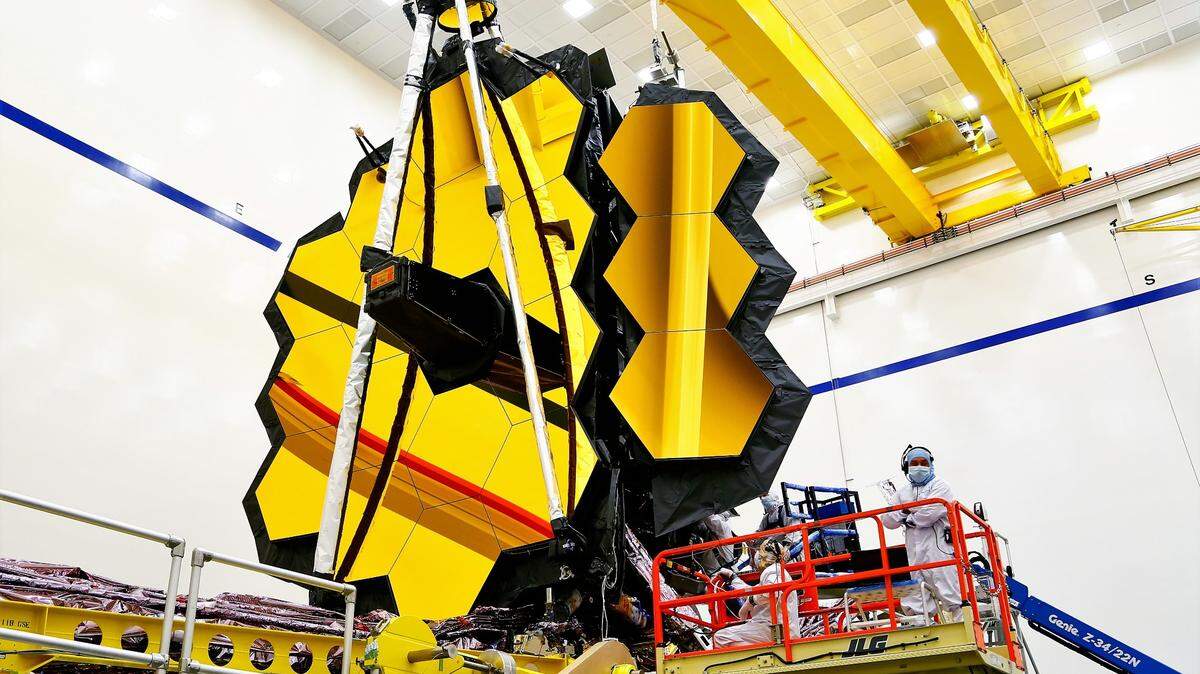
After years of delays, the James Webb Space Telescope is proposed to launch this December from French Guiana near the equator — the spin of the Earth helps to give an additional push. It will be the world’s largest space telescope. The Webb Telescope aims to examine those exoplanets by looking at the infrared spectrum of their atmospheres and, scientists hope, determine the chemical compositions of their skies.
“On December 24, the James Webb telescope is scheduled for liftoff, holding the promise for answering at least two fundamental questions: First, how the galaxies and stars formed in the infancy of the Universe, leading ultimately—to us.” Astronomer Dr. Ray Weymann said.
“Second, among the many billions of planets orbiting other stars in our galaxy, can we find some so like our earth that we may detect signs of life on them?” he said. “Is there a more profound question humans can ask than whether life exists elsewhere in the Universe? Keep your fingers crosses for a successful mission.”
According to NASA’s James Webb Space Telescope website, “the James Webb Space Telescope will not be in orbit around the Earth, like the Hubble Space Telescope is — it will actually orbit the Sun, 1.5 million kilometers (1 million miles) away from the Earth at what is called the second Lagrange point or L2.”
According to NASA, that orbit lets the telescope to stay in line with the Earth as it moves around the Sun, allowing its sunshield to protect the telescope from light and heat.
NASA’s aspiring mission may one day even tell us what the weather is like on those distant planets.
Sea lions are the Sir Edmund Hillary and Tenzing Norgay of the pinniped world. To see why, view a video at https://bit.ly/3J5K8Xo.