
How do weather balloons work? SLO County students get up-close demonstration
For farmers and ranchers, the weather is of infinite importance. I know of no other group of folks that has more situational awareness of the atmosphere and the weather it brings.
Many measure rainfall, meticulously track air temperatures — especially viticulturists — soil moisture, creek and lake levels and the Sierra Nevada snowpack for future water allocations.
They worry, speculate and hope for rain to grow the nourishment we all need. Many of us go to the supermarket to a bounty of food without a thought of what it took to put the grains, produce, dairy, meat and drinks on the shelves.
Many elementary school students throughout the Central Coast are disconnected from agriculture and have little knowledge of where their food comes from.
It’s been estimated that only about 2% of the nation’s population is directly involved in agricultural production.
To remedy this situation, the nonprofit group The Great AGventure each year brings more than a thousand fourth graders, teachers and parent chaperones from local schools together to learn where their food comes from. Last year, due to COVID-19, the event was canceled.
On Oct. 12, students eagerly boarded school buses and attended the Great AGventure at the Paso Robles Event Center, home to the California Mid-State Fair.
When the students arrived, they participated in a series of six interactive stations, each with an agricultural theme: farm animals, seeds and plants, fertilizer, meteorology, harvesting and farm machinery and environmental stewardship.
Volunteers from throughout our agricultural community provided the demonstrations and shared their expertise with the students.
At one station, former Cal Poly professor Joe Sabol taught students about apple grafting. At another station, the fourth graders learned about the physics of horsepower from the Cal Poly Tractor Pull Club.
Other students dissected owl pellets and discovered the type of rodents that owls eat each night. In other words, a lot of really cool stuff.
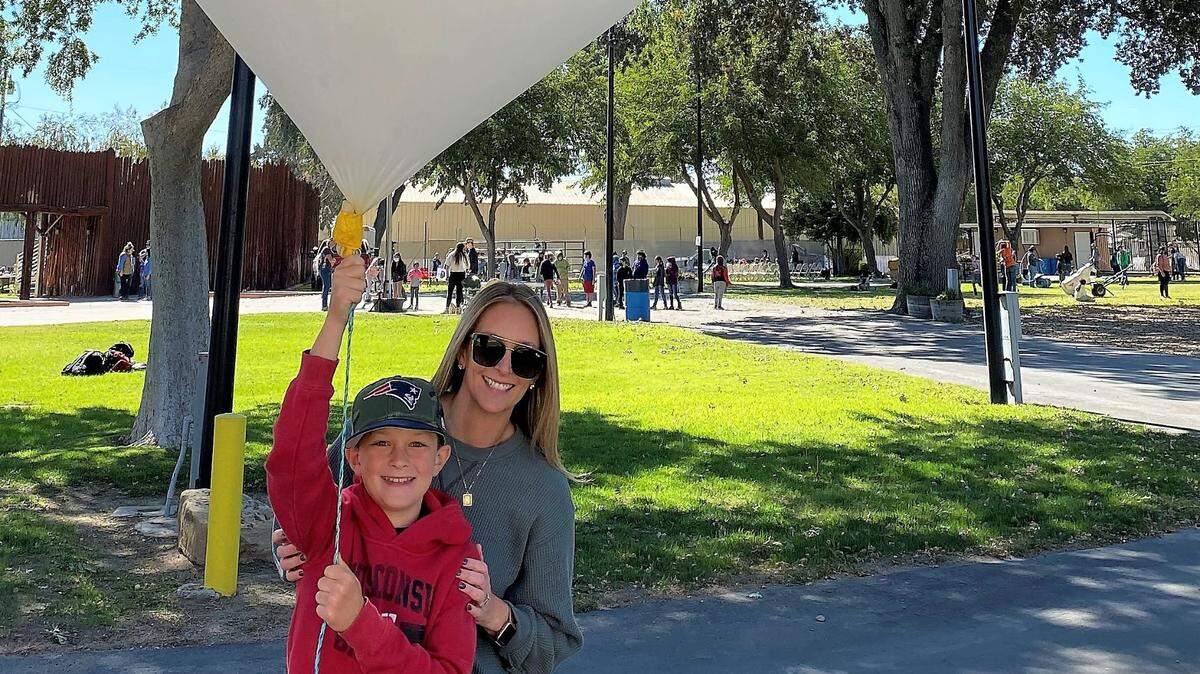
The students that came to my station learned about the weather. I used a lighter-than-air, helium-filled giant latex rubber weather balloon, which is biodegradable. Each student got to hold down the balloon by way of a tether line.
Like a boat floating upon the water, the weather balloon displaced the air and applied pressure on the rope as it wanted to float to the top of the atmosphere.
In Greek mythology, Icarus flew too close to the sun, melting the wax holding his wings together and falling to the sea.
In contrast, latex rubber weather balloons — the kind launched from Vandenberg Space Force Base every morning with a transmitter called a radiosonde — freeze when they get high enough!
These weather balloons quickly rise through the atmosphere to about 100,000 feet and greatly expand in diameter. Air temperatures at this altitude can drop to minus-50 degrees or lower and freeze the latex.
At this high altitude, a frozen balloon undergoes so-called “brittle fracturing” and ruptures into tiny shreds of rubber that fall to Earth. When the balloon pops, the radiosonde — about the size of a milk carton — comes floating back to Earth on a small parachute.
When hiking in some of our more remote areas, it’s not uncommon to come across one of these small, white radiosondes.
The radiosonde broadcasts readings on temperature, pressure and humidity levels and global positioning system coordinates for the upper-level winds.
This data can determine the instability of the atmosphere and the intensity of storms. It can define the height of the temperature inversion layer when forecasting coastal low clouds and fog.
Two types of balloons — Mylar and latex — are in use today.
Mylar balloons are made with Mylar nylon, a material not classified as biodegradable. They often are coated with a metallic finish that conducts electricity.
On the other hand, latex balloons are elastic and composed of biodegradable natural rubber.
When the metallic balloons come into contact with electric power lines, they get tangled and have the same effect as a wrench coming into contact with both the negative and positive terminals of a car battery.
The metallic balloon can cause power lines to short out, causing the conductor to break, resulting in energized lines falling to the ground.
The enthusiasm of the kids at the Great AGventure in Paso Robles was great. These schoolchildren are bright, and some of their questions took me by surprise.
One exceptionally bright schoolgirl asked, “If warm air rises, then why does it get colder as you get higher in the atmosphere?”
As you might imagine, it cost a lot to safely transport the children and conduct this important event.
The San Luis Obispo County Agricultural Education Committee told me that none of this would be possible without the support of its main sponsor, the Harold J. Miossi Charitable Trust, and other contributors.
They included the San Luis Obispo County Cattlemen, San Luis Obispo County Cattlewomen, San Luis Obispo County Farm Bureau and Farm Bureau Women, Umpqua Bank, the San Luis Obispo Open Farm Trail Farmstead and Paso Robles Events Center, as well as Paso Robles, Templeton and Atascadero FFA members.