
Clouds are blanketing SLO County coast. How long will persistent marine layer last?
A trough of low pressure will develop along the California coastline this week, producing gentle (8 to 12 mph) southerly winds during the overnight, shifting out of the northwest and increasing to moderate to fresh (13 to 24 mph) levels during the afternoon on Tuesday through Thursday.
The afternoon northwesterly winds are forecast to decrease to moderate (13 to 18 mph) levels on Friday through Saturday.
A condition of only gentle to fresh winds that persist along the coastline over an entire week in July is unusual.
This condition will produce a “no-sky July,” a term used to describe a persistent marine layer with mist or drizzle, also known as “mizzle,” along the beaches of the Central Coast throughout much of the day.
These clouds resemble a whitish-gray ruffled blanket covering the coastal regions, insulating the shoreline from the afternoon and evening heat.
The gentle to fresh winds combined with a lack of storms in the North Pacific, will create low waves and warmer seawater temperatures. In fact, the swell will drop to 2 to 3 feet (with an 8- to 13-second period) on Wednesday through Saturday.
The low wave energy combined with mainly overcast skies, which should help keep plankton blooms from developing, should produce good seawater visibility.
Historically, the warmest sea water temperature along the Central Coast of the year occurs from September through November, as we have a relaxation of the northwesterly winds.
However, with only moderate to fresh afternoon winds, a decrease in upwelling and a northerly flowing current during the night and morning will produce warmer seawater temperatures.
Seawater temperatures are forecast to range between 58 and 61 degrees Fahrenheit later this week. The historical average for July is about 56 degrees.
By the way, the warmest hourly seawater temperature on record along the Pecho Coast near Diablo Canyon Power Plant occurred in October 2015, which saw a seawater temperature reading reached 67.5 degrees.
At that time, we were in the middle of one of the strongest El Niño events ever recorded, with seawater temperatures warmer than normal seawater temperatures.
The other warmest seawater temperature readings occurred in September 1983 at 66.7 degrees and October 1997 at 66.2 degrees. Both readings also occurred during strong El Niño events.
Tranquil ocean conditions like this remind me of my time in the Persian Gulf.
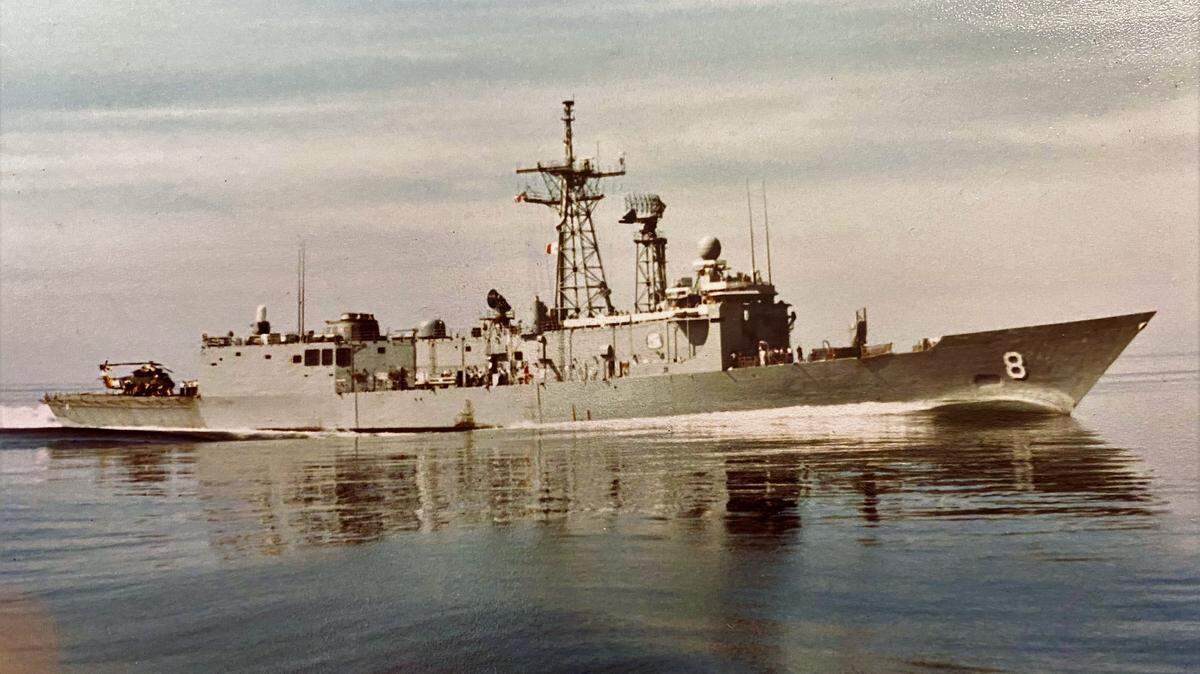
For more than 120 days, the USS Estocin, the frigate I was stationed on in the early 1980s, was haze gray and underway, sailing back and forth between the Persian Gulf and the Arabian Sea without a port of call.
Ninety days into this arduous sea duty, the captain decided to give us a break and throw a picnic on the ship’s small steel flight deck, which we called the steel beach. We ate barbecue, and everyone received one can of Budweiser beer.
At around 100 days, I noticed that some of the ship’s crew members, especially those with children, were beginning to feel depressed.
The ship’s master chief warned us about the doldrums.
Being new to the Navy, I wasn’t sure what the doldrums were. I imagined some sort of flying fish coming out of the water and randomly hitting crewmembers on watch in the dead of night.
The doldrums refer to the convergence of the trade winds near the Equator. This results in a shifting belt of dead calm to light breezes.
The trade winds were named for their ability to quickly propel trading ships across the ocean.
However, when these sailing ships entered the doldrums, they stalled, causing distress among the crews.
The doldrums are usually located between 5 degrees south and north of the Equator.
This area is also known as the Intertropical Convergence Zone. Depending on the season and the amount of solar energy received, the zone can move 30 degrees north or south of the Equator.
Near the zone, the sun’s direct radiation heats the air near the ocean’s surface, making it lighter and causing it to rise. The stillness of this rising air on the horizontal plane can cause sailing ships to go dead in the water for days on end.
Also, as this warm and moist air mass rises, it gives birth to some of the most intense convectional storms on Earth, with the world’s heaviest precipitation.
On the one hand, the storms provided much-needed freshwater for the sailing ships caught in the doldrums but also probably added to the depression of the ships’ crews.
Further northward and southward are the horse latitudes that lie between 30 and 35 degrees from the Equator. This region of strong high pressure and subsiding dry air often results in only light to gentle winds across the seas.
As in the doldrums, sailing ships becalmed in these waters would see their voyage time greatly extended.
Folklore states that sailors stuck in the horse latitudes would throw their cargo of dead or dying animals overboard to preserve precious water.
A more likely explanation for the term is that it derived from sailors’ so-called “dead horse” ritual.
In this ceremony, the seamen would parade a straw-stuffed effigy of a horse around the deck before throwing it overboard to celebrate having worked off the “dead horse” debt.
Seamen were paid partly in advance before a voyage, and by the time they reached the horse latitudes, their debt was paid.
PG&E announces new fire safety initiative
PG&E announced a major new initiative to expand the undergrounding of electric distribution power lines in high fire threat districts to further harden its system and help prevent wildfires. To learn more, please visit pgecurrents.com.